
Table of Contents
Sulaytan is a powerful Arabic name that carries centuries of royal heritage and authority. Derived from the same linguistic root as ‘sultan,’ this name embodies leadership, strength, and sovereignty. Popular in Muslim communities worldwide, Sulaytan represents both temporal power and spiritual responsibility. Its rich history connects modern bearers to a tradition of governance and noble character.
Meaning of Sulaytan
Sulaytan originates from the Arabic triliteral root ‘s-l-t’ (س-ل-ط), which conveys concepts of power, authority, and dominion. The name is a variant of ‘Sultan,’ directly meaning ‘king,’ ‘ruler,’ or ‘sovereign.’ In classical Arabic, ‘sulṭān’ refers to both political authority and moral or spiritual power. The term appears multiple times in the Quran, emphasizing God’s ultimate authority. Linguistically, it’s related to the Aramaic ‘shultānā’ and Hebrew ‘shilton,’ both meaning ‘power’ or ‘rule.’ This name has been used historically for Muslim rulers across the Islamic world from the Ottoman Empire to South Asia.
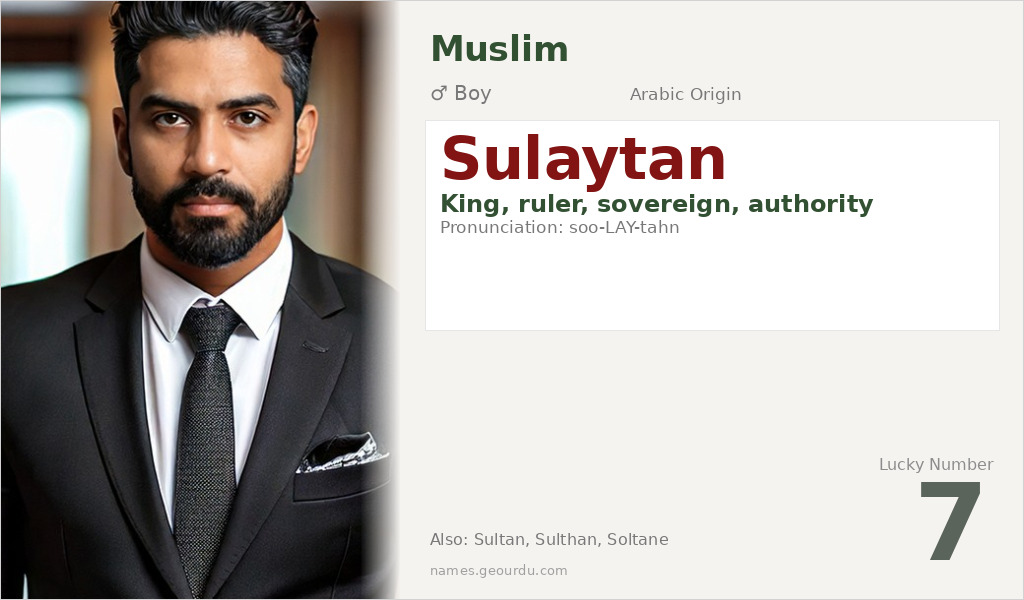
| 📛 Name | Sulaytan |
| 💎 Meaning | King, ruler, sovereign, authority |
| 👤 Gender | Boy |
| 🕌 Religion | Muslim |
| 🌍 Origin | Arabic |
| 🗣 Pronunciation | soo-LAY-tahn |
| ✍️ Urdu | سلطان |
| ✍️ Arabic | سُلَيْطَان |
| 🔢 Numerology | 7 |
| ✨ Spellings | Sultan, Sulthan, Soltane, Sulayman |
Origin & Cultural Significance
Sulaytan has its origins in pre-Islamic Arabic, where the concept of ‘sulṭān’ existed as a term for authority. With the advent of Islam, the name gained religious significance through Quranic usage and was adopted by various Muslim dynasties as a title for rulers. The name spread throughout the Muslim world via Arabic influence, appearing in Persian as ‘Solṭān,’ Turkish as ‘Sultan,’ Urdu as ‘Sultān,’ and other languages. While primarily Arabic in origin, it has been embraced by diverse Muslim cultures including Pashtun, Baloch, Sindhi, and Bengali communities, though always retaining its core meaning of sovereignty and leadership.
Personality Traits
Those named Sulaytan are often associated with leadership qualities, confidence, and a natural ability to take charge. They may exhibit strong organizational skills and a sense of responsibility toward others. The name suggests someone who values justice, tradition, and maintaining order, with potential for both ambition and protective instincts toward family and community.
Similar Names
If you like Sulaytan, consider: Malik, Shah, Amir, Hakim, Qadir
Famous People Named Sulaytan
- Sultan Salahuddin Ayyubi — 12th-century Muslim military leader and sultan of Egypt and Syria
- Sultan Suleiman the Magnificent — 16th-century Ottoman sultan known for expanding the empire
Frequently Asked Questions About Sulaytan
What does Sulaytan mean?
Sulaytan means 'king,' 'ruler,' 'sovereign,' or 'authority' in Arabic, derived from the root word 's-l-t' meaning power or dominion.
Is Sulaytan a boy or girl name?
Sulaytan is exclusively a boy's name in all cultures where it's used, reflecting its meaning of masculine authority and leadership.
What is the origin of Sulaytan?
Sulaytan originates from Arabic language and culture, with roots in pre-Islamic Arabia and significant development through Islamic history and Quranic usage.





