
Table of Contents
Sultana is a name that carries centuries of regal history and cultural significance. Derived from the Arabic word for ruler, this feminine name evokes images of power, authority, and grace. While often associated with Islamic royalty, it has found resonance across various cultures that have been influenced by Arabic linguistic traditions. Today, Sultana remains a meaningful choice for parents seeking a name with historical depth and noble connotations.
Meaning of Sultana
Sultana originates from the Arabic title ‘Sultan’ (سلطان), which means ‘ruler’, ‘authority’, or ‘power’. The feminine form ‘Sultana’ specifically denotes a female sovereign, queen, empress, or the wife of a sultan. The word comes from the Arabic root س-ل-ط (s-l-ṭ), which conveys concepts of ruling, governing, and exercising power. This etymology is well-documented in classical Arabic dictionaries and historical texts, where ‘Sultana’ appears as an honorific for women in positions of authority within Muslim dynasties from the Ottoman Empire to the Delhi Sultanate.
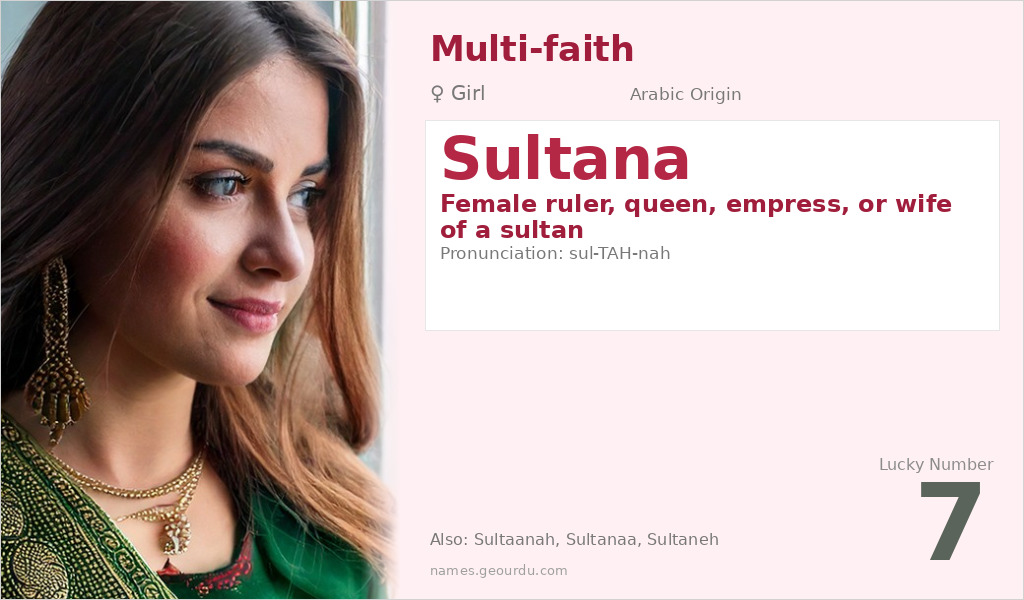
| 📛 Name | Sultana |
| 💎 Meaning | Female ruler, queen, empress, or wife of a sultan |
| 👤 Gender | Girl |
| 🕌 Religion | Multi-faith |
| 🌍 Origin | Arabic |
| 🗣 Pronunciation | sul-TAH-nah |
| ✍️ Urdu | سلطانہ |
| ✍️ Arabic | سلطانة |
| 🔢 Numerology | 7 |
| ✨ Spellings | Sultaanah, Sultanaa, Sultaneh, Sultána |
Origin & Cultural Significance
The name Sultana has its roots in Arabic language and Islamic culture, where it emerged as a title for female members of ruling families. Through the spread of Islam and Arabic influence, the name traveled to Persian, Turkish, Urdu, and various South Asian languages. Historically, several notable women bore this title, including Razia Sultana who ruled the Delhi Sultanate in the 13th century. While the name is most commonly found in Muslim communities, it has occasionally been adopted by people of other faiths in regions with significant Islamic cultural influence, though it remains primarily associated with Muslim naming traditions.
Personality Traits
Those named Sultana are often associated with leadership qualities, confidence, and a commanding presence. The name’s meaning suggests someone who is naturally authoritative yet graceful, with an ability to navigate complex situations with poise. While personality traits vary by individual, the name’s historical connotations often create expectations of dignity, strength, and organizational capability.
Similar Names
If you like Sultana, consider: Sultan, Malika, Shahzadi, Begum, Rani
Famous People Named Sultana
- Sultana Razia — 13th-century ruler of the Delhi Sultanate, one of the few female Muslim rulers in South Asian history
- Sultana Siddiqui — Pakistani television director and producer, founder of Hum TV network
Frequently Asked Questions About Sultana
What does Sultana mean?
Sultana means 'female ruler', 'queen', or 'empress' in Arabic. It is the feminine form of the title 'Sultan' and specifically refers to women in positions of authority or the wives of sultans.
Is Sultana a boy or girl name?
Sultana is exclusively a feminine name. The masculine equivalent is 'Sultan'. The name has never been traditionally used for boys in any culture where it appears.
What is the origin of Sultana?
Sultana originates from Arabic language and Islamic culture. It comes from the Arabic root س-ل-ط (s-l-ṭ) meaning 'to rule', and specifically developed as a title for female rulers or consorts in Muslim societies.





