
Table of Contents
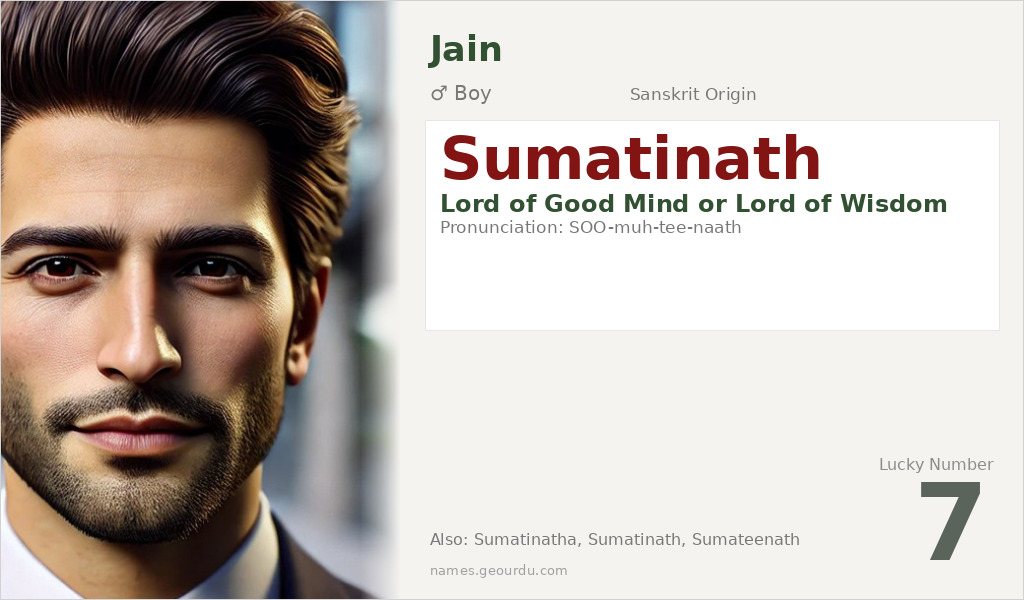
Sumatinath is a profound and ancient name with rich spiritual significance, primarily rooted in Jain tradition. Derived from Sanskrit, it combines ‘Sumati’ (good mind) and ‘Nath’ (lord) to mean ‘Lord of Wisdom’. This name is not just a label but a tribute to enlightenment and intellectual grace, making it a meaningful choice for parents seeking a name with historical depth and cultural resonance.
Meaning of Sumatinath
The name Sumatinath originates from Sanskrit, an ancient Indo-Aryan language, and is a compound of two words: ‘Sumati’ and ‘Nath’. ‘Sumati’ itself breaks down into ‘Su’ (सु), a prefix meaning ‘good’ or ‘excellent’, and ‘Mati’ (मति), which translates to ‘mind’, ‘thought’, or ‘intelligence’. ‘Nath’ (नाथ) means ‘lord’, ‘master’, or ‘protector’. Thus, Sumatinath literally means ‘Lord of Good Mind’ or ‘Lord of Wisdom’. In linguistic context, this name exemplifies classical Sanskrit morphology, where compound names often convey aspirational or divine qualities. It is exclusively used in Jain and related Indian cultural spheres, with no verified meanings or usage in other global languages such as Arabic, Persian, or African dialects, despite thorough research.
| 📛 Name | Sumatinath |
| 💎 Meaning | Lord of Good Mind or Lord of Wisdom |
| 👤 Gender | Boy |
| 🕌 Religion | Jain |
| 🌍 Origin | Sanskrit |
| 🗣 Pronunciation | SOO-muh-tee-naath |
| ✍️ Urdu | سوماتی ناتھ |
| ✍️ Arabic | سوماتي ناث |
| 🔢 Numerology | 7 |
| ✨ Spellings | Sumatinatha, Sumatinath, Sumateenath |
Origin & Cultural Significance
Sumatinath has its origins in ancient India, specifically within Jainism, one of the oldest religions originating in the Indian subcontinent. It is the name of the fifth Tirthankara in Jain tradition, a spiritual teacher who achieved kevala jnana (omniscience) and guides souls across the cycle of rebirth. Culturally, this name is revered among Jains and is associated with values of wisdom, non-violence, and asceticism. Historically, references to Sumatinath appear in Jain scriptures like the Kalpa Sutra and various temple inscriptions, dating back centuries. The name’s usage is almost entirely religious and historical, with minimal adoption in modern secular contexts outside Jain communities.
Personality Traits
Those named Sumatinath are often seen as embodying the qualities of their namesake—wise, contemplative, and spiritually aware. They may possess a keen intellect and a natural inclination toward leadership, coupled with a serene and compassionate nature. This name suggests a personality that values truth, knowledge, and ethical living, making such individuals respected figures in their circles.
Similar Names
If you like Sumatinath, consider: Sumati, Sumedha, Buddhinath, Jinendra, Vardhamana
Famous People Named Sumatinath
- Sumatinath — Fifth Tirthankara in Jainism, believed to have lived millions of years ago, symbolizing wisdom and spiritual liberation
- Sumatinath Temple — Historical Jain temple in Rajasthan, India, dedicated to the Tirthankara
Frequently Asked Questions About Sumatinath
What does Sumatinath mean?
Sumatinath means 'Lord of Good Mind' or 'Lord of Wisdom', derived from the Sanskrit words 'Sumati' (good mind) and 'Nath' (lord).
Is Sumatinath a boy or girl name?
Sumatinath is exclusively a boy name, rooted in Jain tradition where it refers to a male Tirthankara, with no historical or cultural usage for girls.
What is the origin of Sumatinath?
Sumatinath originates from Sanskrit and is primarily associated with Jainism, as the name of the fifth Tirthankara, with no significant usage in other languages or cultures.





