Table of Contents
Sumayya is a beautiful and historically significant name that resonates deeply within Islamic tradition. Derived from Arabic roots meaning ‘high’ or ‘elevated,’ it carries connotations of spiritual loftiness and delicate strength. This name is forever linked to Sumayya bint Khayyat, the first martyr of Islam, whose courage and faith have inspired generations. Today, Sumayya remains a cherished choice for girls in Muslim families worldwide, symbolizing resilience and devotion.
Meaning of Sumayya
The name Sumayya originates from the Arabic language, specifically from the root سَمَا (samā), which conveys meanings of height, elevation, and exaltation. As a diminutive form, it translates to ‘little sky’ or ‘elevated in a gentle manner,’ combining grandeur with subtlety. This linguistic structure is common in Arabic, where diminutives often express endearment or smallness, as seen in names like Suhayl (little star). Historically, the name’s usage was popularized by Sumayya bint Khayyat, an early Muslim figure, reinforcing its association with spiritual ascent and moral high ground. In modern contexts, it is appreciated for its melodic sound and profound meaning, often chosen to inspire qualities of nobility and grace.
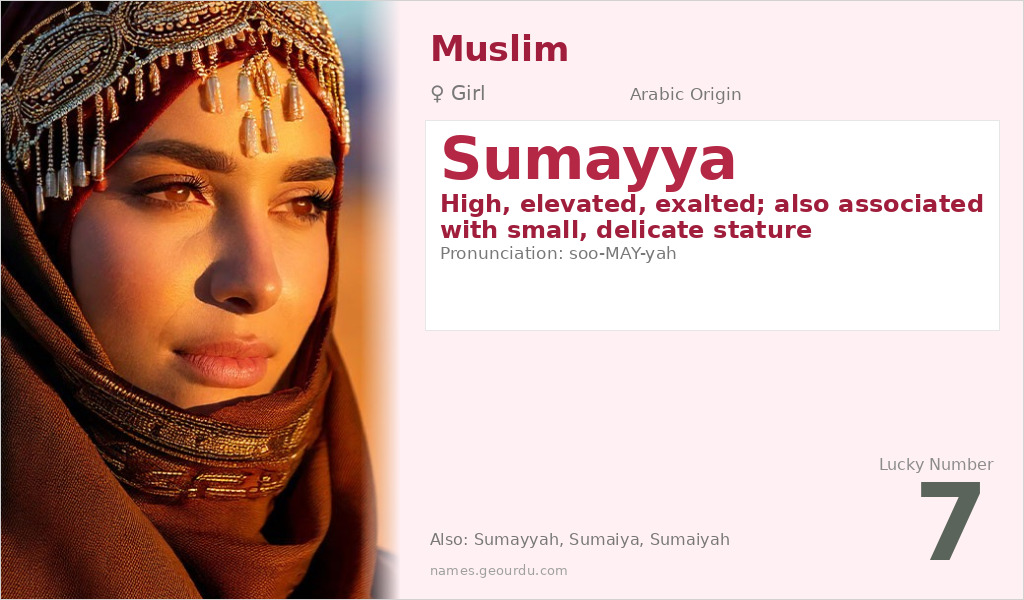
| 📛 Name | Sumayya |
| 💎 Meaning | High, elevated, exalted; also associated with small, delicate stature |
| 👤 Gender | Girl |
| 🕌 Religion | Muslim |
| 🌍 Origin | Arabic |
| 🗣 Pronunciation | soo-MAY-yah |
| ✍️ Urdu | سمیعہ |
| ✍️ Arabic | سُمَيَّة |
| 🔢 Numerology | 7 |
| ✨ Spellings | Sumayyah, Sumaiya, Sumaiyah, Sumaya, Sumaiyya |
Origin & Cultural Significance
Sumayya has its roots firmly in pre-Islamic and early Islamic Arabia, emerging from the Arabic linguistic and cultural milieu. It gained prominence in the 7th century through Sumayya bint Khayyat, a slave who embraced Islam and was martyred for her faith, becoming a symbol of steadfastness. This historical event cemented the name’s place in Muslim naming traditions, particularly among Sunni and Shia communities. Over centuries, it spread across regions influenced by Arabic, such as the Middle East, South Asia, and Africa, often retaining its original form with slight phonetic variations. While primarily used in Muslim contexts, its appeal lies in its universal theme of elevation, making it a timeless choice that transcends strict religious boundaries.
Personality Traits
Those named Sumayya are often seen as individuals of strong character, embodying the resilience and integrity of their namesake. They may display a quiet confidence and a deep sense of justice, driven by inner principles rather than external validation. In social settings, they tend to be compassionate and supportive, earning respect through their consistent actions and spiritual depth. This personality profile aligns with the name’s meaning of being ‘exalted,’ suggesting a natural inclination toward leadership and moral clarity.
Similar Names
If you like Sumayya, consider: Samia, Samira, Sana, Safiya, Sumaira
Famous People Named Sumayya
- Sumayya bint Khayyat — early companion of Prophet Muhammad and first martyr in Islam, known for her steadfast faith
- Sumayya Al-Bahrani — contemporary Omani poet and writer recognized for her literary contributions
Frequently Asked Questions About Sumayya
What does Sumayya mean?
Sumayya means 'high,' 'elevated,' or 'exalted' in Arabic, derived from the root سَمَا (samā). It is a diminutive form, often interpreted as 'little sky,' conveying both grandeur and delicacy.
Is Sumayya a boy or girl name?
Sumayya is exclusively a girl name in Arabic and Islamic naming traditions, with no common usage for boys. Its feminine form is consistent across cultures where it is used.
What is the origin of Sumayya?
Sumayya originates from the Arabic language, with deep roots in early Islamic history. It is specifically associated with Sumayya bint Khayyat, the first martyr of Islam, which solidified its cultural and religious significance.