
Table of Contents
Sunda is a distinctive and meaningful name with deep roots in ancient Sanskrit culture. Primarily used for boys in Hindu communities, it carries connotations of beauty and attractiveness. This name not only reflects aesthetic values but also connects to rich mythological stories from Hindu traditions. Exploring Sunda reveals a blend of linguistic heritage and cultural significance.
Meaning of Sunda
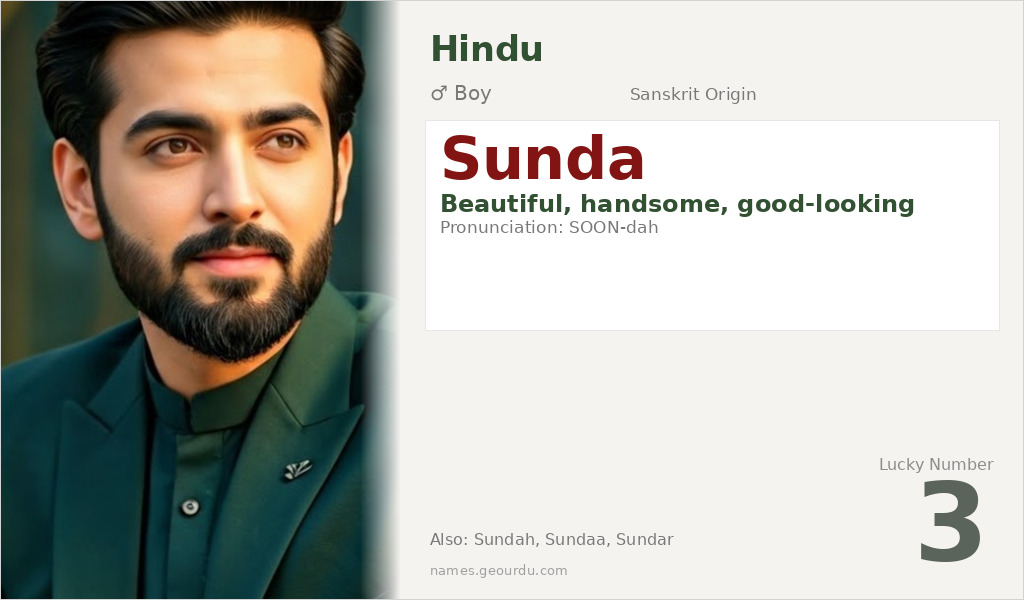
The name Sunda derives from the Sanskrit word ‘सुन्दर’ (sundara), which translates to ‘beautiful,’ ‘handsome,’ or ‘good-looking.’ Sanskrit, as an ancient Indo-Aryan language, has profoundly influenced many modern Indian languages, and ‘sundara’ is a common term in literary and everyday contexts. In etymology, ‘sundara’ is rooted in the concept of visual appeal and grace, often used in classical texts like the Ramayana and Mahabharata to describe characters. The shortened form ‘Sunda’ retains this essence, symbolizing attractiveness and charm. It is distinct from unrelated words in other languages, such as ‘Sunda’ in geography referring to islands in Indonesia, which also traces back to Sanskrit origins.
| 📛 Name | Sunda |
| 💎 Meaning | Beautiful, handsome, good-looking |
| 👤 Gender | Boy |
| 🕌 Religion | Hindu |
| 🌍 Origin | Sanskrit |
| 🗣 Pronunciation | SOON-dah |
| ✍️ Urdu | سندا |
| ✍️ Arabic | سوندا |
| 🔢 Numerology | 3 |
| ✨ Spellings | Sundah, Sundaa, Sundar |
Origin & Cultural Significance
Sunda originates from Sanskrit, an ancient language central to Hindu scriptures, philosophy, and culture. It is predominantly used in Hindu communities across India and Nepal, reflecting the importance of beauty and virtue in Hindu naming traditions. In Hindu mythology, Sunda appears as a demon brother in the Mahabharata, highlighting its historical usage in epic narratives. The name has also spread to regions influenced by Indian culture, such as parts of Southeast Asia, through trade and religious exchanges. While it remains a boy’s name in Hindu contexts, its linguistic roots make it a timeless choice that emphasizes positive qualities.
Personality Traits
People named Sunda are often perceived as charismatic and aesthetically inclined, with a natural ability to attract others through their charm and creativity. They may excel in fields that require expression, such as arts or communication, and value harmony in relationships. Their personality tends to be lively and engaging, making them well-liked in social circles.
Similar Names
If you like Sunda, consider: Sundar, Sunder, Sundaram, Sundara, Sundari
Famous People Named Sunda
- Sunda — A figure in Hindu mythology, one of the two demon brothers (Sunda and Upasunda) who were killed by the goddess Tilottama as per the Mahabharata.
- Sunda Islands — A geographical region in Indonesia, named from the Sanskrit word, though not a person.
Frequently Asked Questions About Sunda
What does Sunda mean?
Sunda means 'beautiful' or 'handsome,' derived from the Sanskrit word 'sundara.'
Is Sunda a boy or girl name?
Sunda is traditionally a boy's name in Hindu culture, though variations like Sundari are used for girls.
What is the origin of Sunda?
Sunda originates from Sanskrit, an ancient Indian language, and is associated with Hindu traditions and mythology.





