Table of Contents
Susan is a timeless feminine name with rich historical roots spanning multiple cultures. Derived from Persian and Hebrew words for ‘lily’ or ‘lotus flower,’ this name carries botanical elegance and has been beloved for centuries. From Biblical references to modern celebrities, Susan maintains its graceful appeal across generations and continents.
Meaning of Susan
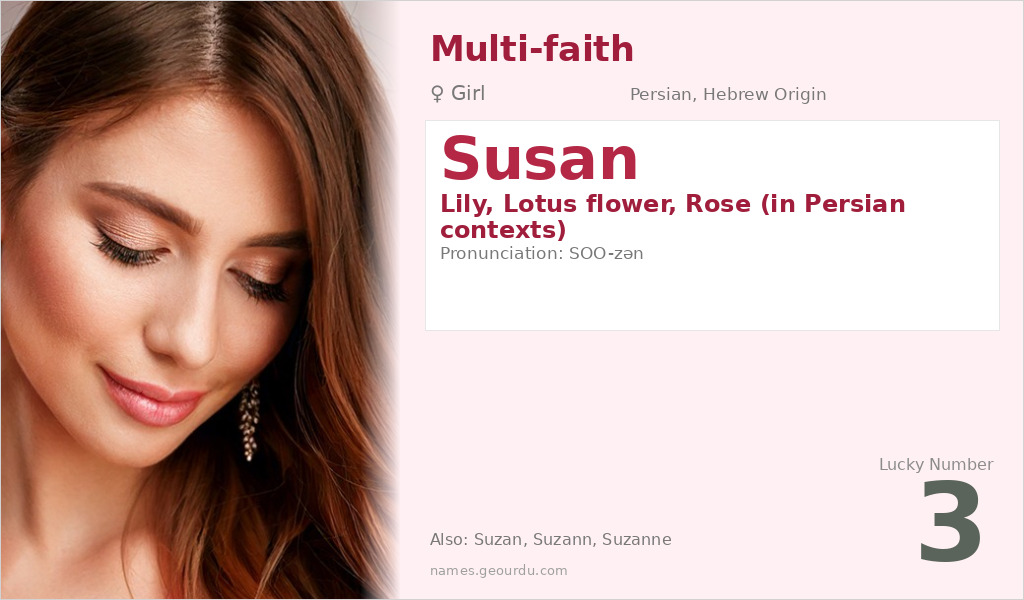
The name Susan originates from two primary linguistic sources. In Persian (Farsi), ‘Susan’ (سوسن) comes from the Middle Persian word ‘sōsan,’ meaning ‘lily’ or ‘lotus flower,’ reflecting the cultural appreciation for floral beauty in Persian poetry and art. Simultaneously, in Hebrew, Susan derives from ‘Shoshana’ (שׁוֹשַׁנָּה), which also translates to ‘lily’ or ‘rose,’ appearing in the Hebrew Bible’s Song of Songs. The name entered Western tradition through the Greek form ‘Σουσάννα’ (Sousanna) in the Biblical Apocrypha’s Story of Susanna. These floral meanings symbolize purity, beauty, and renewal across cultures.
| 📛 Name | Susan |
| 💎 Meaning | Lily, Lotus flower, Rose (in Persian contexts) |
| 👤 Gender | Girl |
| 🕌 Religion | Multi-faith |
| 🌍 Origin | Persian, Hebrew |
| 🗣 Pronunciation | SOO-zən |
| ✍️ Urdu | سوسن |
| ✍️ Arabic | سوسن |
| 🔢 Numerology | 3 |
| ✨ Spellings | Suzan, Suzann, Suzanne, Susanna, Shoshana |
Origin & Cultural Significance
Susan’s cultural journey began in ancient Persia and Hebrew traditions, where floral names held significant symbolic value. The name spread through early Christian communities via the deuterocanonical Book of Daniel’s story of the virtuous Susanna. During the Middle Ages, variants like Suzanne became popular in France, while Susan gained prominence in English-speaking countries after the Protestant Reformation. The 20th century saw Susan peak in popularity in the United States and United Kingdom, reinforced by notable figures like Susan B. Anthony. Today, it remains a cross-cultural name found in Persian, Jewish, Christian, and secular contexts worldwide.
Personality Traits
Those named Susan often embody the graceful qualities associated with lilies and lotuses—elegance, resilience, and natural beauty. They tend to approach life with compassion and artistic sensitivity, creating harmonious environments. While individual personalities vary, the name’s floral etymology suggests someone who values growth, purity, and meaningful connections.
Similar Names
If you like Susan, consider: Susanna, Suzette, Lily, Rose, Lotus
Famous People Named Susan
- Susan B. Anthony — American social reformer and women's rights activist
- Susan Sarandon — Academy Award-winning American actress
Frequently Asked Questions About Susan
What does Susan mean?
Susan means 'lily' or 'lotus flower' originating from Persian (سوسن) and Hebrew (Shoshana) languages.
Is Susan a boy or girl name?
Susan is historically and predominantly a feminine name across all cultures where it appears, with no traditional usage as a masculine name.
What is the origin of Susan?
Susan has dual origins: Persian (meaning 'lily/lotus') and Hebrew (via Shoshana, also meaning 'lily'). It entered Western culture through Biblical texts.