Table of Contents
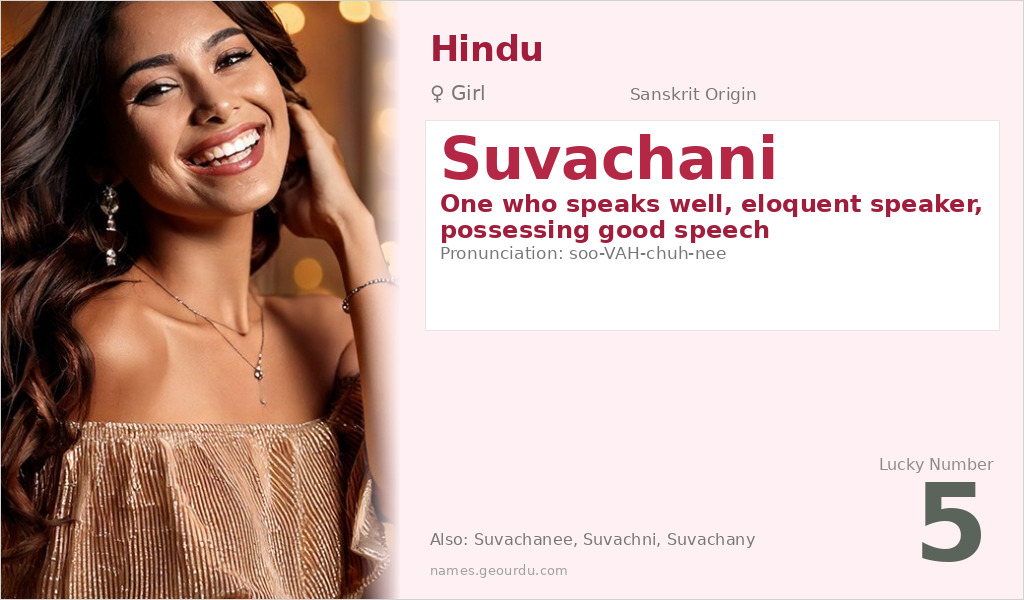
Suvachani is a beautiful Sanskrit name that carries the profound meaning of ‘one who speaks well’ or ‘eloquent speaker’. Rooted in ancient Indian linguistic traditions, this name celebrates the power of articulate expression and thoughtful communication. As a predominantly Hindu name for girls, Suvachani embodies qualities of wisdom, clarity, and verbal grace that have been valued across Indian cultural history. The name’s melodic sound and meaningful etymology make it a distinctive choice for parents seeking a name with both cultural depth and contemporary appeal.
Meaning of Suvachani
Suvachani derives from classical Sanskrit, combining ‘Su’ (सु) meaning ‘good, excellent, or beautiful’ with ‘Vachani’ (वाचनी) from the verbal root ‘vach’ (वच्) meaning ‘to speak, to utter, to declare’. The complete compound thus translates precisely to ‘one who speaks well’, ‘eloquent speaker’, or ‘possessor of good speech’. In Sanskrit grammatical tradition, the ‘-ani’ suffix often indicates a feminine agent noun, making this specifically a female designation. The concept of ‘su-vach’ (good speech) appears throughout Sanskrit literature, from the Vedas to classical poetry, where it represents not just articulate expression but also truthful, beneficial, and harmonious communication. This name reflects the high cultural value placed on both the content and delivery of speech in traditional Indian philosophy.
| 📛 Name | Suvachani |
| 💎 Meaning | One who speaks well, eloquent speaker, possessing good speech |
| 👤 Gender | Girl |
| 🕌 Religion | Hindu |
| 🌍 Origin | Sanskrit |
| 🗣 Pronunciation | soo-VAH-chuh-nee |
| ✍️ Urdu | سوواچنی |
| ✍️ Arabic | سوفاشاني |
| 🔢 Numerology | 5 |
| ✨ Spellings | Suvachanee, Suvachni, Suvachany, Suvachaney |
Origin & Cultural Significance
Suvachani originates from Sanskrit, the classical language of ancient India that has influenced numerous South Asian languages and naming traditions. As a Hindu name, it appears in various regional adaptations across India, particularly in Sanskrit-educated communities and among those who value traditional linguistic heritage. The name’s components are deeply embedded in Hindu philosophical texts where ‘vāk’ (speech) is considered a divine faculty and ‘su-vākya’ (good speech) is praised as a virtue. While primarily used in Hindu contexts, the name’s linguistic elements have parallels in other Indo-European languages through shared Proto-Indo-European roots related to speech and voice. In contemporary usage, Suvachani remains most popular in India, Nepal, and among Hindu diaspora communities worldwide who maintain connections to Sanskrit naming traditions.
Personality Traits
Those named Suvachani often naturally embody the qualities suggested by their name’s meaning. They tend to be thoughtful communicators who choose their words carefully and value meaningful dialogue. Their eloquence often extends beyond mere verbal skill to include persuasive abilities and diplomatic tact. Many Suvachani-named individuals find themselves drawn to fields involving communication, education, or counseling, where their natural articulateness serves them well. Friends and colleagues typically describe them as wise, measured, and possessing a calming presence in conversations.
Similar Names
If you like Suvachani, consider: Suvarna, Suvidha, Vachasya, Vachana, Suvakya
Famous People Named Suvachani
- Suvachani Devi — 19th century Indian poetess and scholar known for her Sanskrit compositions
- Suvachani Sharma — Contemporary Indian classical vocalist specializing in Dhrupad style
Frequently Asked Questions About Suvachani
What does Suvachani mean?
Suvachani means 'one who speaks well' or 'eloquent speaker' in Sanskrit, derived from 'su' (good) and 'vachani' (speaker).
Is Suvachani a boy or girl name?
Suvachani is traditionally a feminine name in Hindu and Sanskrit naming traditions, with grammatical elements specifically indicating a female speaker.
What is the origin of Suvachani?
Suvachani originates from Sanskrit, the classical language of ancient India, and is primarily used in Hindu cultural contexts across South Asia and the diaspora.