
Table of Contents
Swatantra is a powerful Sanskrit name that carries deep cultural and philosophical significance. Meaning ‘independent’ or ‘self-ruling’, this name has resonated through Indian history and continues to be chosen by parents who value autonomy and strength. With roots in ancient Sanskrit literature and modern political discourse, Swatantra represents both personal freedom and collective sovereignty. This comprehensive guide explores every aspect of this meaningful name.
Meaning of Swatantra
Swatantra is a compound Sanskrit name with profound linguistic roots. It combines ‘sva’ (स्व), meaning ‘self’ or ‘one’s own’, with ‘tantra’ (तन्त्र), meaning ‘system’, ‘rule’, or ‘governance’. The complete term therefore translates to ‘self-governing’ or ‘self-ruling’. In classical Sanskrit texts, this concept appears in philosophical discussions about autonomy and self-determination. The name gained particular prominence during India’s independence movement in the 20th century, where ‘swatantrata’ (freedom) became a central political concept. Today, it continues to symbolize both personal independence and national sovereignty in Indian naming traditions.
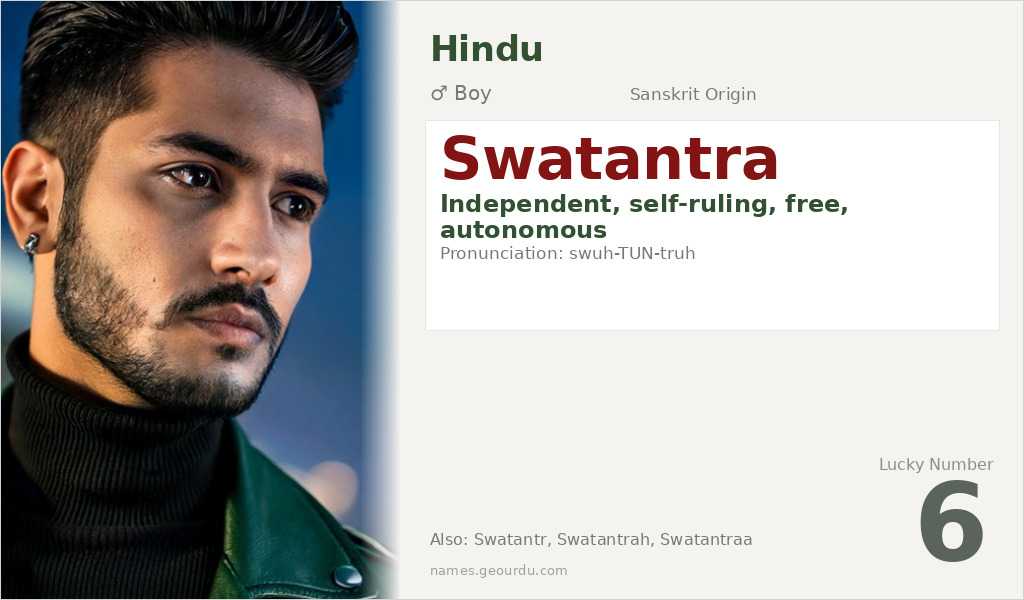
| 📛 Name | Swatantra |
| 💎 Meaning | Independent, self-ruling, free, autonomous |
| 👤 Gender | Boy |
| 🕌 Religion | Hindu |
| 🌍 Origin | Sanskrit |
| 🗣 Pronunciation | swuh-TUN-truh |
| ✍️ Urdu | سواتنتر |
| ✍️ Arabic | سواتنترا |
| 🔢 Numerology | 6 |
| ✨ Spellings | Swatantr, Swatantrah, Swatantraa |
Origin & Cultural Significance
Swatantra originates from classical Sanskrit, one of the oldest languages in the Indo-European family. While primarily associated with Hindu culture due to Sanskrit’s role in Hindu scriptures, the name transcends strict religious boundaries and appears in various Indian communities. Historically, the concept of ‘swatantra’ appears in ancient Indian political philosophy, particularly in discussions of statecraft and governance. During the Indian independence movement, the term became politically charged, with ‘Purna Swaraj’ (complete independence) becoming a rallying cry. This historical context has made Swatantra a name that carries both cultural heritage and modern political resonance.
Personality Traits
Those named Swatantra are often perceived as natural leaders with strong independent streaks. They typically value personal freedom and self-determination, making them innovative problem-solvers who prefer to chart their own course. Their name’s meaning tends to manifest in a confident, self-reliant personality that can inspire others while maintaining principled autonomy. These individuals often excel in fields where independence and original thinking are valued.
Similar Names
If you like Swatantra, consider: Swaraj, Swayam, Swadesh, Mukti, Azaad
Famous People Named Swatantra
- Swatantra Singh — Indian politician and former Member of Parliament
- Swatantra Kumar — Indian classical vocalist and composer
Frequently Asked Questions About Swatantra
What does Swatantra mean?
Swatantra means 'independent', 'self-ruling', or 'autonomous'. It is derived from the Sanskrit words 'sva' (self) and 'tantra' (rule/governance).
Is Swatantra a boy or girl name?
Swatantra is traditionally a masculine name in Indian naming conventions, though names can sometimes be adapted across genders in modern usage.
What is the origin of Swatantra?
Swatantra originates from Sanskrit, an ancient Indo-European language that is the liturgical language of Hinduism and has influenced many South Asian languages.





