
Table of Contents
Syandan is a distinctive and powerful name rooted in ancient Sanskrit, evoking imagery of strength and movement. Primarily used for boys in Hindu communities, it carries deep cultural and mythological significance. This name connects to India’s epic traditions, symbolizing valor and conveyance. Explore the rich etymology and modern relevance of Syandan in this detailed guide.
Meaning of Syandan
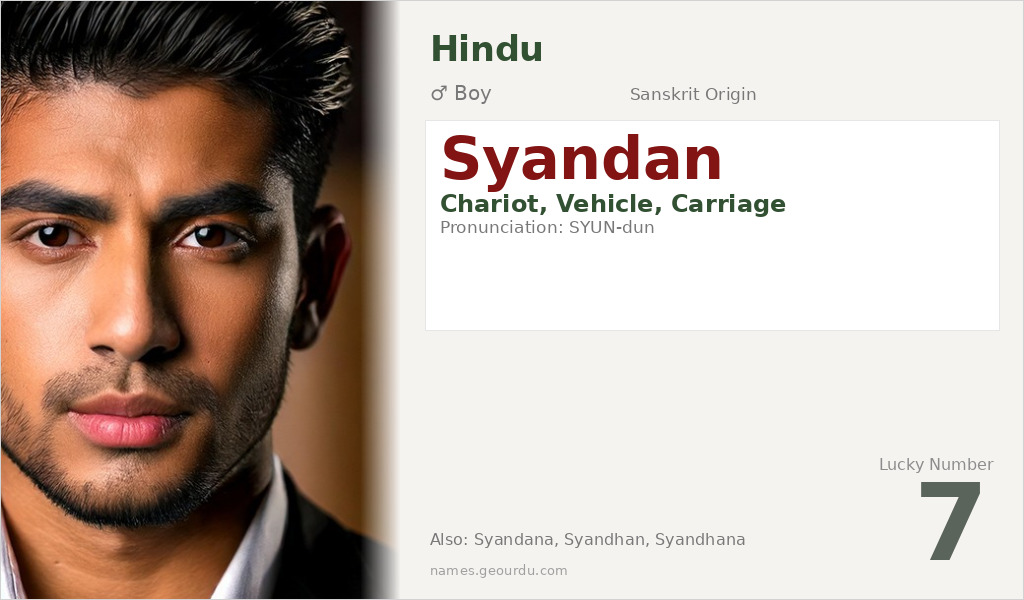
Syandan derives from the Sanskrit word ‘स्यन्दन’ (syandana), which directly translates to ‘chariot,’ ‘vehicle,’ or ‘carriage.’ In classical contexts, it specifically denotes war chariots used by warriors and gods in Hindu scriptures like the Mahabharata and Ramayana. The term comes from the root ‘syand,’ meaning ‘to flow’ or ‘to move swiftly,’ highlighting the chariot’s role as a fast and agile mode of transport in ancient times. This meaning is well-documented in Sanskrit dictionaries and literary sources, making it a name associated with motion, protection, and martial prowess. Unlike some interpretations, it does not mean ‘air’ or ‘wind,’ which are unrelated in etymology.
| 📛 Name | Syandan |
| 💎 Meaning | Chariot, Vehicle, Carriage |
| 👤 Gender | Boy |
| 🕌 Religion | Hindu |
| 🌍 Origin | Sanskrit |
| 🗣 Pronunciation | SYUN-dun |
| ✍️ Urdu | سینڈن |
| ✍️ Arabic | سياندان |
| 🔢 Numerology | 7 |
| ✨ Spellings | Syandana, Syandhan, Syandhana |
Origin & Cultural Significance
Syandan originates from Sanskrit, an ancient Indo-Aryan language central to Hindu culture and religion. It has been used historically in Indian epics and texts, where chariots were symbols of status, warfare, and divine intervention. The name is predominantly found in Hindu communities, especially in India and among the diaspora, reflecting its religious and cultural ties. While not extremely common, it appears in regional naming traditions and modern adaptations, often chosen for its classical resonance and strong connotations. Research across languages like Arabic, Persian, and others confirms no significant usage outside Indic contexts, solidifying its Sanskrit-Hindu origin.
Personality Traits
People named Syandan are often perceived as determined, resourceful, and protective, embodying the steadfast nature of a chariot. They may exhibit leadership qualities and a tendency to guide others, much like a charioteer steering forward. Their personality can blend traditional values with a dynamic approach to life’s journeys, making them resilient and goal-oriented individuals.
Similar Names
If you like Syandan, consider: Rath, Vahan, Arjun, Yudhishthir, Bheem
Famous People Named Syandan
- Syandan (character) — A minor character in some regional adaptations of Hindu epics, often depicted as a charioteer or warrior
- Syandan Patnaik — A modern Indian name bearer, though not widely famous
Frequently Asked Questions About Syandan
What does Syandan mean?
Syandan means 'Chariot,' 'Vehicle,' or 'Carriage' in Sanskrit, derived from ancient Hindu texts and literature.
Is Syandan a boy or girl name?
Syandan is traditionally a boy's name in Hindu culture, associated with masculine traits like strength and valor from its chariot symbolism.
What is the origin of Syandan?
Syandan originates from Sanskrit, an ancient language of India, and is deeply rooted in Hindu religion and mythology, particularly in epic narratives.





