
Table of Contents
Tabari is a distinguished name with deep historical roots in the Middle East, particularly associated with the region of Tabaristan in northern Iran. While often recognized through the famous Muslim scholar al-Tabari, the name itself carries geographical significance that transcends religious boundaries. This name represents a connection to Persian and Arabic heritage, blending cultural identity with intellectual legacy. Discover the true meaning and rich background of this historically significant name.
Meaning of Tabari
Tabari derives from the Arabic word ‘Tabar’ (طبر), meaning ‘axe’ or ‘hatchet’, which originally described the rugged, mountainous terrain of Tabaristan. The ‘-i’ suffix in Arabic and Persian creates a nisba (attributive form), indicating origin or belonging, thus Tabari literally means ‘from Tabaristan’ or ‘pertaining to the Tabari people’. This naming convention is common in Semitic and Persian languages where geographical names become personal identifiers. The name is linguistically connected to the historical region along the Caspian Sea’s southern coast, known for its distinct culture and resistance to Arab conquest during early Islamic expansion. While the name gained prominence through Muhammad ibn Jarir al-Tabari, its fundamental meaning remains geographical rather than descriptive of personal qualities.
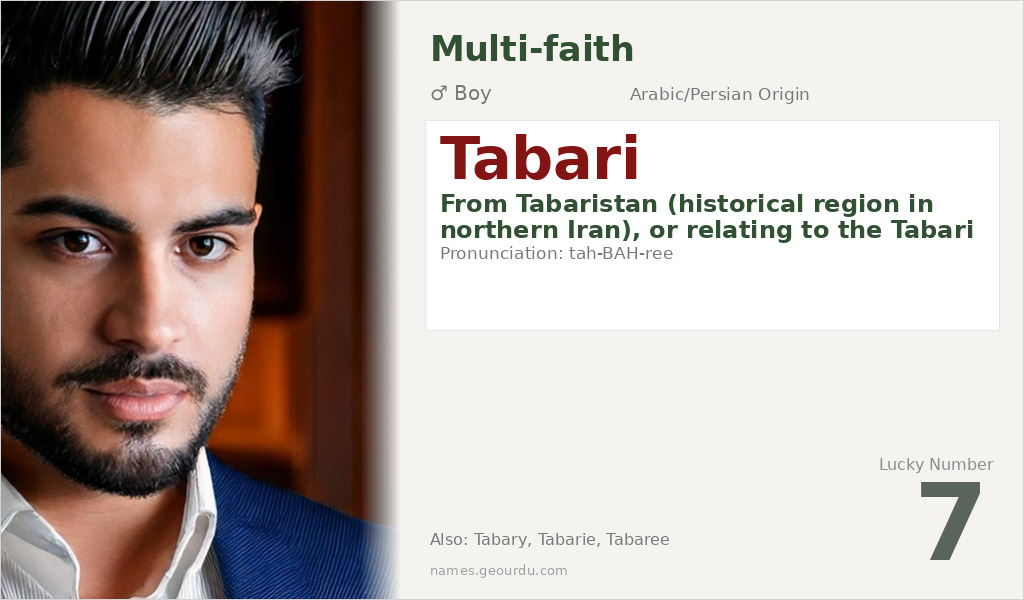
| 📛 Name | Tabari |
| 💎 Meaning | From Tabaristan (historical region in northern Iran), or relating to the Tabari people |
| 👤 Gender | Boy |
| 🕌 Religion | Multi-faith |
| 🌍 Origin | Arabic/Persian |
| 🗣 Pronunciation | tah-BAH-ree |
| ✍️ Urdu | طبری |
| ✍️ Arabic | الطبری |
| 🔢 Numerology | 7 |
| ✨ Spellings | Tabary, Tabarie, Tabaree |
Origin & Cultural Significance
Tabari originates from the historical region of Tabaristan (modern-day Mazandaran province in Iran), which maintained semi-independence during the early Islamic period. The name entered wider usage through the nisba naming tradition common in Arabic and Persian cultures, where individuals were identified by their place of origin. While strongly associated with Islamic scholarship through al-Tabari, the name predates Islam and reflects the region’s pre-Islamic Persian heritage. Today, Tabari is used across Muslim communities but also appears in multi-faith contexts due to its geographical rather than religious meaning. The name’s persistence reflects the enduring cultural memory of Tabaristan’s distinct identity within the broader Persianate world.
Personality Traits
Those named Tabari often embody qualities associated with scholars and historians—curiosity, depth of thought, and respect for tradition. The name’s connection to the renowned scholar al-Tabari suggests an intellectual heritage that may influence perceptions of individuals bearing this name. While personality traits vary individually, the historical weight of the name may inspire a sense of responsibility toward learning and cultural preservation.
Similar Names
If you like Tabari, consider: Tabarak, Tabassum, Tabish, Tahir, Tariq
Famous People Named Tabari
- Muhammad ibn Jarir al-Tabari (839-923 CE) — Persian Muslim historian, scholar, and commentator on the Quran, author of 'History of the Prophets and Kings'
- Abu Ja'far Muhammad ibn Jarir al-Tabari — The same scholar, often referred to simply as al-Tabari, one of the most influential Islamic scholars of the medieval period
Frequently Asked Questions About Tabari
What does Tabari mean?
Tabari means 'from Tabaristan' or 'relating to the Tabari people', referring to a historical region in northern Iran. It originates from Arabic/Persian 'Tabar' (axe) describing the region's mountainous terrain, with the '-i' suffix indicating geographical origin.
Is Tabari a boy or girl name?
Tabari is traditionally a masculine name in Arabic and Persian naming conventions. The nisba '-i' ending is typically used for male names, though in modern contexts it could theoretically be adapted, but historical and current usage overwhelmingly favors male gender assignment.
What is the origin of Tabari?
Tabari originates from the historical region of Tabaristan in northern Iran (modern Mazandaran). It comes from Arabic and Persian linguistic traditions where geographical names become personal identifiers through the nisba suffix '-i', indicating 'from' or 'of' that place.





