Table of Contents
Tahmina is a beautiful Persian name rich with mythological significance and linguistic depth. Most famously known as the wife of the legendary hero Rostam in Ferdowsi’s epic Shahnameh, this name carries centuries of cultural heritage. Beyond its literary fame, Tahmina has a concrete meaning rooted in the Persian language that speaks to strength and power. Today, it remains a popular choice in Persian-speaking communities and beyond, connecting modern bearers to ancient stories.
Meaning of Tahmina
The name Tahmina derives from the Persian word ‘tahm’, which means ‘strong, powerful, or mighty’. This linguistic root gives the name its fundamental meaning of strength and capability. In Persian mythology, particularly in Ferdowsi’s 10th-century epic Shahnameh (Book of Kings), Tahmina is the princess of Samangan who marries the hero Rostam during his travels, and their union produces the tragic hero Sohrab. The name appears in various forms in Persian literature and historical texts, maintaining its association with nobility and mythological significance. While the mythological connection is its most famous aspect, the name’s literal meaning in Persian remains ‘strong’ or ‘powerful’.
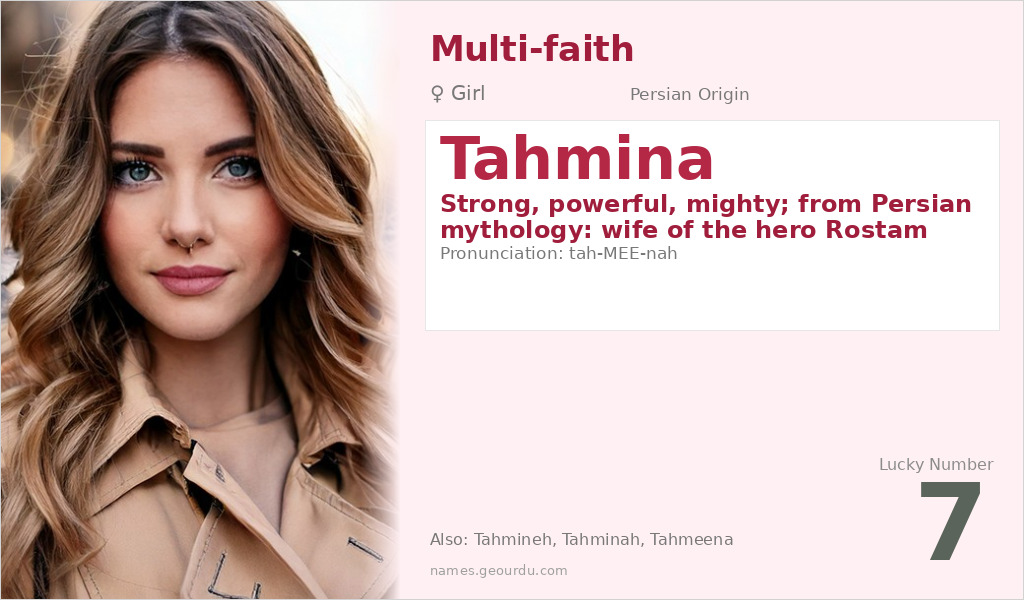
| 📛 Name | Tahmina |
| 💎 Meaning | Strong, powerful, mighty; from Persian mythology: wife of the hero Rostam and mother of Sohrab |
| 👤 Gender | Girl |
| 🕌 Religion | Multi-faith |
| 🌍 Origin | Persian |
| 🗣 Pronunciation | tah-MEE-nah |
| ✍️ Urdu | تہمینہ |
| ✍️ Arabic | تهمينة |
| 🔢 Numerology | 7 |
| ✨ Spellings | Tahmineh, Tahminah, Tahmeena, Tahminé |
Origin & Cultural Significance
Tahmina originates from Persian (Farsi) culture and language, with its earliest documented appearance in Persian epic poetry. The name gained prominence through Ferdowsi’s Shahnameh, composed around 977-1010 CE, which solidified Tahmina’s place in Persian cultural consciousness. While primarily used in Persian-speaking regions (Iran, Afghanistan, Tajikistan), the name has spread to neighboring cultures including Urdu-speaking communities and among diaspora populations. It is not exclusively tied to any single religion, though it appears frequently in Muslim communities due to Persian cultural influence in the Islamic world. The name represents a bridge between linguistic meaning and mythological narrative in Persian tradition.
Personality Traits
Those named Tahmina often embody the strength and dignity suggested by their name’s meaning. They may display natural leadership abilities combined with grace and intelligence, reflecting their namesake’s royal and heroic associations. The mythological connection to Rostam’s wife suggests qualities of loyalty, courage in adversity, and deep familial bonds. While personality varies by individual, the name carries connotations of resilience and noble character.
Similar Names
If you like Tahmina, consider: Roxana, Parisa, Soraya, Farah, Leila
Famous People Named Tahmina
- Tahmineh Milani — Iranian film director and screenwriter
- Tahmineh Ebrahimi — Afghan singer and musician
Frequently Asked Questions About Tahmina
What does Tahmina mean?
Tahmina means 'strong, powerful, mighty' in Persian. It is also the name of Rostam's wife in Persian mythology from Ferdowsi's Shahnameh.
Is Tahmina a boy or girl name?
Tahmina is exclusively a feminine name in all cultural contexts where it is used, from its origins in Persian to modern usage.
What is the origin of Tahmina?
Tahmina originates from Persian (Farsi) language and culture, with its most famous appearance in the 10th-century epic Shahnameh by Ferdowsi, though the name predates this literary work.