
Table of Contents
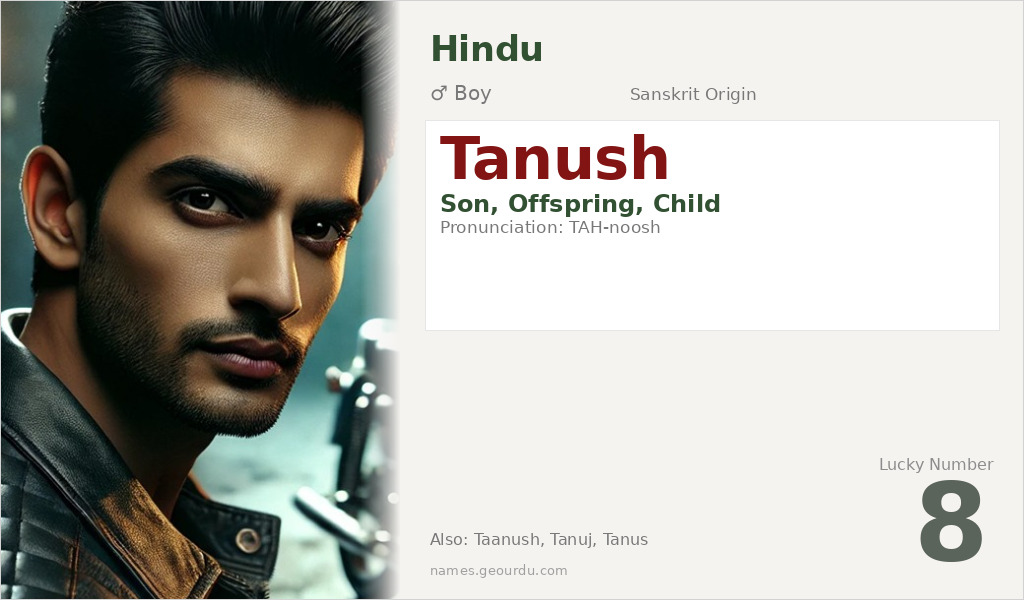
Tanush is a classic Hindu boy’s name with deep roots in Sanskrit language and culture. Often chosen for its meaningful connection to family and progeny, this name carries a sense of tradition and heritage. In this guide, we explore the true etymology, pronunciation, and cultural context of Tanush. Discover why it remains a popular choice for parents seeking a name with historical significance.
Meaning of Tanush
Tanush originates from the Sanskrit term ‘tanūja’ (तनूज), which combines ‘tanu’ (body) and ‘ja’ (born from), literally translating to ‘born from the body’ or ‘offspring’. This makes it a direct reference to a son or child, emphasizing familial bonds. The name is documented in ancient Hindu scriptures and epics like the Mahabharata, where it is used descriptively. Over centuries, it transitioned into a personal name, retaining its core meaning. In modern usage, Tanush is appreciated for its linguistic purity and cultural resonance, symbolizing continuity and legacy.
| 📛 Name | Tanush |
| 💎 Meaning | Son, Offspring, Child |
| 👤 Gender | Boy |
| 🕌 Religion | Hindu |
| 🌍 Origin | Sanskrit |
| 🗣 Pronunciation | TAH-noosh |
| ✍️ Urdu | تنوش |
| ✍️ Arabic | تانوش |
| 🔢 Numerology | 8 |
| ✨ Spellings | Taanush, Tanuj, Tanus |
Origin & Cultural Significance
Tanush has its origins in Sanskrit, the ancient Indo-Aryan language of India, and is deeply embedded in Hindu culture. It emerged as a given name in regions influenced by Sanskrit traditions, such as India, Nepal, and the Hindu diaspora. Historically, names derived from Sanskrit often reflect virtues, relationships, or natural elements, with Tanush specifically highlighting the parent-child connection. The name is commonly found among Hindu communities, where it is chosen for its auspicious and meaningful connotations. Its usage spans centuries, appearing in classical literature and continuing in contemporary naming practices.
Personality Traits
People named Tanush are often perceived as dependable and family-focused, with a natural inclination toward caregiving and responsibility. They may exhibit traditional values and a strong sense of identity, drawing from the name’s roots in lineage and heritage. Their personality tends to be grounded and nurturing, making them supportive figures in their social circles.
Similar Names
If you like Tanush, consider: Tanuj, Tanay, Tanish, Tanu, Tanveer
Famous People Named Tanush
- Tanushree Dutta — Indian actress and model
- Tanush Kotian — Indian cricketer
Frequently Asked Questions About Tanush
What does Tanush mean?
Tanush means 'son', 'offspring', or 'child', derived from the Sanskrit word 'tanūja' (तनूज), which literally translates to 'born from the body'.
Is Tanush a boy or girl name?
Tanush is traditionally a boy's name in Hindu culture, reflecting its meaning related to male progeny, though it is rarely used for girls.
What is the origin of Tanush?
Tanush originates from Sanskrit, an ancient Indo-Aryan language of India, and is closely associated with Hindu traditions and texts.





