
Table of Contents
Teerthankar is a profound spiritual name with deep roots in Jain tradition. Meaning ‘ford-maker’ or ‘one who creates a crossing,’ this name carries centuries of religious significance and philosophical weight. Unlike common given names, Teerthankar refers specifically to the 24 enlightened teachers in Jainism who establish the path to liberation. This name represents spiritual guidance, wisdom, and the ultimate goal of crossing the ocean of worldly existence.
Meaning of Teerthankar
Teerthankar derives from two Sanskrit components: ‘tīrtha’ meaning ‘ford,’ ‘crossing place,’ or ‘pilgrimage site,’ and ‘kara’ meaning ‘maker’ or ‘creator.’ In Jain theology, a Tirthankara is an enlightened being who establishes the ‘tirtha’—the fourfold community of monks, nuns, laymen, and laywomen—that serves as a crossing from samsara (the cycle of rebirth) to moksha (liberation). The term appears in ancient Jain scriptures including the Kalpa Sutra, Tattvartha Sutra, and various Puranas. Unlike the generic translation ‘saint,’ Teerthankar has precise theological meaning: one who fords the ocean of existence and shows others the way. The 24 Tirthankaras are central figures in Jain cosmology, with Mahavira being the most recent historical figure from the 6th century BCE.
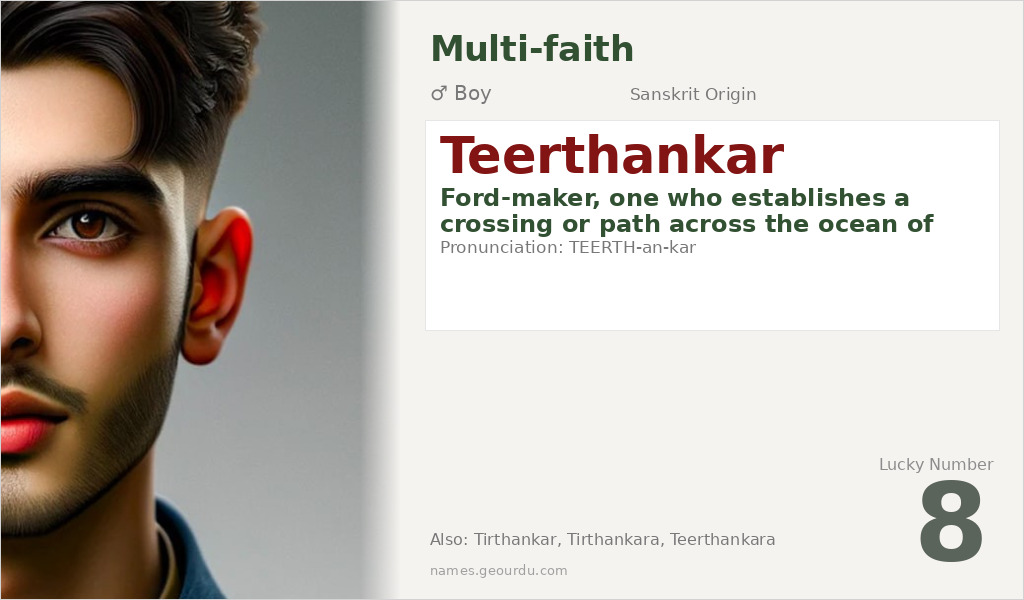
| 📛 Name | Teerthankar |
| 💎 Meaning | Ford-maker, one who establishes a crossing or path across the ocean of existence |
| 👤 Gender | Boy |
| 🕌 Religion | Multi-faith |
| 🌍 Origin | Sanskrit |
| 🗣 Pronunciation | TEERTH-an-kar |
| ✍️ Urdu | تیرتھنکر |
| ✍️ Arabic | تيرثانكار |
| 🔢 Numerology | 8 |
| ✨ Spellings | Tirthankar, Tirthankara, Teerthankara, Tirthankara |
Origin & Cultural Significance
Teerthankar originates from Sanskrit, the classical language of ancient India, and is deeply embedded in Jain religious tradition. While Jainism shares historical and cultural connections with Hinduism and Buddhism, the concept of Tirthankara is uniquely Jain. The earliest references appear in Jain canonical texts dating back over 2,500 years. The name is used both as a theological term for the enlightened teachers and occasionally as a given name in Jain communities, particularly among Digambara and Śvētāmbara traditions. Unlike Hindu names that might reference deities, Teerthankar specifically denotes those who have achieved kevala jnana (omniscience) and established the Jain path. The name’s usage reflects Jain values of spiritual leadership, non-violence (ahimsa), and liberation from karmic bondage.
Personality Traits
Those named Teerthankar often embody qualities of spiritual leadership and guidance. They tend to be thoughtful, disciplined individuals with strong moral compasses and a natural inclination toward teaching or mentoring others. The name suggests someone who helps others navigate life’s challenges, much like the Tirthankaras guide souls across existential waters. These individuals often value truth, simplicity, and non-violence in their interactions, reflecting the Jain principles associated with the name’s origin.
Similar Names
If you like Teerthankar, consider: Mahavira, Parshvanatha, Rishabhanatha, Arihant, Jina
Famous People Named Teerthankar
- Lord Mahavira — 24th and last Tirthankara of Jainism, founder of modern Jain tradition
- Lord Parshvanatha — 23rd Tirthankara, historical figure from 9th century BCE
Frequently Asked Questions About Teerthankar
What does Teerthankar mean?
Teerthankar means 'ford-maker' or 'one who creates a crossing' in Sanskrit. Specifically, it refers to the 24 enlightened spiritual teachers in Jainism who establish the path to liberation across the ocean of existence.
Is Teerthankar a boy or girl name?
Teerthankar is traditionally a boy's name, as all 24 Tirthankaras in Jain tradition are male. The name carries masculine grammatical forms in Sanskrit and is used for boys in Jain communities.
What is the origin of Teerthankar?
Teerthankar originates from Sanskrit and is central to Jain religious tradition. It combines 'tīrtha' (ford/crossing) and 'kara' (maker), referring specifically to the enlightened teachers who establish the Jain spiritual community and path to liberation.





