
Table of Contents
Thor is one of the most iconic names from ancient mythology, carrying the powerful meaning of ‘thunder’ from its Old Norse roots. As the name of the Norse god of thunder, strength, and protection, it evokes images of power and resilience. This name has transcended its mythological origins to become a popular choice in various cultures, particularly in Scandinavian countries and among those appreciating Germanic heritage.
Meaning of Thor
The name Thor comes directly from Old Norse ‘Þórr’, which evolved from the Proto-Germanic word ‘*Þunraz’, meaning ‘thunder’. This etymology is exceptionally well-documented through ancient texts, runic inscriptions, and comparative linguistics across Germanic languages. In Old English, the related form ‘Þunor’ appears, while Old High German used ‘Donar’ for the same thunder deity. The name’s meaning is unequivocally tied to thunder and the associated Norse god, making it one of the most transparent mythological names in terms of linguistic origin and semantic content.
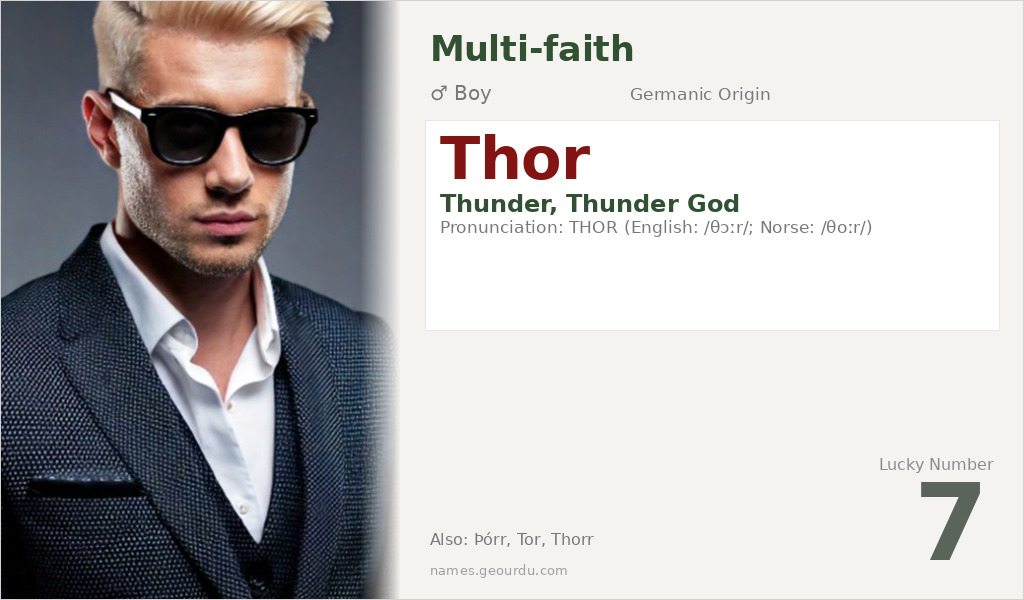
| 📛 Name | Thor |
| 💎 Meaning | Thunder, Thunder God |
| 👤 Gender | Boy |
| 🕌 Religion | Multi-faith |
| 🌍 Origin | Germanic |
| 🗣 Pronunciation | THOR (English: /θɔːr/; Norse: /θoːr/) |
| ✍️ Urdu | تھور |
| ✍️ Arabic | ثور |
| 🔢 Numerology | 7 |
| ✨ Spellings | Þórr, Tor, Thorr, Thorir |
Origin & Cultural Significance
Thor originates from ancient Germanic mythology, specifically Norse mythology where Thor (Þórr) was the god of thunder, strength, protection, and hallowing. The name appears in numerous historical sources including the Poetic Edda, Prose Edda, and various runic inscriptions from the Viking Age. While the name has been adopted in Christian contexts in Scandinavia (where many traditional Norse names remained in use after Christianization), its fundamental origin is pre-Christian Germanic religion. The name spread through Viking expansion and later through literary works, becoming particularly popular in Iceland, Norway, Sweden, and Denmark.
Personality Traits
Those named Thor often carry associations of strength, protection, and authority derived from the mythological figure. They may be perceived as natural leaders with physical and mental resilience, embodying the thunder god’s characteristics of determination and power. The name suggests someone who is dependable in challenging situations and possesses a strong sense of justice and protection toward others.
Similar Names
If you like Thor, consider: Odin, Loki, Freyr, Baldur, Tyr
Famous People Named Thor
- Thor Heyerdahl — Norwegian explorer and anthropologist known for the Kon-Tiki expedition
- Thor Bjørnsson — Icelandic strongman and actor known as 'The Mountain' from Game of Thrones
Frequently Asked Questions About Thor
What does Thor mean?
Thor means 'thunder' in Old Norse, derived from Proto-Germanic '*Þunraz'. It is the name of the Norse god of thunder, strength, and protection.
Is Thor a boy or girl name?
Thor is exclusively a boy's name, originating as the name of the male Norse thunder god and traditionally used for males in Scandinavian cultures.
What is the origin of Thor?
Thor originates from Old Norse/Germanic mythology, specifically as the name of the thunder god in Norse religion. It comes from the Proto-Germanic word for thunder and has been used in Scandinavian countries for centuries.





