Table of Contents
Tilottama is a name that resonates with celestial beauty and mythological grandeur. Originating from ancient Sanskrit texts, this name belongs to one of the most celebrated apsaras (divine nymphs) in Hindu tradition. With its poetic meaning and rich cultural heritage, Tilottama represents the ideal of perfect beauty and divine grace. Parents seeking a name with deep spiritual roots and timeless elegance often find Tilottama particularly appealing.
Meaning of Tilottama
The name Tilottama derives from the Sanskrit words ’tila’ (sesame seed, small particle) and ‘uttama’ (highest, best, most excellent). This combination creates the beautiful meaning ‘one whose smallest particle is the finest’ or ‘one with the most perfect measure’. In Hindu scriptures, this name specifically refers to a celestial nymph created by Vishvakarma, the divine architect, at Brahma’s request. Her beauty was so extraordinary that it could distract even powerful demons, making her a pivotal figure in several mythological narratives. The name embodies the concept of perfection down to the smallest detail, reflecting the Sanskrit linguistic tradition of creating compound words with profound philosophical implications.
| 📛 Name | Tilottama |
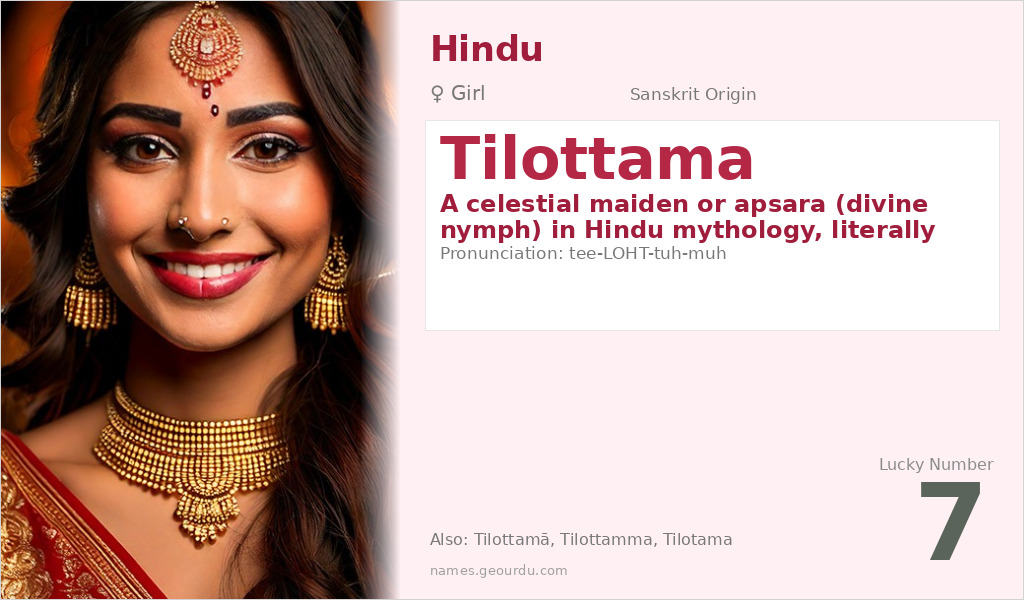
| 💎 Meaning | A celestial maiden or apsara (divine nymph) in Hindu mythology, literally meaning "one with the finest or most perfect measure" |
| 👤 Gender | Girl |
| 🕌 Religion | Hindu |
| 🌍 Origin | Sanskrit |
| 🗣 Pronunciation | tee-LOHT-tuh-muh |
| ✍️ Urdu | تلوتما |
| ✍️ Arabic | تيلوتاما |
| 🔢 Numerology | 7 |
| ✨ Spellings | Tilottamā, Tilottamma, Tilotama |
Origin & Cultural Significance
Tilottama originates from ancient Sanskrit literature, specifically appearing in the Mahabharata and various Puranas. As a mythological figure, she plays significant roles in Hindu stories, most notably in distracting the demon brothers Sunda and Upasunda, leading to their destruction. The name represents the Hindu tradition of naming children after divine beings and virtues, connecting them to cultural heritage and spiritual ideals. While primarily used in Hindu communities, the name has gained appreciation across cultures for its melodic sound and rich mythological associations. Its usage reflects the enduring influence of Sanskrit literature on Indian naming traditions.
Personality Traits
Those named Tilottama are often perceived as possessing natural elegance and artistic sensibility. They tend to approach life with a sense of harmony and balance, seeking perfection in their endeavors. With roots in celestial mythology, individuals with this name may exhibit spiritual depth and philosophical thinking, combined with the charm and grace associated with their namesake. Their personality often reflects the name’s meaning of ‘perfect measure’ through balanced judgment and aesthetic appreciation.
Similar Names
If you like Tilottama, consider: Urvashi, Rambha, Menaka, Apsara, Devika
Famous People Named Tilottama
- Tilottama — A character in Indian author Amitav Ghosh's novel 'The Glass Palace'
- Tilottama — A prominent apsara in Hindu mythology mentioned in the Mahabharata and Puranas
Frequently Asked Questions About Tilottama
What does Tilottama mean?
Tilottama means 'one with the finest or most perfect measure' in Sanskrit. It specifically refers to a celestial nymph (apsara) in Hindu mythology whose beauty was considered unparalleled.
Is Tilottama a boy or girl name?
Tilottama is exclusively a girl's name. In Hindu mythology, Tilottama is a female celestial being (apsara), and the name has been traditionally used for girls in Hindu communities.
What is the origin of Tilottama?
Tilottama originates from Sanskrit, the ancient language of India. It appears in Hindu scriptures like the Mahabharata and Puranas as the name of a divine nymph created by Vishvakarma.