
Table of Contents
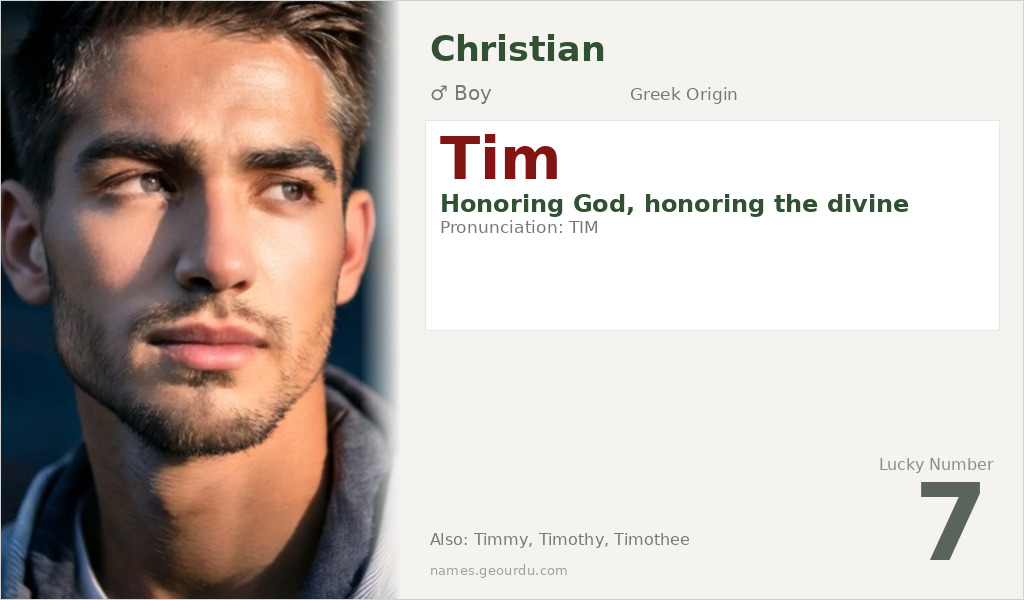
Tim is a classic, enduring name with deep roots in ancient Greek and Christian tradition. As a shortened form of Timothy, it carries the beautiful meaning ‘honoring God’ or ‘one who honors the divine’. This name has maintained popularity across centuries and cultures, appearing in religious texts, literature, and modern celebrity circles. Its simplicity and strong meaning make it a timeless choice for parents seeking a name with spiritual significance.
Meaning of Tim
The name Tim derives from the Greek name Τιμόθεος (Timotheos), which is composed of two elements: τιμάω (timao) meaning ‘to honor, to esteem, to revere’ and θεός (theos) meaning ‘god, deity’. This creates the literal translation ‘honoring God’ or ‘one who honors God’. The name entered Christian tradition through the New Testament, where Timothy was a young disciple and companion of the Apostle Paul. As Christianity spread throughout Europe, the name was adopted in various forms across languages, maintaining its core meaning of divine reverence. In English, Tim emerged as a familiar short form of Timothy during the Middle Ages and became independently established as a given name.
| 📛 Name | Tim |
| 💎 Meaning | Honoring God, honoring the divine |
| 👤 Gender | Boy |
| 🕌 Religion | Christian |
| 🌍 Origin | Greek |
| 🗣 Pronunciation | TIM |
| ✍️ Urdu | ٹم |
| ✍️ Arabic | تيم |
| 🔢 Numerology | 7 |
| ✨ Spellings | Timmy, Timothy, Timothee, Timotheus, Tym |
Origin & Cultural Significance
Tim originates from ancient Greece, specifically from the name Timothy (Timotheos), which was in use during classical times. The name gained significant prominence through early Christianity, as Saint Timothy appears in the New Testament as a companion of Paul the Apostle and recipient of two Pauline epistles. During the Protestant Reformation, biblical names like Timothy (and its short form Tim) experienced renewed popularity in English-speaking countries. The name spread globally through missionary activity and colonial expansion, becoming established in diverse cultures while retaining its Greek-Christian heritage. Today, Tim remains particularly common in English, German, Dutch, and Scandinavian speaking regions.
Personality Traits
Those named Tim are often associated with qualities of reliability, thoughtfulness, and spiritual awareness. The name’s meaning ‘honoring God’ suggests individuals who value integrity, tradition, and meaningful purpose in their lives. They tend to be steady, dependable personalities who approach relationships and responsibilities with sincerity. While personalities vary, the name carries connotations of humility, service, and grounded character.
Similar Names
If you like Tim, consider: Timothy, Theodore, Theophilus, Timon, Titus
Famous People Named Tim
- Tim Berners-Lee — British computer scientist, inventor of the World Wide Web
- Tim Burton — American film director known for gothic fantasy films
- Tim Duncan — American former professional basketball player, NBA champion
- Tim McGraw — American country music singer and actor
- Tim Robbins — American actor, director, and producer, Oscar winner
Frequently Asked Questions About Tim
What does Tim mean?
Tim means 'honoring God' or 'one who honors God'. It comes from the Greek name Timothy (Timotheos), combining 'timao' (to honor) and 'theos' (god).
Is Tim a boy or girl name?
Tim is traditionally and overwhelmingly a masculine name, being the short form of Timothy which has been used for boys since ancient times. While names can evolve, Tim remains primarily a boy's name in all cultures where it's used.
What is the origin of Tim?
Tim originates from ancient Greek, specifically as a shortened form of Timothy (Timotheos). The name gained prominence through early Christianity and spread throughout Europe and eventually globally via missionary and colonial activity.





