Table of Contents
Tista is a beautiful and meaningful name with deep geographical and cultural roots in South Asia. Derived from the majestic Tista River that flows through the Himalayas, this name carries the essence of nature’s purity and persistence. Primarily used as a feminine name in Hindu communities, Tista represents both natural beauty and cultural heritage. Its connection to one of India’s important rivers makes it a name with both literal and symbolic significance.
Meaning of Tista
The name Tista originates from the Sanskrit word ‘Trisrota’, which literally translates to ‘three streams’ or ‘triple current’. This refers to the hydrological characteristics of the Tista River, which has significant confluences in its course through Sikkim and West Bengal. In its journey from Sanskrit to modern usage, ‘Trisrota’ evolved into ‘Tista’ through regional linguistic adaptations in Bengali, Nepali, and other languages of the eastern Himalayan region. As a personal name, Tista carries the metaphorical meaning of flow, continuity, and life-giving properties, much like the river it represents. The name is exclusively geographical in origin rather than having abstract philosophical or religious meanings found in many Sanskrit names.
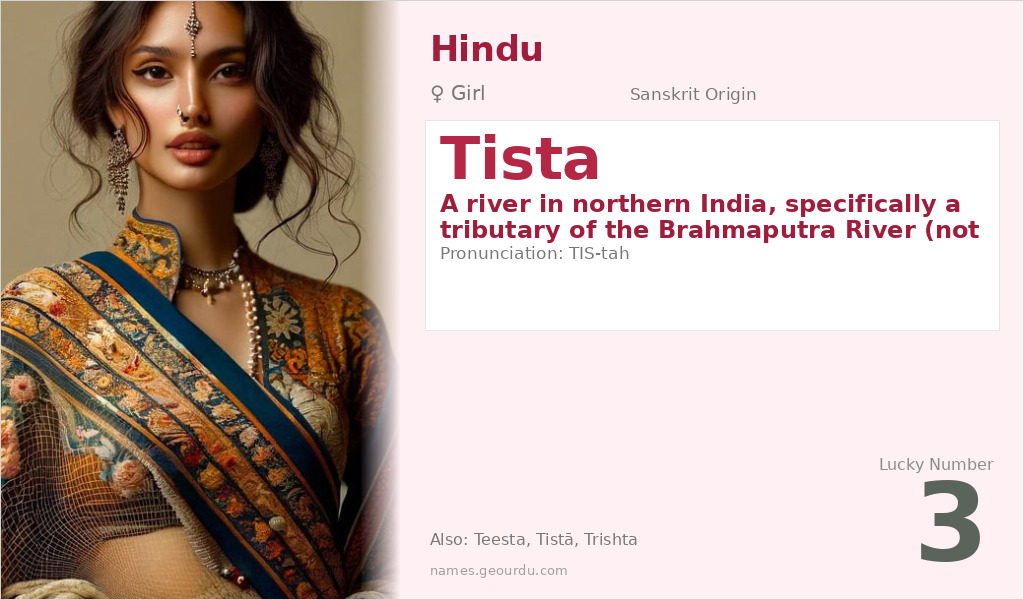
| 📛 Name | Tista |
| 💎 Meaning | A river in northern India, specifically a tributary of the Brahmaputra River (not Ganga) flowing through Sikkim and West Bengal |
| 👤 Gender | Girl |
| 🕌 Religion | Hindu |
| 🌍 Origin | Sanskrit |
| 🗣 Pronunciation | TIS-tah |
| ✍️ Urdu | تیستا |
| ✍️ Arabic | تيستا |
| 🔢 Numerology | 3 |
| ✨ Spellings | Teesta, Tistā, Trishta |
Origin & Cultural Significance
Tista has its origins in the Indian subcontinent, specifically in the regions surrounding the Tista River basin. The river itself flows through the Indian states of Sikkim and West Bengal before entering Bangladesh and joining the Brahmaputra River. Culturally, the name gained popularity as a personal name among Hindu families living in these regions, particularly in West Bengal and Bangladesh, where the river holds economic and cultural significance. Historically, the Tista River has been mentioned in various regional texts and folklore, contributing to its adoption as a personal name. Unlike many Hindu names derived from deities or virtues, Tista represents a geographical feature, making it part of a smaller category of nature-based names in Hindu naming traditions.
Personality Traits
Those named Tista are often perceived as having qualities reminiscent of a river—fluid, adaptable, and life-enhancing. They tend to exhibit natural grace and persistence in pursuing their goals, much like a river that continues its course despite obstacles. The connection to nature inherent in the name often translates to a personality that values harmony, growth, and nurturing relationships with others.
Similar Names
If you like Tista, consider: Ganga, Yamuna, Narmada, Kaveri, Brahmaputra
Famous People Named Tista
- Tista Das — Indian actress known for Bengali television and film roles
- Tista — Character in Indian mythology and literature referencing the river
Frequently Asked Questions About Tista
What does Tista mean?
Tista means 'three streams' in Sanskrit, named after the Tista River that flows through Sikkim, West Bengal, and Bangladesh as a tributary of the Brahmaputra River.
Is Tista a boy or girl name?
Tista is primarily used as a girl's name in Hindu communities, particularly in regions near the Tista River basin in India and Bangladesh.
What is the origin of Tista?
Tista originates from Sanskrit 'Trisrota' and is a geographical name derived from the Tista River in the Himalayan region of South Asia.