
Table of Contents
Trimurti is one of the most fundamental concepts in Hindu theology, representing the cosmic functions of creation, preservation, and destruction through the deities Brahma, Vishnu, and Shiva. While sometimes mistakenly listed as a baby name, it’s important to understand that Trimurti is primarily a philosophical and religious term rather than a traditional given name in Hindu culture. This deep dive explores the true meaning, etymology, and cultural significance of this important Hindu concept. Understanding Trimurti provides insight into core Hindu beliefs about the universe’s cyclical nature.
Meaning of Trimurti
Trimurti derives from the Sanskrit words ‘tri’ (three) and ‘murti’ (form or embodiment), literally meaning ‘three forms’ or ‘triple form’. In Hindu philosophy, it specifically refers to the three main deities who represent different aspects of the Supreme Reality: Brahma as the creator, Vishnu as the preserver, and Shiva as the destroyer/transformer. This concept appears in various Puranic texts and represents the cyclical nature of the universe — creation, maintenance, and dissolution. The Trimurti concept illustrates how these three functions are interconnected and essential to cosmic order. While sometimes compared to the Christian Trinity, the Hindu Trimurti represents functional aspects rather than persons of a single God.
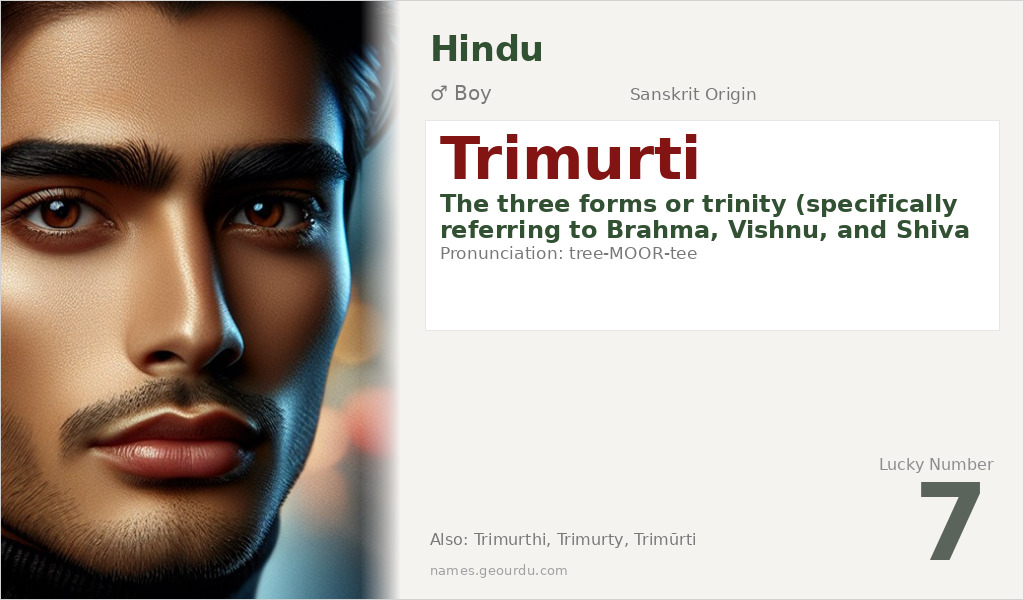
| 📛 Name | Trimurti |
| 💎 Meaning | The three forms or trinity (specifically referring to Brahma, Vishnu, and Shiva in Hinduism) |
| 👤 Gender | Boy |
| 🕌 Religion | Hindu |
| 🌍 Origin | Sanskrit |
| 🗣 Pronunciation | tree-MOOR-tee |
| ✍️ Urdu | تری مورتی |
| ✍️ Arabic | تريمورتي |
| 🔢 Numerology | 7 |
| ✨ Spellings | Trimurthi, Trimurty, Trimūrti |
Origin & Cultural Significance
The Trimurti concept originated in ancient India and is deeply rooted in Sanskrit scriptures and Hindu philosophical traditions. It gained prominence during the Puranic period (approximately 300-1500 CE) as Hindu theology developed more systematic approaches to understanding the divine. The concept appears in texts like the Vishnu Purana and represents an attempt to harmonize different sectarian traditions within Hinduism. While the individual deities (Brahma, Vishnu, Shiva) have ancient origins, their grouping as the Trimurti represents a later theological development. This concept is central to Smarta tradition Hinduism and appears in temple iconography across India and Southeast Asia.
Personality Traits
As Trimurti is a theological concept rather than a traditional personal name, it doesn’t have established personality associations. If used unconventionally as a name today, it might reflect parents’ deep connection to Hindu philosophy or desire to honor the cosmic principles it represents. Such a name could symbolize balance, cyclical thinking, and spiritual depth. However, it’s important to note that in traditional Hindu naming practices, names of individual deities (like Krishna, Shiva, Lakshmi) are common, while theological concepts like Trimurti are not typically used as personal names.
Similar Names
If you like Trimurti, consider: Tridev, Trilok, Trivikram, Trishul, Triveni
Famous People Named Trimurti
- No notable individuals with this as a personal name found — Trimurti is a theological concept, not a traditional given name
Frequently Asked Questions About Trimurti
What does Trimurti mean?
Trimurti means 'three forms' in Sanskrit — specifically referring to the Hindu trinity of Brahma (creator), Vishnu (preserver), and Shiva (destroyer/transformer). It's a theological concept, not traditionally a personal name.
Is Trimurti a boy or girl name?
If used unconventionally as a name, it would typically be masculine as it refers to male deities, but it's primarily a philosophical concept rather than a traditional given name in any gender.
What is the origin of Trimurti?
Trimurti originates from Sanskrit Hindu philosophy and scriptures, specifically from ancient Indian theological developments during the Puranic period that systematized the roles of the three main Hindu deities.





