
Table of Contents
Tripurari is a powerful Sanskrit name steeped in Hindu mythology, carrying the weight of divine victory over evil. As an epithet of Lord Shiva, this name symbolizes the destruction of three demonic cities and the triumph of righteousness. Primarily used for boys in Hindu communities, Tripurari connects the bearer to one of Shiva’s most celebrated mythological achievements. The name’s rich etymology and cultural significance make it a meaningful choice with deep spiritual resonance.
Meaning of Tripurari
Tripurari is a compound Sanskrit name with precise mythological meaning. Breaking down the components: ‘Tripura’ (त्रिपुर) translates to ‘three cities’ or ‘three fortresses,’ referring to the three flying cities built by the demon Maya for the asuras Tarakaksha, Kamalaksha, and Vidyunmali. The suffix ‘ari’ (अरि) means ‘enemy,’ ‘foe,’ or ‘destroyer.’ Thus, Tripurari literally means ‘Destroyer of the three cities’ or ‘Enemy of Tripura.’ This refers specifically to Lord Shiva’s mythological feat of destroying these three demonic cities with a single arrow from his divine bow Pinaka. The name appears in ancient Hindu scriptures including the Shiva Purana and Mahabharata as one of Shiva’s thousand names, celebrating this particular aspect of his divinity.
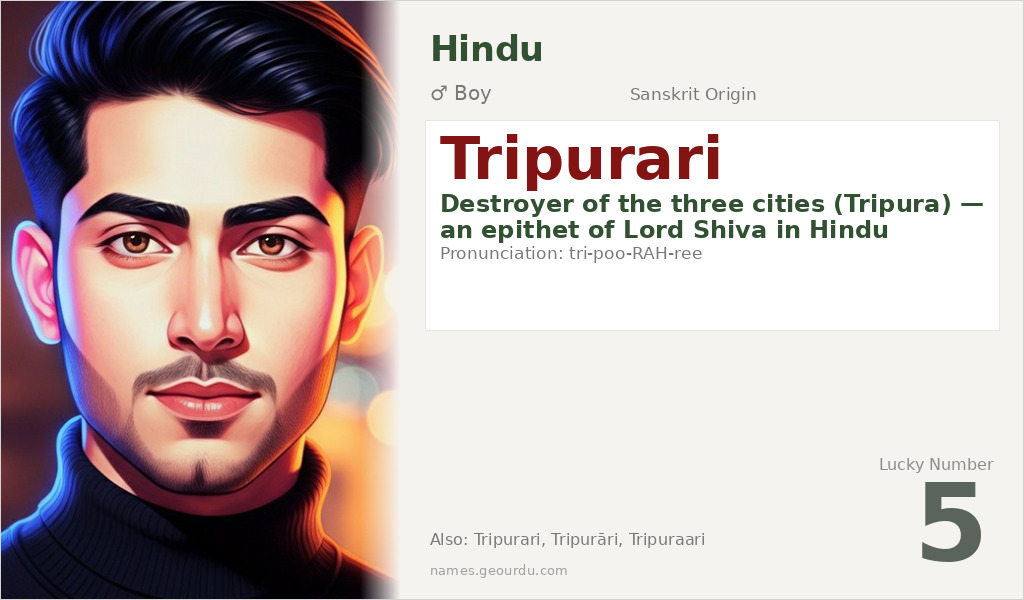
| 📛 Name | Tripurari |
| 💎 Meaning | Destroyer of the three cities (Tripura) — an epithet of Lord Shiva in Hindu mythology |
| 👤 Gender | Boy |
| 🕌 Religion | Hindu |
| 🌍 Origin | Sanskrit |
| 🗣 Pronunciation | tri-poo-RAH-ree |
| ✍️ Urdu | تری پوراری |
| ✍️ Arabic | تريبوراري |
| 🔢 Numerology | 5 |
| ✨ Spellings | Tripurari, Tripurāri, Tripuraari |
Origin & Cultural Significance
Tripurari originates from classical Sanskrit, the liturgical language of Hinduism, and is deeply embedded in Hindu mythology and scriptures. The name first appears in ancient texts like the Mahabharata (circa 400 BCE-400 CE) and various Puranas, particularly the Shiva Purana and Matsya Purana. Culturally, the name references the Tripuravadha (destruction of the three cities) narrative, where Shiva destroys the three flying cities of the asuras that were causing havoc across the three worlds. This mythological event symbolizes the destruction of ignorance, ego, and attachment in Hindu philosophy. The name is used predominantly in Hindu communities across India and the diaspora, particularly among those with Shaivite traditions who worship Shiva as the supreme deity.
Personality Traits
Those named Tripurari are often associated with qualities of strength, determination, and protective energy. The mythological connection suggests a personality capable of overcoming great challenges and destroying obstacles, much like Shiva’s destruction of the three cities. There may be an inclination toward spiritual pursuits or leadership roles, with a natural authority that commands respect. The name carries connotations of transformation and renewal, as Shiva’s destructive aspect ultimately serves creative and purifying purposes in Hindu cosmology.
Similar Names
If you like Tripurari, consider: Tripura, Tripurasundari, Tripurantaka, Shiva, Mahadeva, Rudra
Famous People Named Tripurari
- Tripurari Swami — American Hindu spiritual leader and guru in the Gaudiya Vaishnava tradition
- Tripurari Sharma — Indian theatre director and playwright known for her work in Hindi theatre
Frequently Asked Questions About Tripurari
What does Tripurari mean?
Tripurari means 'Destroyer of the three cities' — a Sanskrit name referring to Lord Shiva's mythological destruction of three demonic flying cities called Tripura.
Is Tripurari a boy or girl name?
Tripurari is exclusively a boy's name in Hindu naming traditions, as it is an epithet of the male deity Lord Shiva and carries masculine grammatical forms in Sanskrit.
What is the origin of Tripurari?
Tripurari originates from Sanskrit, the classical language of Hinduism, and comes from Hindu mythology where it describes Shiva's destruction of three demonic cities, first appearing in ancient texts like the Mahabharata and Puranas.





