
Table of Contents
Tristin is a distinctive boy’s name with roots in medieval romance and Celtic legend. Best known from the tragic love story of Tristan and Isolde in Arthurian tales, this name carries centuries of literary heritage. While it sounds modern, Tristin connects today’s children to ancient stories of chivalry, passion, and destiny. Discover the rich history and meaning behind this evocative name.
Meaning of Tristin
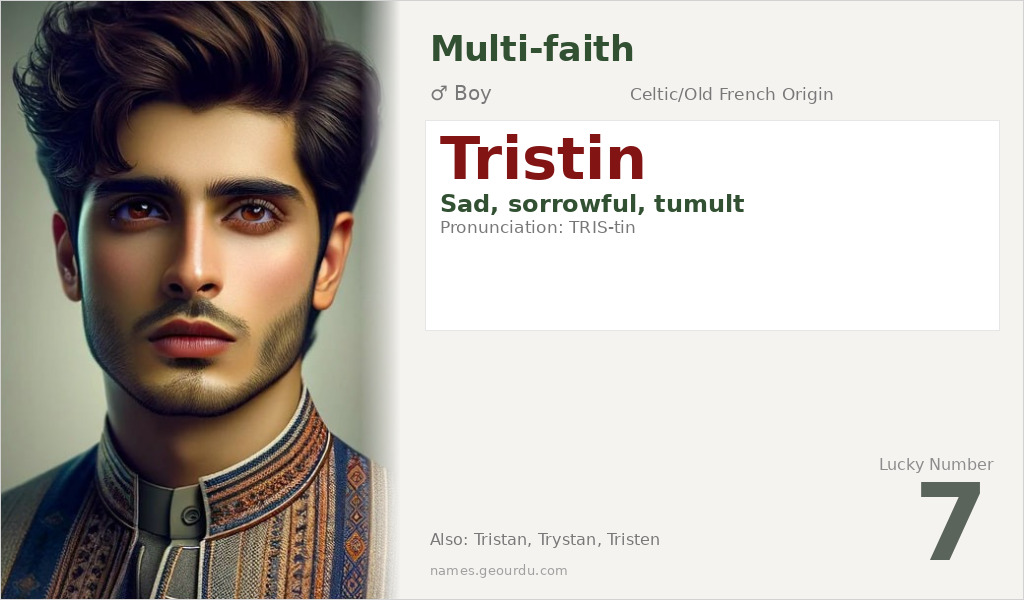
The name Tristin derives from the Old French ‘Tristan’, which originated from the Celtic name ‘Drustan’ or ‘Drystan’. The Celtic root ‘drest’ or ‘drust’ means ‘riot’, ‘tumult’, or ‘noise’, referring to commotion or uproar. However, through the famous medieval romance of Tristan and Isolde, the name became associated with sadness and melancholy, reinforced by the Welsh word ‘trist’ meaning ‘sad’. This dual meaning—both the original Celtic ‘tumult’ and the literary ‘sorrowful’—gives the name its distinctive character. The spelling ‘Tristin’ represents a modern variation of the traditional ‘Tristan’, maintaining the same etymological roots.
| 📛 Name | Tristin |
| 💎 Meaning | Sad, sorrowful, tumult |
| 👤 Gender | Boy |
| 🕌 Religion | Multi-faith |
| 🌍 Origin | Celtic/Old French |
| 🗣 Pronunciation | TRIS-tin |
| ✍️ Urdu | ٹرسٹن |
| ✍️ Arabic | تريستان |
| 🔢 Numerology | 7 |
| ✨ Spellings | Tristan, Trystan, Tristen, Triston, Tristyn |
Origin & Cultural Significance
Tristin originates from Celtic languages, specifically through the name Drustan, which was borne by early Pictish kings in Scotland. The name gained widespread popularity through medieval literature, particularly the 12th-century Arthurian legends where Tristan (Tristram) was a Knight of the Round Table famous for his tragic love affair with Isolde. The story was popularized by poets like Béroul and Thomas of Britain, and later by Richard Wagner’s opera ‘Tristan und Isolde’. While the character exists in Christian Arthurian tradition, the name itself is not exclusively Christian and has been used across cultures. The modern spelling ‘Tristin’ emerged in English-speaking countries as a phonetic variation of the traditional ‘Tristan’.
Personality Traits
Those named Tristin often exhibit qualities of depth, sensitivity, and creativity. Drawing from the name’s association with the legendary Tristan, they may possess a romantic nature and strong sense of loyalty. Their intuitive understanding of emotions can make them empathetic friends and partners, though they might sometimes struggle with melancholy. The name’s literary heritage suggests an appreciation for art, music, and storytelling.
Similar Names
If you like Tristin, consider: Tristram, Christian, Justin, Austin, Dustin
Famous People Named Tristin
- Tristin Mays — American actress known for 'MacGyver' and 'The Vampire Diaries'
- Tristin Rogers — American model and actress
Frequently Asked Questions About Tristin
What does Tristin mean?
Tristin means 'sad', 'sorrowful', or 'tumult'. It comes from Celtic origins through Old French, famously associated with the tragic hero Tristan from Arthurian legend.
Is Tristin a boy or girl name?
Tristin is primarily a boy's name, though the similar spelling 'Tristen' is sometimes used for girls. The traditional form 'Tristan' is overwhelmingly masculine across cultures.
What is the origin of Tristin?
Tristin originates from Celtic languages, specifically from the name Drustan/Drystan, which became Tristan in Old French through Arthurian legends. The modern spelling 'Tristin' is an English phonetic variation.





