
Table of Contents
Tritiya is a meaningful name with deep roots in Hindu tradition and Sanskrit language. Unlike many modern names, Tritiya carries specific calendrical significance, representing the third day of the lunar fortnight. This name connects the bearer to ancient timekeeping systems and religious observances that have been part of Indian culture for millennia. Whether chosen for its numerical symbolism or cultural resonance, Tritiya offers a distinctive choice with historical depth.
Meaning of Tritiya
Tritiya originates from the Sanskrit language, where it literally translates to ‘the third’. The word is composed of the root ‘tri’ (meaning three) combined with the ordinal suffix ‘-tīya’, creating a term that specifically denotes third position in a sequence. In Hindu calendrical systems, Tritiya refers to the third tithi (lunar day) of both the waxing and waning phases of the moon. This term appears in numerous Hindu scriptures including the Vedas, Puranas, and Dharmaśāstras, where specific rituals, fasts, and ceremonies are prescribed for this tithi. The name thus carries both numerical and temporal significance, connecting the bearer to ancient systems of time measurement and religious observance.
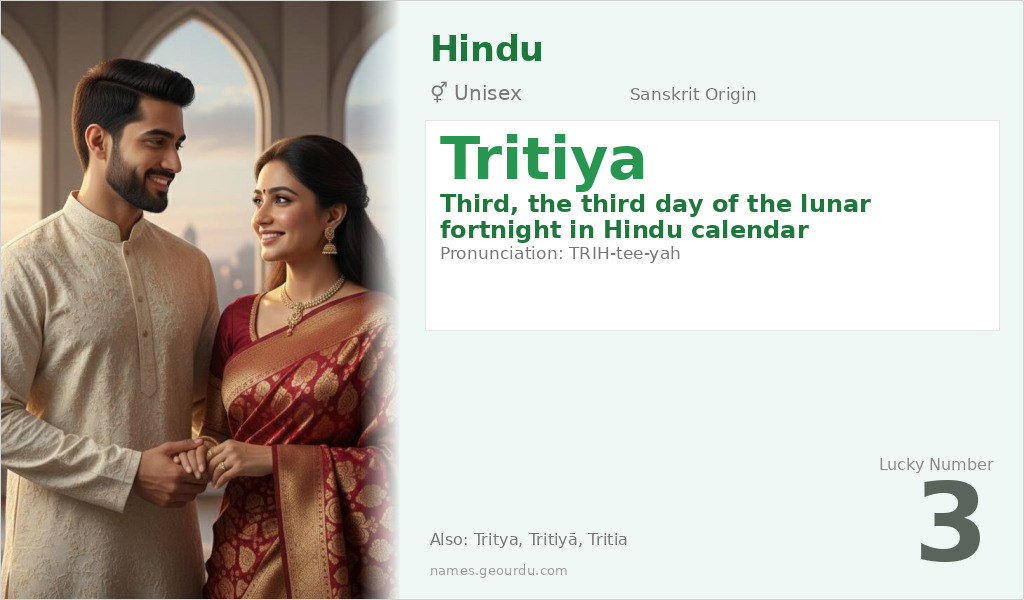
| 📛 Name | Tritiya |
| 💎 Meaning | Third, the third day of the lunar fortnight in Hindu calendar |
| 👤 Gender | Unisex |
| 🕌 Religion | Hindu |
| 🌍 Origin | Sanskrit |
| 🗣 Pronunciation | TRIH-tee-yah |
| ✍️ Urdu | تریتیا |
| ✍️ Arabic | تريتيا |
| 🔢 Numerology | 3 |
| ✨ Spellings | Tritya, Tritiyā, Tritia |
Origin & Cultural Significance
Tritiya has its origins in ancient Sanskrit, the classical language of India that dates back over 3,500 years. As a calendrical term, it has been used in Hindu timekeeping systems since Vedic times, with references found in texts like the Rigveda and later astronomical works. The name reflects the sophisticated lunar calendar system developed in ancient India, where each tithi (lunar day) was named and associated with specific qualities and observances. While primarily used as a calendrical term rather than a personal name historically, in modern times it has been adopted as a given name, particularly in Hindu communities. The name’s connection to the number three also resonates with Hindu philosophical concepts like the Trimurti (Brahma, Vishnu, Shiva) and the three gunas (qualities of nature).
Personality Traits
While personality traits associated with names are largely cultural rather than scientific, names with numerical significance like Tritiya often carry symbolic associations. The connection to the number three suggests qualities of creativity, expression, and social interaction. In various cultural traditions, three represents harmony, completeness (as in beginning-middle-end), and creative expression. Individuals with this name might be perceived as communicative, adaptable, and inclined toward artistic or intellectual pursuits that involve synthesis of different elements.
Similar Names
If you like Tritiya, consider: Traya, Trishna, Triveni, Trilok, Tridev
Famous People Named Tritiya
- No widely known contemporary figures with this given name, but it appears in historical and religious contexts as a tithi name
Frequently Asked Questions About Tritiya
What does Tritiya mean?
Tritiya means 'third' in Sanskrit, specifically referring to the third day of the lunar fortnight in Hindu calendrical systems.
Is Tritiya a boy or girl name?
Tritiya is considered a unisex name in modern usage, though it originates from a gender-neutral Sanskrit term. It can be given to children of any gender.
What is the origin of Tritiya?
Tritiya originates from Sanskrit, the ancient classical language of India, where it has been used for millennia as a calendrical term for the third lunar day in Hindu timekeeping systems.