Table of Contents
Tufaylah is a distinctive Arabic feminine name with deep historical roots in early Islamic society. Unlike many names with abstract meanings, Tufaylah carries a specific historical reference that connects it to the companions of Prophet Muhammad. This name represents a unique blend of personal history and linguistic tradition, offering parents a name with both cultural significance and historical authenticity. While uncommon today, Tufaylah preserves an important link to Islamic heritage.
Meaning of Tufaylah
Tufaylah derives from the Arabic root ‘T-F-L’ (طفل), which fundamentally means ‘child’ or ‘infant’. The feminine suffix ‘-ah’ transforms it into a proper feminine name. Historically, the name is specifically documented as belonging to Tufaylah, the freed slave of Al-Waleed bin Abdullah, who was among the companions of Prophet Muhammad. This makes Tufaylah primarily a historical personal name rather than one with a descriptive abstract meaning. The name’s etymology connects it to concepts of childhood, innocence, and nurturing, though its primary significance lies in its historical reference rather than its literal meaning.
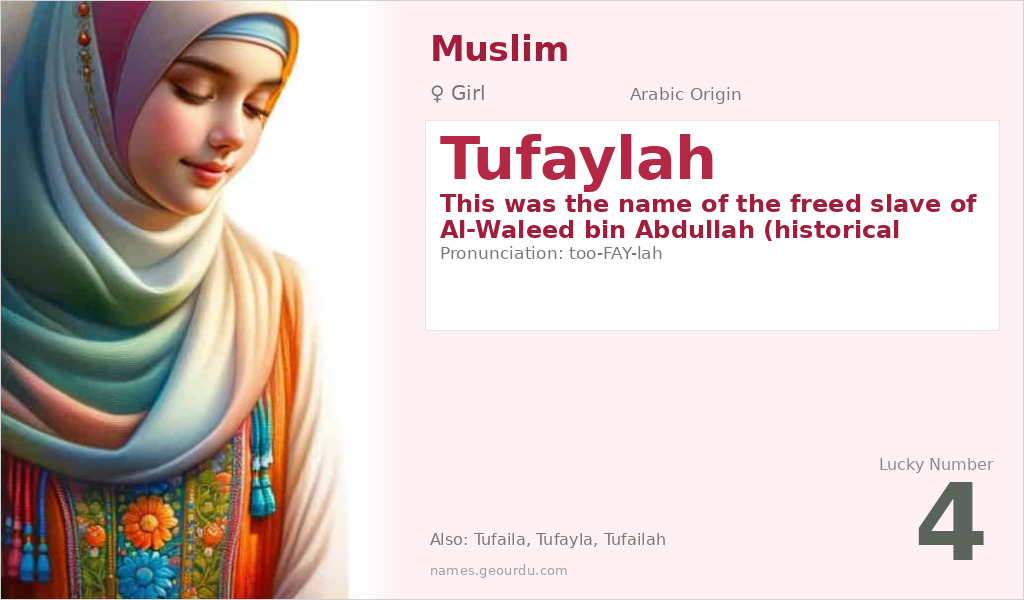
| 📛 Name | Tufaylah |
| 💎 Meaning | This was the name of the freed slave of Al-Waleed bin Abdullah (historical figure reference) |
| 👤 Gender | Girl |
| 🕌 Religion | Muslim |
| 🌍 Origin | Arabic |
| 🗣 Pronunciation | too-FAY-lah |
| ✍️ Urdu | طفیلہ |
| ✍️ Arabic | طفيلة |
| 🔢 Numerology | 4 |
| ✨ Spellings | Tufaila, Tufayla, Tufailah, Tufayla |
Origin & Cultural Significance
Tufaylah originates from classical Arabic and early Islamic history, specifically from the 7th century Arabian Peninsula. The name appears in historical records documenting the companions of Prophet Muhammad and their households. As the name of a freed slave, Tufaylah represents an important aspect of early Islamic society where emancipation was encouraged and former slaves often became respected members of the community. The name’s preservation in historical texts demonstrates how personal names served as markers of social transformation during Islam’s formative period. While the name is rarely used in contemporary times, it remains part of the rich tapestry of Arabic onomastics.
Personality Traits
Those named Tufaylah are often perceived as having protective and nurturing qualities, reflecting the name’s connection to childhood and caregiving. The historical association with emancipation suggests traits of resilience, transformation, and newfound freedom. Individuals with this name may be seen as bridge-builders who honor tradition while embracing progress, much like the historical figure who transitioned from slavery to freedom within early Islamic society.
Similar Names
If you like Tufaylah, consider: Tufail, Tifl, Tifla, Tiflana, Tiflani
Famous People Named Tufaylah
- Tufaylah — Freed slave of Al-Waleed bin Abdullah, mentioned in early Islamic historical records
- No other widely documented famous individuals with this name in modern times
Frequently Asked Questions About Tufaylah
What does Tufaylah mean?
Tufaylah is an Arabic feminine name that historically refers to 'the freed slave of Al-Waleed bin Abdullah'. The name derives from the Arabic root meaning 'child' or 'infant', but its primary significance is as a historical personal name rather than having an abstract meaning.
Is Tufaylah a boy or girl name?
Tufaylah is exclusively a feminine name in Arabic, indicated by the feminine suffix '-ah'. All historical references to this name are for female individuals, particularly the freed slave of Al-Waleed bin Abdullah.
What is the origin of Tufaylah?
Tufaylah originates from classical Arabic and early Islamic history of the 7th century Arabian Peninsula. It is specifically documented in historical records about the companions of Prophet Muhammad and represents an important name from Islam's formative period.