Table of Contents
Tulip is a charming floral name that has gained popularity as a modern choice for baby girls. Unlike traditional names with deep religious roots, Tulip represents the beauty of nature through its connection to the vibrant tulip flower. This name carries a fresh, contemporary feel while drawing from interesting linguistic origins that trace back through Turkish and Persian languages. Parents choosing Tulip often appreciate its botanical elegance and international appeal.
Meaning of Tulip
The name Tulip directly refers to the tulip flower, a spring-blooming perennial that has captivated gardeners and artists for centuries. Linguistically, the word traveled from Persian ‘dulband’ (meaning turban) to Ottoman Turkish ‘tülbend’, then to French ‘tulipe’, before entering English as ‘tulip’. This journey reflects how the flower’s shape was thought to resemble a turban. As a given name, Tulip functions as a botanical name similar to Rose, Lily, or Daisy, representing natural beauty rather than having a symbolic meaning beyond the flower itself. The name evokes images of colorful spring blooms and has been used in English-speaking countries since the 19th century.
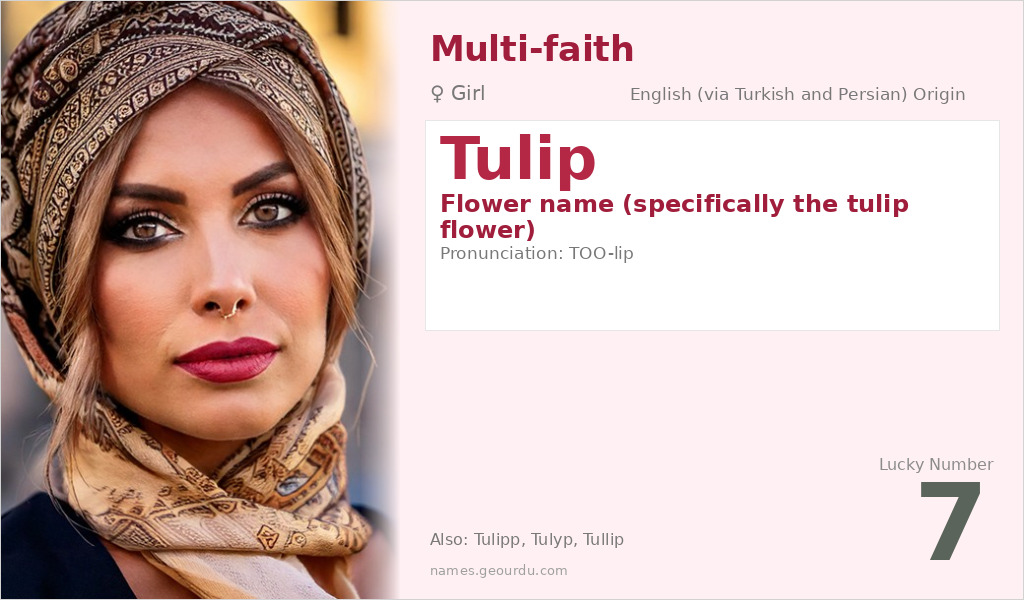
| 📛 Name | Tulip |
| 💎 Meaning | Flower name (specifically the tulip flower) |
| 👤 Gender | Girl |
| 🕌 Religion | Multi-faith |
| 🌍 Origin | English (via Turkish and Persian) |
| 🗣 Pronunciation | TOO-lip |
| ✍️ Urdu | ٹیولپ |
| ✍️ Arabic | توليب |
| 🔢 Numerology | 7 |
| ✨ Spellings | Tulipp, Tulyp, Tullip |
Origin & Cultural Significance
Tulip originated as a modern English given name inspired by the tulip flower, which itself has fascinating historical connections. Tulips were first cultivated in the Ottoman Empire and became immensely popular in the Netherlands during the 17th century ‘Tulip Mania’. The name as a personal choice emerged in English-speaking countries during the Victorian era when flower names became fashionable. Unlike traditional names tied to specific religions or cultures, Tulip is a secular botanical name that can be used by families of any background. Its usage has spread globally along with the popularity of nature-inspired names in recent decades.
Personality Traits
Those named Tulip are often perceived as creative, gentle, and aesthetically inclined individuals. The floral association suggests someone who appreciates beauty in all forms and may have artistic talents. Like the tulip flower that blooms brightly in spring, people with this name might bring freshness and color to their social circles. They tend to be sensitive and intuitive, with a natural grace that draws others to them.
Similar Names
If you like Tulip, consider: Lily, Rose, Daisy, Iris, Violet
Famous People Named Tulip
- Tulip Joshi — Indian actress and model
- Tulip Siddiq — British Labour Party politician
Frequently Asked Questions About Tulip
What does Tulip mean?
Tulip means 'tulip flower.' The name comes from the English word for the flowering plant, which originated from Turkish 'tülbend' and Persian 'dulband,' both meaning 'turban,' due to the flower's shape.
Is Tulip a boy or girl name?
Tulip is primarily used as a girl's name in modern times, following the pattern of floral names being feminine in English-speaking cultures. However, as a botanical term, it could theoretically be used for any gender.
What is the origin of Tulip?
Tulip originated as an English given name inspired by the tulip flower. The word 'tulip' has linguistic roots in Turkish and Persian, but as a personal name, it's a modern English creation without specific cultural or religious ties.