
Table of Contents
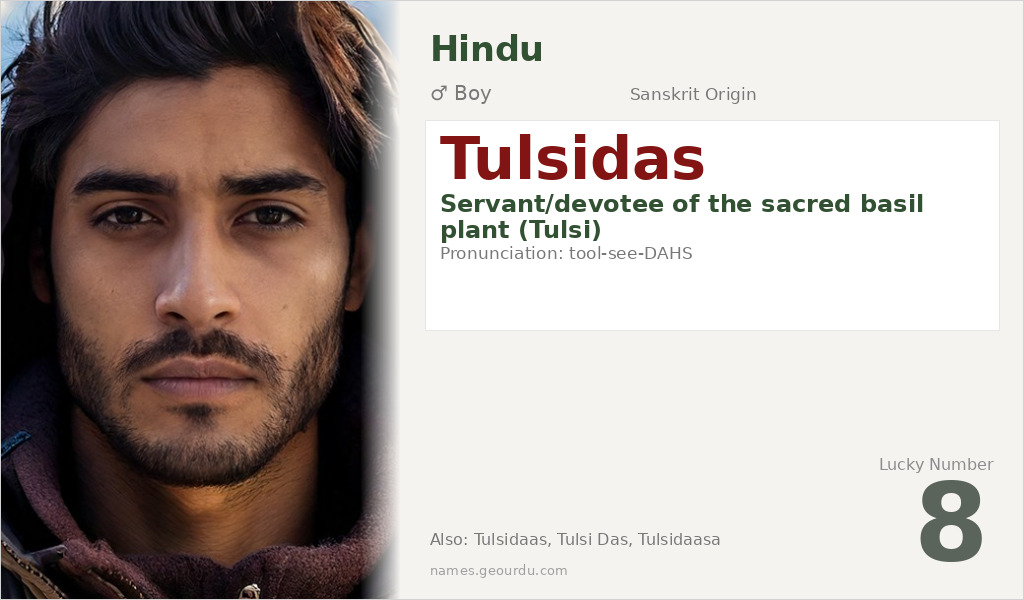
Tulsidas is a profoundly meaningful Hindu boy name with deep roots in Sanskrit language and Hindu spirituality. Most famously borne by the 16th-century poet-saint who authored the beloved Ramcharitmanas, this name carries both linguistic significance and cultural weight. Meaning ‘servant or devotee of the sacred basil plant’, Tulsidas represents devotion to divine principles through nature. This name continues to inspire parents seeking a name with spiritual depth and historical resonance.
Meaning of Tulsidas
Tulsidas derives from classical Sanskrit, combining ‘Tulsi’ (तुलसी), referring to the sacred basil plant (Ocimum tenuiflorum), with ‘das’ (दास), meaning ‘servant’, ‘slave’, or ‘devotee’. The sacred Tulsi plant holds immense religious significance in Hinduism, believed to be an earthly manifestation of the goddess Lakshmi and closely associated with Lord Vishnu. Thus, the name Tulsidas literally translates to ‘servant of Tulsi’ or ‘devotee of the sacred basil’, implying devotion to Vishnu/Lakshmi through this holy plant. The ‘das’ suffix appears in many Indian names (like Ramdas, Krishnadas) indicating servitude or devotion to a deity. This compound construction follows standard Sanskrit naming patterns where the first element identifies the object of devotion and the second indicates the devotee relationship.
| 📛 Name | Tulsidas |
| 💎 Meaning | Servant/devotee of the sacred basil plant (Tulsi) |
| 👤 Gender | Boy |
| 🕌 Religion | Hindu |
| 🌍 Origin | Sanskrit |
| 🗣 Pronunciation | tool-see-DAHS |
| ✍️ Urdu | تلسی داس |
| ✍️ Arabic | تولسيداس |
| 🔢 Numerology | 8 |
| ✨ Spellings | Tulsidaas, Tulsi Das, Tulsidaasa |
Origin & Cultural Significance
Tulsidas originates from Sanskrit, the classical language of ancient India and the primary liturgical language of Hinduism. While the name existed before the 16th century, it gained widespread recognition and popularity through Goswami Tulsidas (1532-1623), the celebrated poet-saint who composed the Ramcharitmanas—an Awadhi retelling of the Ramayana that made the epic accessible to the masses. The name reflects the Hindu tradition of naming children after virtues, deities, or spiritual concepts, particularly those ending in ‘-das’ indicating devotion. Culturally, the name is predominantly used in Hindu communities across North India, especially in Uttar Pradesh, Bihar, and surrounding regions where Tulsidas’s literary works are most revered. The name’s association with the famous saint has made it particularly significant in Hindu naming traditions.
Personality Traits
Those named Tulsidas are often associated with qualities of devotion, spirituality, and literary or philosophical inclination, reflecting the legacy of the famous saint. They may exhibit disciplined character, strong moral principles, and a deep connection to cultural and religious traditions. The name suggests someone who values service, humility before the divine, and possibly creative expression through writing or religious discourse.
Similar Names
If you like Tulsidas, consider: Tulsiram, Tulsinath, Tulsibai, Tulsikumar, Tulsipriya
Famous People Named Tulsidas
- Goswami Tulsidas (1532-1623) — Renowned Hindu poet-saint, author of Ramcharitmanas and Hanuman Chalisa, considered an incarnation of Valmiki
- Tulsidas Borkar (1934-2018) — Indian classical harmonium player and vocalist from the Gwalior gharana
Frequently Asked Questions About Tulsidas
What does Tulsidas mean?
Tulsidas means 'servant or devotee of the sacred basil plant (Tulsi)' in Sanskrit. It combines 'Tulsi' (sacred basil) with 'das' (servant/devotee).
Is Tulsidas a boy or girl name?
Tulsidas is exclusively a boy's name in Hindu naming traditions, following the masculine Sanskrit suffix '-das' and being historically borne by male figures.
What is the origin of Tulsidas?
Tulsidas originates from Sanskrit, the classical language of ancient India. It is a compound name meaning 'servant of Tulsi' and is most famous as the name of the 16th-century Hindu poet-saint who wrote Ramcharitmanas.





