
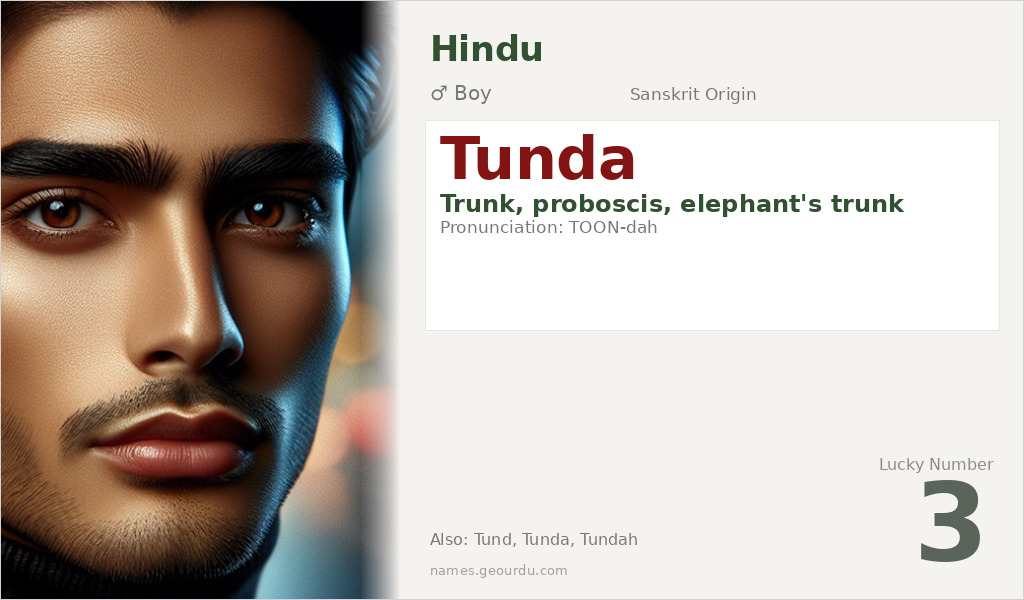
Table of Contents
Tunda is a distinctive Sanskrit name with deep roots in Hindu tradition. Primarily used for boys, it carries the literal meaning of ‘trunk’ or ‘elephant’s trunk’, making it a symbolic choice connected to wisdom and strength. This name is often linked to Lord Ganesha, the remover of obstacles, rather than Lord Shiva as sometimes mistakenly thought. Explore the rich etymology and cultural context of Tunda in this comprehensive guide.
Meaning of Tunda
Tunda derives from the Sanskrit word ‘तुण्ड’ (tunda), which specifically means ‘trunk’, ‘proboscis’, or ‘elephant’s trunk’. The term is linguistically connected to the Sanskrit root ‘tund’, meaning ‘to strike’ or ‘to push’, reflecting the trunk’s functional use. In Hindu mythology, it’s commonly used as an epithet for Ganesha, who is depicted with an elephant head and trunk, symbolizing wisdom, strength, and the ability to overcome obstacles. The name appears in classical texts like the Puranas and is not directly associated with Lord Shiva, though both are revered deities in Hinduism. Its meaning is well-documented in Sanskrit dictionaries and etymological sources, making it a name with clear linguistic heritage.
| 📛 Name | Tunda |
| 💎 Meaning | Trunk, proboscis, elephant's trunk |
| 👤 Gender | Boy |
| 🕌 Religion | Hindu |
| 🌍 Origin | Sanskrit |
| 🗣 Pronunciation | TOON-dah |
| ✍️ Urdu | ٹنڈا |
| ✍️ Arabic | توندا |
| 🔢 Numerology | 3 |
| ✨ Spellings | Tund, Tunda, Tundah |
Origin & Cultural Significance
Tunda originates from Sanskrit, an ancient Indo-Aryan language and the liturgical language of Hinduism. It has been used in India for centuries, particularly in Hindu communities, where names with natural or divine associations are common. The name is deeply embedded in Hindu iconography, often referencing Ganesha’s elephant trunk, which symbolizes intelligence, adaptability, and removal of barriers. While it may appear in regional variations or folklore, its primary cultural and linguistic roots are firmly in Sanskrit tradition. It is not commonly found in other major language families like Arabic, Persian, or Germanic, remaining specific to Indic contexts.
Personality Traits
People named Tunda are often perceived as resilient, intelligent, and compassionate, mirroring the symbolic traits of the elephant trunk in Hindu culture. They may exhibit strong problem-solving skills and a calm, nurturing demeanor, with an ability to adapt to challenges gracefully. This name suggests a personality that balances strength with gentleness, making individuals with this name respected and admired in their communities.
Similar Names
If you like Tunda, consider: Ganesha, Gajanan, Vighnaharta, Vinayak, Tundikesh
Famous People Named Tunda
- Tunda — a character in Hindu mythology, often an epithet for Ganesha meaning 'one with a trunk'
- Tunda — appears in some regional Indian folklore and texts as a name or descriptor
Frequently Asked Questions About Tunda
What does Tunda mean?
Tunda means 'trunk', 'proboscis', or specifically 'elephant's trunk' in Sanskrit, often associated with the Hindu deity Ganesha.
Is Tunda a boy or girl name?
Tunda is traditionally a boy name in Hindu culture, derived from Sanskrit and used primarily for males.
What is the origin of Tunda?
Tunda originates from Sanskrit, an ancient Indian language, and is deeply rooted in Hindu mythology and tradition.





