
Table of Contents
Tunga is a distinctive name rooted in ancient Sanskrit, evoking images of flowing rivers and lofty heights. Commonly given to boys in Hindu communities, it carries deep cultural and geographical significance, particularly in India. This name blends natural beauty with symbolic strength, making it a meaningful choice for parents seeking a name with historical resonance. Explore the rich layers of Tunga’s meaning and origin in this detailed guide.
Meaning of Tunga
Tunga derives from the Sanskrit word meaning ‘river’ or ‘stream,’ specifically referencing the Tunga River in Karnataka, a vital tributary of the Tungabhadra. The Sanskrit root ‘tung’ also conveys ‘high’ or ‘tall,’ leading to secondary interpretations like ‘prominent’ or ‘elevated.’ In Dravidian languages such as Kannada and Telugu, Tunga similarly denotes water bodies, emphasizing its linguistic spread across South India. This dual meaning reflects both natural elements and aspirational qualities, rooted in ancient texts and regional geography. The name’s etymology highlights its connection to Hindu mythology and Indian landscapes, where rivers are revered as sacred. Overall, Tunga embodies fluidity and stature, making it a name rich in symbolic depth.
| 📛 Name | Tunga |
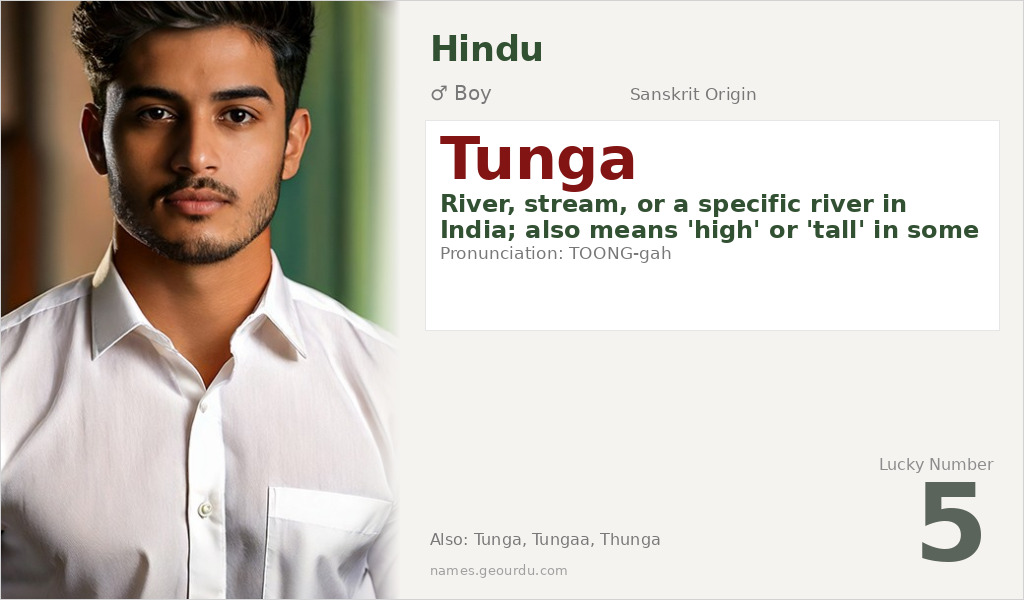
| 💎 Meaning | River, stream, or a specific river in India; also means 'high' or 'tall' in some contexts |
| 👤 Gender | Boy |
| 🕌 Religion | Hindu |
| 🌍 Origin | Sanskrit |
| 🗣 Pronunciation | TOONG-gah |
| ✍️ Urdu | ٹنگا |
| ✍️ Arabic | تونغا |
| 🔢 Numerology | 5 |
| ✨ Spellings | Tunga, Tungaa, Thunga |
Origin & Cultural Significance
Originating from Sanskrit, Tunga has strong ties to Hindu culture and Indian geography, particularly in the states of Karnataka and Andhra Pradesh. It is historically linked to the Tunga River, mentioned in regional lore and Hindu scriptures as a life-giving water source. The name’s usage extends beyond Sanskrit to Dravidian languages, where it maintains similar meanings, showcasing its cross-cultural adoption in South India. In Hindu tradition, names derived from natural features like rivers are considered auspicious, symbolizing purity and continuity. Today, Tunga remains popular among Hindu families, often chosen for its melodic sound and profound connections to heritage and nature.
Personality Traits
People named Tunga are often perceived as adaptable and resilient, mirroring the steady flow of a river. They may exhibit natural leadership and a pioneering spirit, driven by the name’s connotations of height and prominence. With a numerology number of 5, they tend to be energetic, curious, and versatile, embracing change and new experiences with ease. This combination of traits makes Tunga a name associated with dynamic and influential personalities.
Similar Names
If you like Tunga, consider: Tungabhadra, Ganga, Yamuna, Nadi, Sindhu
Famous People Named Tunga
- Tunga — A famous Indian contemporary artist known for sculptures and installations, born Antônio José de Barros Carvalho e Mello Mourão (1952–2016)
- Tunga — A village and river in Karnataka, India, historically significant in Hindu mythology and geography
Frequently Asked Questions About Tunga
What does Tunga mean?
Tunga primarily means 'river' or 'stream' in Sanskrit, with secondary meanings of 'high' or 'tall,' derived from the root 'tung.'
Is Tunga a boy or girl name?
Tunga is traditionally a boy's name in Hindu culture, though it can be unisex in some modern contexts, but male usage is predominant.
What is the origin of Tunga?
Tunga originates from Sanskrit, with strong connections to Hindu culture and Indian geography, specifically the Tunga River in Karnataka.





