
Table of Contents
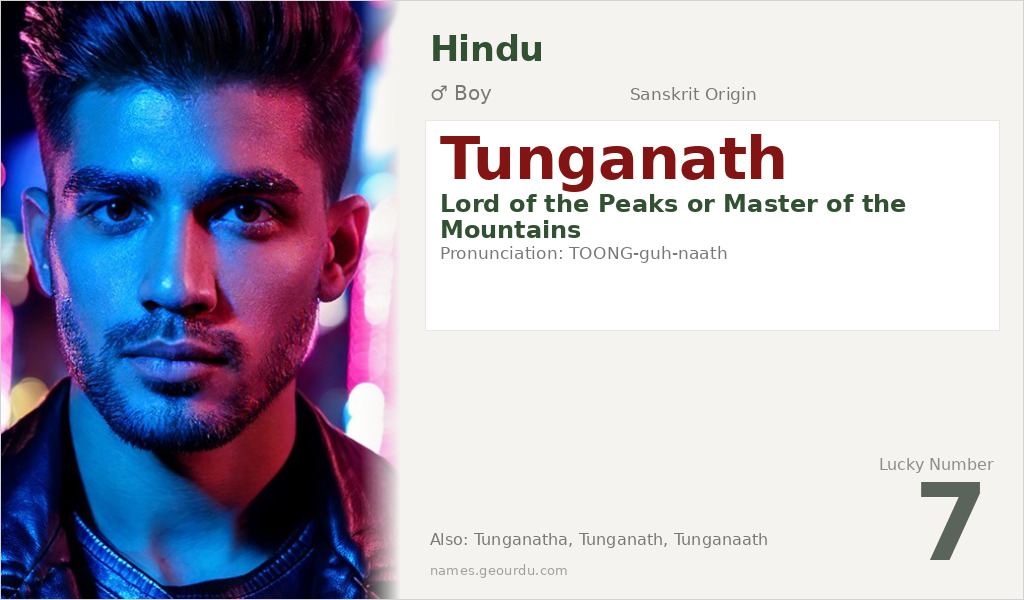
Tunganath is a powerful and ancient Sanskrit name that carries the majestic meaning ‘Lord of the Peaks’ or ‘Master of the Mountains’. Primarily used in Hindu communities, this name evokes imagery of strength, elevation, and spiritual authority. With deep roots in Indian culture and religious tradition, Tunganath connects bearers to Himalayan heritage and divine protection. This name is both historically significant and phonetically distinctive.
Meaning of Tunganath
Tunganath derives from classical Sanskrit, combining ‘Tunga’ (तुङ्ग) meaning ‘high, lofty, elevated, or peak’ and ‘Nath’ (नाथ) meaning ‘lord, master, or protector’. The word ‘Tunga’ originates from the Sanskrit verbal root √tuj, which conveys upward motion and height, appearing in texts like the Mahabharata to describe mountainous regions. ‘Nath’ comes from √nāth, meaning to protect or rule, commonly used in titles for deities and spiritual leaders. Together, they form a compound that specifically denotes sovereignty over high mountainous terrain rather than general hills. This precise linguistic construction reflects the importance of mountains in Hindu cosmology as abodes of gods.
| 📛 Name | Tunganath |
| 💎 Meaning | Lord of the Peaks or Master of the Mountains |
| 👤 Gender | Boy |
| 🕌 Religion | Hindu |
| 🌍 Origin | Sanskrit |
| 🗣 Pronunciation | TOONG-guh-naath |
| ✍️ Urdu | تنگ ناتھ |
| ✍️ Arabic | تونغانات |
| 🔢 Numerology | 7 |
| ✨ Spellings | Tunganatha, Tunganath, Tunganaath |
Origin & Cultural Significance
Tunganath originates from Sanskrit, the ancient liturgical language of Hinduism, with its earliest usage traceable to Indian religious and geographical contexts. The name is most famously associated with the Tunganath Temple in the Garhwal Himalayas, one of the Panch Kedar pilgrimage sites dedicated to Lord Shiva. This temple, situated at 3,680 meters, gives the name particular cultural resonance in Uttarakhand and surrounding regions. While primarily a given name today, Tunganath also functions as an epithet for Shiva in his mountain-dwelling form, connecting the name to specific Hindu theological traditions.
Personality Traits
Those named Tunganath are often associated with qualities of strength, resilience, and spiritual depth. The name’s mountainous connotations suggest someone who is stable yet aspirational, with natural leadership abilities. In cultural perception, they may be seen as protectors who value tradition while reaching for high goals, embodying both earthly groundedness and spiritual elevation.
Similar Names
If you like Tunganath, consider: Girish, Parvatnath, Shailesh, Himanshu, Adrinath
Famous People Named Tunganath
- Tunganath Temple — Ancient Himalayan temple dedicated to Lord Shiva, one of the Panch Kedar pilgrimage sites in Uttarakhand, India
- Tunganath Mahadev — The deity form of Shiva worshipped at the Tunganath temple, considered the highest Shiva temple in the world at 3,680 meters
Frequently Asked Questions About Tunganath
What does Tunganath mean?
Tunganath means 'Lord of the Peaks' or 'Master of the Mountains', derived from Sanskrit 'Tunga' (high/lofty) + 'Nath' (lord/protector).
Is Tunganath a boy or girl name?
Tunganath is exclusively a masculine name in Hindu naming tradition, with no documented usage as a feminine name.
What is the origin of Tunganath?
Tunganath originates from Sanskrit, the classical language of Hinduism, with specific cultural connections to Himalayan regions and Shiva worship in India.





