Table of Contents
Udayagiri is a profound Sanskrit name that beautifully combines natural imagery with spiritual symbolism. Meaning ‘Mountain of Sunrise’ or ‘Mountain of Dawn’, this name evokes both earthly stability and celestial illumination. While not commonly used as a personal name today, Udayagiri holds significant historical and religious importance in Hindu and Jain traditions. Its legacy continues through ancient cave complexes and temples that bear this evocative name.
Meaning of Udayagiri
Udayagiri derives from classical Sanskrit, combining ‘Udaya’ (उदय) meaning ‘sunrise’, ‘dawn’, or ‘ascent’ with ‘Giri’ (गिरि) meaning ‘mountain’, ‘hill’, or ‘peak’. The compound creates a powerful metaphor of a mountain that greets the first light of day, symbolizing enlightenment, new beginnings, and spiritual awakening. In Vedic literature, mountains are often seen as abodes of gods and sites of meditation, while sunrise represents knowledge dispelling ignorance. The name appears in ancient Indian texts and inscriptions, particularly associated with sacred sites where sunrise observations were ritually significant. Linguistically, both components are well-documented in Sanskrit dictionaries with clear etymological roots.
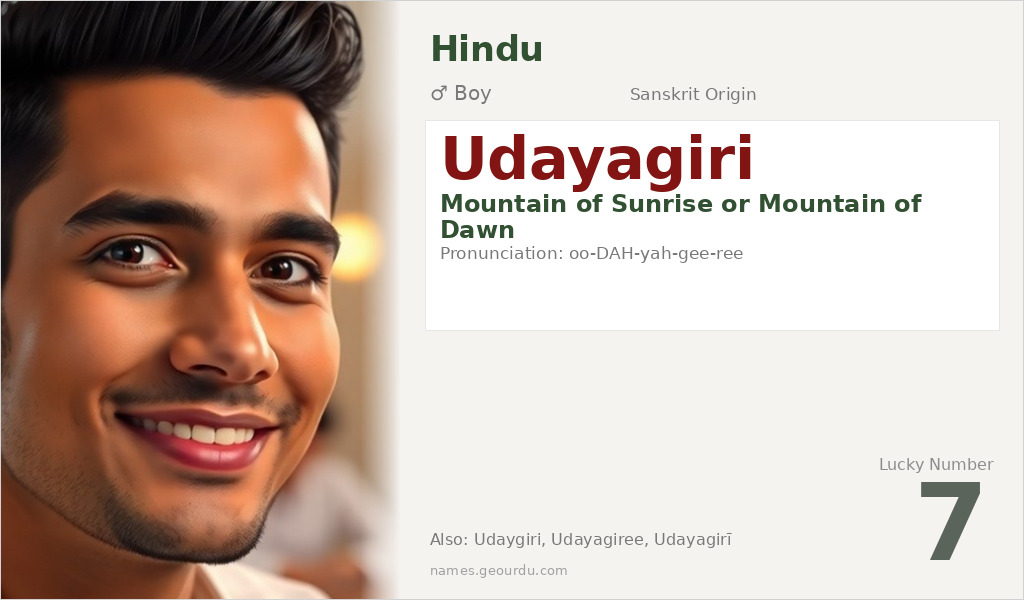
| 📛 Name | Udayagiri |
| 💎 Meaning | Mountain of Sunrise or Mountain of Dawn |
| 👤 Gender | Boy |
| 🕌 Religion | Hindu |
| 🌍 Origin | Sanskrit |
| 🗣 Pronunciation | oo-DAH-yah-gee-ree |
| ✍️ Urdu | اُدے گری |
| ✍️ Arabic | أوداياجيري |
| 🔢 Numerology | 7 |
| ✨ Spellings | Udaygiri, Udayagiree, Udayagirī |
Origin & Cultural Significance
Udayagiri originates from Sanskrit, the classical language of ancient India, and is deeply embedded in Hindu and Jain religious geography. The name is most famously associated with the Udayagiri Caves in Madhya Pradesh, a 4th-5th century CE complex with Hindu sculptures and inscriptions from the Gupta period. Another significant site is Udayagiri in Odisha, containing Buddhist, Jain, and Hindu monuments dating from the 1st century BCE. These locations were strategically oriented to capture sunrise phenomena, reflecting the name’s literal meaning. While occasionally used as a personal name, Udayagiri remains primarily a geographical and historical designation rather than a common given name in contemporary Hindu practice. Its usage reflects India’s tradition of naming places after natural and spiritual concepts.
Personality Traits
The name Udayagiri suggests a personality that balances steadfastness with illumination. Like a mountain that stands firm through time, individuals with this name may exhibit reliability, strength, and deep roots in tradition. Simultaneously, the sunrise element implies optimism, spiritual seeking, and the ability to inspire new beginnings in themselves and others. This combination often points toward leadership with wisdom, someone who provides stability while guiding toward enlightenment. The name carries an inherent connection to nature and spirituality that might influence one’s worldview.
Similar Names
If you like Udayagiri, consider: Uday, Udayan, Girish, Arunagiri, Himagiri, Arunodaya, Udayachal, Girindra, Udaybhanu, Udayaditya
Famous People Named Udayagiri
- Udayagiri Madhavacharya — 16th century Hindu philosopher and commentator from Karnataka
- Udayagiri — Historical site in Odisha with Buddhist, Jain, and Hindu monuments dating from 1st century BCE
Frequently Asked Questions About Udayagiri
What does Udayagiri mean?
Udayagiri means 'Mountain of Sunrise' or 'Mountain of Dawn' in Sanskrit, combining 'Udaya' (sunrise) and 'Giri' (mountain).
Is Udayagiri a boy or girl name?
Udayagiri is traditionally a masculine name in Hindu culture, though as a geographical name it is gender-neutral. The historical and religious associations are primarily masculine.
What is the origin of Udayagiri?
Udayagiri originates from Sanskrit, the classical language of ancient India, and is most famously associated with historical cave complexes in Madhya Pradesh and Odisha that bear this name.