Table of Contents
Umasankari is a beautiful and meaningful Hindu girl name with deep roots in Sanskrit mythology. This name directly references one of Hinduism’s most revered goddesses, Parvati, the divine consort of Lord Shiva. Choosing Umasankari connects a child to centuries of spiritual tradition and feminine divinity. In this guide, we explore the rich etymology, cultural context, and modern relevance of this distinctive name.
Meaning of Umasankari
Umasankari is a compound Sanskrit name with clear etymological components. ‘Uma’ is a classic name for Goddess Parvati, derived from the Sanskrit root meaning ‘light’, ‘splendor’, or ‘tranquility’—qualities associated with the goddess. ‘Sankari’ comes from ‘Sankara’, an epithet of Lord Shiva meaning ‘the auspicious one’ or ‘beneficent’. When combined, Umasankari literally means ‘the consort of Sankara’ or ‘Goddess Parvati as Shiva’s wife’. This name appears in Hindu scriptures and devotional literature as a respectful title for Parvati, emphasizing her inseparable connection to Shiva in the divine partnership that represents cosmic balance.
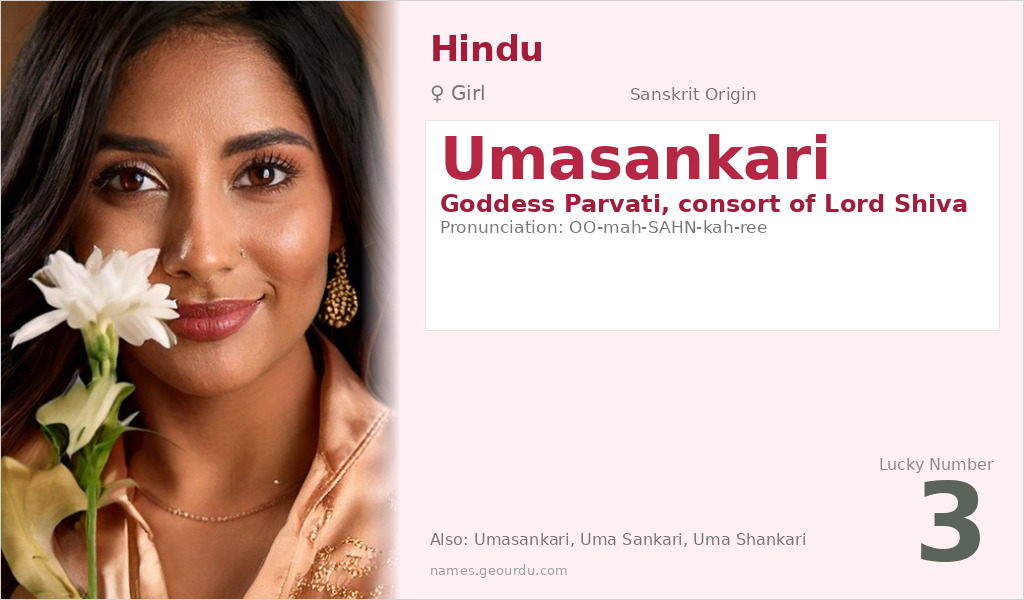
| 📛 Name | Umasankari |
| 💎 Meaning | Goddess Parvati, consort of Lord Shiva |
| 👤 Gender | Girl |
| 🕌 Religion | Hindu |
| 🌍 Origin | Sanskrit |
| 🗣 Pronunciation | OO-mah-SAHN-kah-ree |
| ✍️ Urdu | اوماسنکاری |
| ✍️ Arabic | أوماسانكاري |
| 🔢 Numerology | 3 |
| ✨ Spellings | Umasankari, Uma Sankari, Uma Shankari |
Origin & Cultural Significance
Umasankari originates from classical Sanskrit, the ancient liturgical language of Hinduism. As a theophoric name (derived from deities), it belongs to the rich tradition of Hindu naming where children are named after divine figures to invoke blessings and virtues. The name is particularly popular in South Indian Hindu communities, where Sanskrit-derived names are common, though it appears across the Indian subcontinent. Historically, such names were chosen during religious ceremonies, often based on family deities (kuladevata) or astrological considerations. Umasankari reflects the enduring cultural practice of honoring Goddess Parvati, who symbolizes power, devotion, and maternal grace in Hindu tradition.
Personality Traits
Names like Umasankari, connected to Goddess Parvati, are often believed to influence personality traits associated with the deity. Those named Umasankari may be perceived as compassionate, resilient, and spiritually inclined, mirroring Parvati’s roles as a nurturing mother and powerful goddess. The name suggests a balance of strength and gentleness, with potential for creative expression and deep emotional connections. In cultural contexts, such names inspire values of devotion, family harmony, and inner strength.
Similar Names
If you like Umasankari, consider: Uma, Parvati, Shankari, Gauri, Durga
Famous People Named Umasankari
- No widely known contemporary public figures with this name found in research. It appears primarily in religious and mythological contexts as an epithet for Goddess Parvati.
Frequently Asked Questions About Umasankari
What does Umasankari mean?
Umasankari means 'Goddess Parvati, consort of Lord Shiva' in Sanskrit. It combines 'Uma' (a name for Parvati) and 'Sankari' (feminine form of Sankara, Shiva's epithet).
Is Umasankari a boy or girl name?
Umasankari is exclusively a girl's name in Hindu tradition, as it refers to the feminine goddess Parvati. The '-i' suffix in Sankari is feminine in Sanskrit grammar.
What is the origin of Umasankari?
Umasankari originates from Sanskrit, the classical language of Hinduism. It is a compound name derived from Hindu mythology, specifically referencing Goddess Parvati as the consort of Lord Shiva.