
Table of Contents
Umberto is a distinguished Italian name with royal heritage and literary prestige. Derived from ancient Germanic roots meaning ‘renowned warrior’, this name has graced kings, scholars, and artists throughout history. Its sophisticated sound and rich historical associations make it a timeless choice that bridges medieval tradition with modern elegance. From the House of Savoy to contemporary intellectuals, Umberto carries an air of nobility and intellect.
Meaning of Umberto
The name Umberto originates from the Germanic name Humbert, composed of two Old High German elements: ‘hun’ meaning ‘warrior’ or sometimes interpreted as ‘bear cub’, and ‘beraht’ meaning ‘bright, famous, or shining’. This combination creates the meaning ‘renowned warrior’ or ‘famous brightness’. The name entered Italian culture through the Lombards, a Germanic tribe that established a kingdom in Italy during the 6th century. As the name Italianized, it evolved from Humbert to Umberto, maintaining its core meaning while adapting to Romance language phonetics. The ‘bright’ component suggests not just physical light but also intellectual or spiritual illumination, giving the name layers of significance beyond mere martial prowess.
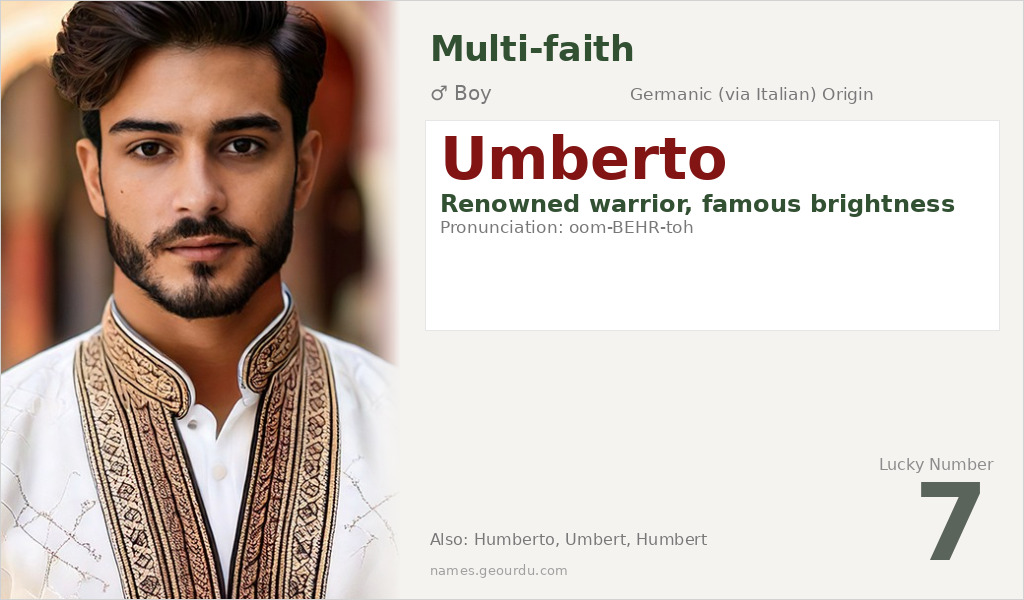
| 📛 Name | Umberto |
| 💎 Meaning | Renowned warrior, famous brightness |
| 👤 Gender | Boy |
| 🕌 Religion | Multi-faith |
| 🌍 Origin | Germanic (via Italian) |
| 🗣 Pronunciation | oom-BEHR-toh |
| ✍️ Urdu | امبرٹو |
| ✍️ Arabic | أومبيرتو |
| 🔢 Numerology | 7 |
| ✨ Spellings | Humberto, Umbert, Humbert |
Origin & Cultural Significance
Umberto has its roots in Germanic tribal names that spread throughout Europe during the Migration Period. It became particularly established in Italy through Lombard influence and was notably adopted by the House of Savoy, the royal family that unified Italy in the 19th century. Two Italian kings bore this name: Umberto I (reigned 1878-1900) and Umberto II (the last king, reigning briefly in 1946). The name’s royal associations gave it prestige throughout Italian-speaking regions. Beyond royalty, the name gained intellectual cachet through figures like Umberto Eco, the renowned semiotician and novelist. Today, while most common in Italy, the name appears in various forms across Europe and the Americas.
Personality Traits
Those named Umberto are often associated with qualities of leadership, intelligence, and depth. The name’s meaning suggests someone who combines strength of character with intellectual brightness. Historically, Umbertos have been rulers, thinkers, and creators, from kings to novelists. The name carries an expectation of sophistication and capability, with a touch of aristocratic bearing that doesn’t preclude approachability or creativity.
Similar Names
If you like Umberto, consider: Alberto, Roberto, Gilberto, Norberto, Hubert
Famous People Named Umberto
- Umberto Eco — Italian novelist and philosopher, author of 'The Name of the Rose'
- Umberto I of Italy — King of Italy from 1878 until his assassination in 1900
- Umberto II of Italy — Last King of Italy, reigning for 34 days in 1946
Frequently Asked Questions About Umberto
What does Umberto mean?
Umberto means 'renowned warrior' or 'famous brightness', derived from the Germanic elements 'hun' (warrior) and 'beraht' (bright, famous). It's the Italian form of the name Humbert.
Is Umberto a boy or girl name?
Umberto is exclusively a masculine name in Italian and other cultures where it's used. There is no feminine equivalent in common usage.
What is the origin of Umberto?
Umberto originates from Germanic (Old High German) roots, specifically the name Humbert. It entered Italian through Lombard influence during the early Middle Ages and became particularly associated with Italian royalty.





