Table of Contents
Umm Hamdi is a beautiful Arabic name with deep cultural and religious significance in Muslim communities. Unlike typical given names, it follows the traditional kunya pattern where a woman is honored through her connection to her child. This name carries centuries of Islamic heritage and reflects the importance of family relationships in Arab naming traditions. Understanding Umm Hamdi requires exploring both its linguistic components and its cultural context.
Meaning of Umm Hamdi
Umm Hamdi is a compound Arabic name with clear etymological roots. The first element ‘Umm’ (أم) literally means ‘mother’ and is used as a prefix meaning ‘mother of’. The second element ‘Hamdi’ (حمدي) is the possessive form of ‘Hamd’ (حمد), which means ‘praise’ and comes from the triliteral root Ḥ-M-D (ح-م-د). This root appears throughout the Quran and Islamic tradition, most notably in ‘Alhamdulillah’ (الحمد لله) meaning ‘All praise is due to God’. When combined, Umm Hamdi specifically means ‘Mother of Hamdi’, where Hamdi itself means ‘my praise’ or ‘praiseworthy’. This naming convention reflects the Arab practice of teknonymy, where parents are respectfully addressed by their relationship to their children.
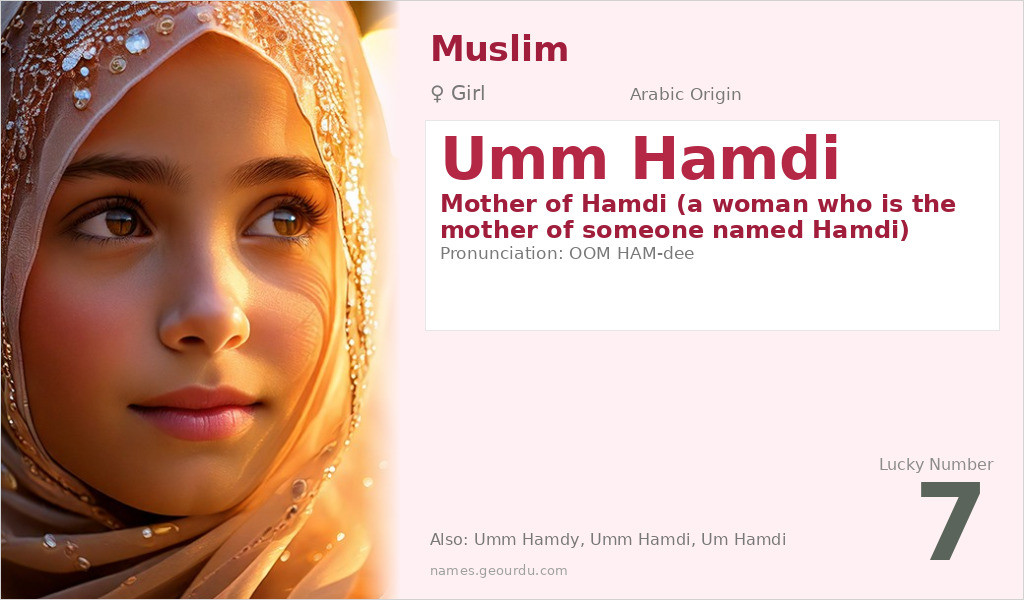
| 📛 Name | Umm Hamdi |
| 💎 Meaning | Mother of Hamdi (a woman who is the mother of someone named Hamdi) |
| 👤 Gender | Girl |
| 🕌 Religion | Muslim |
| 🌍 Origin | Arabic |
| 🗣 Pronunciation | OOM HAM-dee |
| ✍️ Urdu | ام حمدی |
| ✍️ Arabic | أم حمدي |
| 🔢 Numerology | 7 |
| ✨ Spellings | Umm Hamdy, Umm Hamdi, Um Hamdi, Umm Hamdee |
Origin & Cultural Significance
Umm Hamdi originates from classical Arabic and Islamic naming traditions that date back to pre-Islamic Arabia and were formalized during the early Islamic period. In Arab culture, kunya names (like Umm + child’s name) serve as honorific titles that recognize a person’s parental status and social standing. This practice was particularly common among early Muslims, where women like Umm Salama and Umm Ayman were known by their kunyas rather than their given names. The name Hamdi, from which this kunya is derived, gained popularity as a masculine name meaning ‘praiseworthy’ and referring to praise of God. Today, Umm Hamdi continues as both an actual name and an honorific title in Arabic-speaking Muslim communities worldwide.
Personality Traits
Those named Umm Hamdi are often associated with maternal strength, family devotion, and spiritual gratitude. The name suggests a person who finds identity and pride in nurturing relationships, particularly within the family unit. There’s an inherent dignity in the name, as it positions the bearer as someone worthy of respect through their connection to a child named Hamdi. The spiritual element of ‘Hamdi’ (praise) adds a layer of religious consciousness, implying someone who values gratitude and recognition of divine blessings.
Similar Names
If you like Umm Hamdi, consider: Umm Kulthum, Umm Salama, Umm Ayman, Umm Hani, Umm Habiba
Famous People Named Umm Hamdi
- Umm Hamdi bint Abdul Muttalib — Paternal aunt of Prophet Muhammad and mother of notable companion Zubayr ibn al-Awwam
- Contemporary women in Arab world who use this as an honorific title rather than given name
Frequently Asked Questions About Umm Hamdi
What does Umm Hamdi mean?
Umm Hamdi means 'Mother of Hamdi' in Arabic. It's a compound name where 'Umm' means 'mother of' and 'Hamdi' means 'my praise' or 'praiseworthy', derived from the Arabic root for praise (Ḥ-M-D).
Is Umm Hamdi a boy or girl name?
Umm Hamdi is exclusively a girl's name. In Arabic naming tradition, 'Umm' (mother of) prefixes are always feminine, while 'Abu' (father of) prefixes are masculine. This is a teknonym honoring a woman's maternal role.
What is the origin of Umm Hamdi?
Umm Hamdi originates from Arabic language and Islamic culture. It follows the traditional Arab kunya system where women are respectfully addressed as 'Mother of [child's name]'. The name has been used since early Islamic times and remains popular in Muslim communities.