
Table of Contents
Usman is a distinguished Arabic name with deep historical roots in Islamic tradition. Most famously borne by Uthman ibn Affan, the third Caliph of Islam, this name carries both linguistic significance and religious importance. While commonly used across Muslim communities worldwide, its meaning traces back to the natural world of pre-Islamic Arabia. Understanding Usman requires exploring both its etymological origins and its cultural evolution.
Meaning of Usman
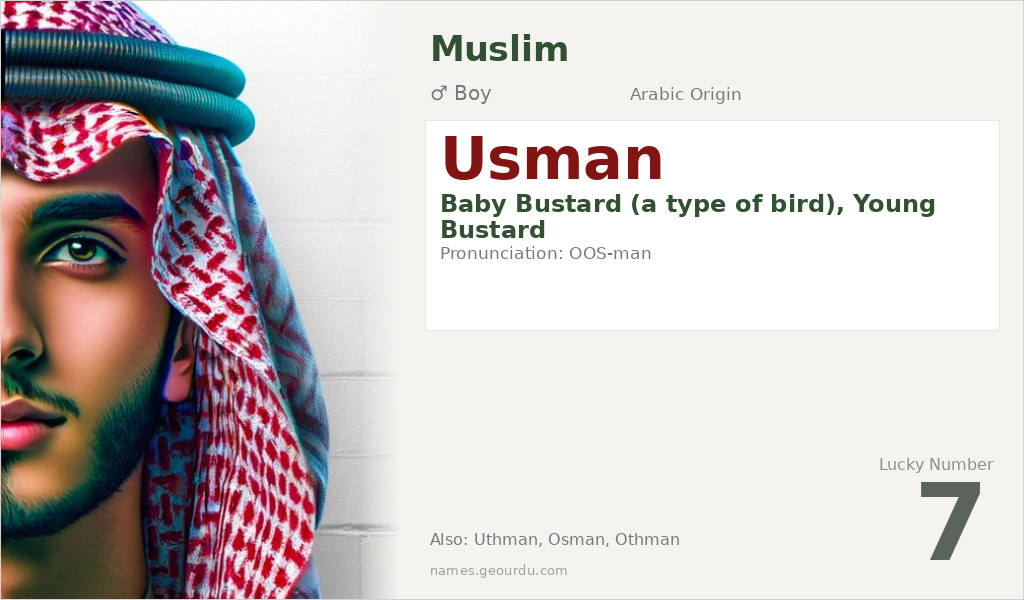
The name Usman (عثمان) has a clear and specific meaning in Classical Arabic: ‘young bustard’ or ‘baby bustard.’ It derives from the Arabic root ‘ع-ث-م’ (ʕ-th-m), which refers specifically to the bustard bird, a large terrestrial bird found in arid regions of the Middle East and North Africa. This is not a metaphorical or abstract meaning but a literal zoological reference common in pre-Islamic Arabic naming conventions where animals and natural phenomena were frequently used. The name predates Islam and was already in use among Arab tribes before gaining prominence through Islamic history. The bustard bird was known for its size and ground-dwelling nature, characteristics that may have been admired in naming traditions.
| 📛 Name | Usman |
| 💎 Meaning | Baby Bustard (a type of bird), Young Bustard |
| 👤 Gender | Boy |
| 🕌 Religion | Muslim |
| 🌍 Origin | Arabic |
| 🗣 Pronunciation | OOS-man |
| ✍️ Urdu | عثمان |
| ✍️ Arabic | عثمان |
| 🔢 Numerology | 7 |
| ✨ Spellings | Uthman, Osman, Othman, Usmaan |
Origin & Cultural Significance
Usman originates from the Arabic language and culture of the Arabian Peninsula. While the name existed in pre-Islamic times, it gained significant prominence through Uthman ibn Affan (c. 574-656 CE), who was among the earliest converts to Islam, a close companion of Prophet Muhammad, and served as the third Caliph of the Rashidun Caliphate. His leadership and compilation of the Quran into a single standardized text cemented the name’s importance in Islamic history. From Arabia, the name spread throughout the Muslim world via conquests and trade, adapting slightly in pronunciation across regions (Osman in Turkish, Usman in South Asian languages). The Ottoman Empire’s founder, Osman I, further popularized the name in Turkic cultures.
Personality Traits
In naming traditions, Usman is associated with qualities of wisdom, leadership, and spiritual depth, largely influenced by the historical figure Uthman ibn Affan. Those named Usman are often thought to possess analytical minds, strong moral compasses, and a respectful demeanor toward tradition. The name carries expectations of responsibility and integrity, reflecting the caliph’s reputation for modesty and organizational skills. While personality traits vary individually, the name’s historical weight often inspires qualities of patience and thoughtful decision-making.
Similar Names
If you like Usman, consider: Umar, Ali, Abu Bakr, Hasan, Husayn
Famous People Named Usman
- Uthman ibn Affan — Third Caliph of Islam, companion of Prophet Muhammad
- Osman I — Founder of the Ottoman Empire
Frequently Asked Questions About Usman
What does Usman mean?
Usman means 'young bustard' or 'baby bustard' in Arabic, referring to a large ground-dwelling bird found in arid regions.
Is Usman a boy or girl name?
Usman is exclusively a masculine name in all cultures where it is used, particularly in Muslim communities.
What is the origin of Usman?
Usman originates from Classical Arabic language and culture, with historical significance through Uthman ibn Affan, the third Caliph of Islam.





