
Table of Contents
Uttara is a beautiful Sanskrit name rich with cultural heritage and profound meaning. While often associated with Hindu tradition through epic literature, this name carries geographical, spiritual, and qualitative significance. From ancient texts to modern usage, Uttara represents both direction and excellence, making it a meaningful choice for parents seeking a name with depth and history.
Meaning of Uttara
Uttara originates from the Sanskrit word ‘uttara’ (उत्तर), which fundamentally means ‘north’ but encompasses several related meanings including ‘superior’, ‘later’, ‘subsequent’, and ‘answer’. In Sanskrit linguistics, the term derives from the root ‘ud’ meaning ‘upward’ or ‘high’, combined with the comparative suffix ‘-tara’, literally translating to ‘higher’ or ‘more upward’. This directional meaning connects to Vedic cosmology where the northern direction was considered auspicious and associated with the Himalayas, the abode of gods. The qualitative meanings of ‘superior’ or ‘excellent’ developed from this spatial concept, as north was metaphorically seen as ‘higher’ or ‘better’. In classical Sanskrit literature, ‘uttara’ also means ‘answer’ or ‘solution’, representing what comes after a question or problem.
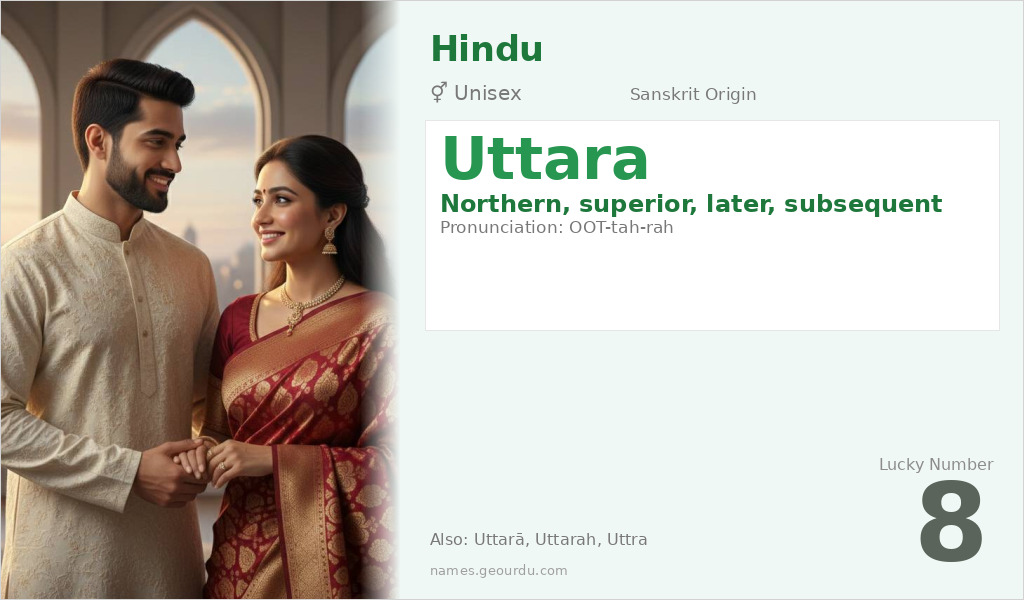
| 📛 Name | Uttara |
| 💎 Meaning | Northern, superior, later, subsequent |
| 👤 Gender | Unisex |
| 🕌 Religion | Hindu |
| 🌍 Origin | Sanskrit |
| 🗣 Pronunciation | OOT-tah-rah |
| ✍️ Urdu | اتر |
| ✍️ Arabic | أوتارا |
| 🔢 Numerology | 8 |
| ✨ Spellings | Uttarā, Uttarah, Uttra |
Origin & Cultural Significance
Uttara has deep roots in ancient Indian culture and Hindu tradition, primarily appearing in Sanskrit texts. Most famously, Princess Uttara appears in the Mahabharata as the daughter of King Virata and wife of Abhimanyu, who gave birth to Parikshit, the sole surviving heir of the Kuru dynasty. This establishes the name’s historical feminine usage in Hindu epics. The name also appears in Buddhist texts and has been used in various Indian languages including Hindi, Bengali, and Marathi. While strongly associated with Hindu culture due to its epic connections, the name’s Sanskrit origin gives it broader cultural relevance across South Asia. In contemporary usage, it remains popular in India and among Hindu communities worldwide.
Personality Traits
Those named Uttara often embody the qualities suggested by their name’s meanings—they tend to be directional in their life choices, often taking leadership roles or guiding others. The ‘northern’ association suggests they may have a strong moral compass and clear sense of purpose. Their ‘superior’ connotation doesn’t necessarily mean arrogance, but rather a striving for excellence and high standards in their endeavors. Many Uttaras display intellectual curiosity and philosophical depth, reflecting the name’s ancient literary heritage.
Similar Names
If you like Uttara, consider: Uttam, Uttanka, Uttarika, Uttariya, Uttishtha
Famous People Named Uttara
- Uttara — Indian actress known for Bengali and Hindi films
- Uttara Baokar — renowned Indian actress in Marathi and Hindi theater and cinema
- Uttara Mhatre — Indian actress in Marathi television and film
Frequently Asked Questions About Uttara
What does Uttara mean?
Uttara means 'northern', 'superior', 'later', or 'subsequent' in Sanskrit, with the primary meaning being directional (north) which metaphorically extends to qualities of excellence.
Is Uttara a boy or girl name?
Uttara is primarily a feminine name in Hindu tradition and Sanskrit literature (e.g., Princess Uttara in the Mahabharata), though it can be considered unisex in modern usage.
What is the origin of Uttara?
Uttara originates from Sanskrit, an ancient Indo-Aryan language of India, and appears prominently in Hindu epics like the Mahabharata.