
Table of Contents
Vagn is a distinctive Scandinavian name with deep historical roots in Nordic culture. Derived from Old Norse, this masculine name carries the practical meaning of ‘wagon’ or ‘cart’, reflecting the importance of transportation in medieval Scandinavian society. While relatively uncommon today, Vagn maintains a presence in Denmark, Norway, and Sweden, often associated with tradition and heritage. This name offers a unique connection to Viking-era linguistics and Scandinavian naming conventions.
Meaning of Vagn
The name Vagn originates from the Old Norse word ‘vagn’, which directly translates to ‘wagon’, ‘cart’, or ‘carriage’. This etymology connects to the Proto-Germanic root *wagnaz, sharing linguistic ancestry with Old English ‘wægn’ and German ‘Wagen’. In medieval Scandinavia, the name was both a given name and a descriptive nickname for individuals associated with wagon-making or driving. The meaning has remained remarkably consistent through linguistic evolution, appearing in various forms across Nordic languages including Danish, Norwegian, Swedish, and Icelandic. Unlike many names that evolved metaphorical meanings, Vagn maintained its literal transportation-related significance throughout history.
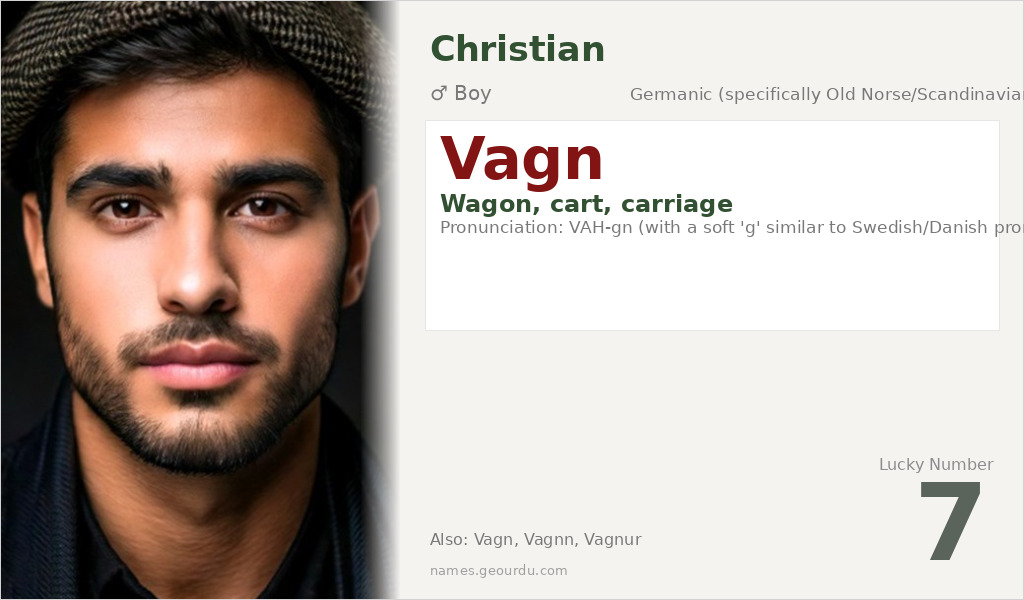
| 📛 Name | Vagn |
| 💎 Meaning | Wagon, cart, carriage |
| 👤 Gender | Boy |
| 🕌 Religion | Christian |
| 🌍 Origin | Germanic (specifically Old Norse/Scandinavian) |
| 🗣 Pronunciation | VAH-gn (with a soft 'g' similar to Swedish/Danish pronunciation) |
| ✍️ Urdu | ویگن |
| ✍️ Arabic | فاغن |
| 🔢 Numerology | 7 |
| ✨ Spellings | Vagn, Vagnn, Vagnur, Vagni |
Origin & Cultural Significance
Vagn has its origins in medieval Scandinavia, specifically emerging from Old Norse naming traditions. The name appears in historical records from Denmark, Norway, and Sweden dating back to the Viking Age and medieval period. It was particularly common in Denmark, where it remains part of the cultural naming heritage. While the name is sometimes associated with Iceland due to shared Norse linguistic roots, its usage spans across Scandinavian countries rather than being specifically Icelandic. The name reflects practical, occupation-related naming patterns common in Norse society, where names often described tools, objects, or characteristics. Today, Vagn is recognized as a traditional Scandinavian name, though its usage has declined in modern times.
Personality Traits
Those named Vagn are often associated with qualities of reliability, practicality, and steadfastness. The name’s connection to transportation suggests someone who facilitates movement and progress in both literal and metaphorical senses. In Scandinavian cultural context, the name carries connotations of traditional values, craftsmanship, and connection to heritage. While personality traits vary by individual, the name’s historical roots in practical utility often translate to perceptions of dependability and grounded character.
Similar Names
If you like Vagn, consider: Vagnar, Vagnbjørn, Vagnhild, Vagnur, Wagn, Wagoner, Vagni, Vagnbjörn, Vagnarsson, Vagnbjørnsen
Famous People Named Vagn
- Vagn Holmboe — Danish composer (1909-1996) known for his symphonies and chamber music
- Vagn Walfrid Ekman — Swedish oceanographer (1874-1954) known for Ekman spiral and Ekman transport theories
Frequently Asked Questions About Vagn
What does Vagn mean?
Vagn means 'wagon', 'cart', or 'carriage' in Old Norse and Scandinavian languages. It derives from the Proto-Germanic root *wagnaz, related to transportation.
Is Vagn a boy or girl name?
Vagn is exclusively a masculine name in Scandinavian naming traditions. There are no recorded instances of it being used as a feminine name in historical or contemporary usage.
What is the origin of Vagn?
Vagn originates from Old Norse/Scandinavian languages, specifically emerging from medieval Nordic naming traditions in Denmark, Norway, and Sweden. It is not specifically Icelandic as sometimes misattributed, but rather pan-Scandinavian in origin.





