
Table of Contents
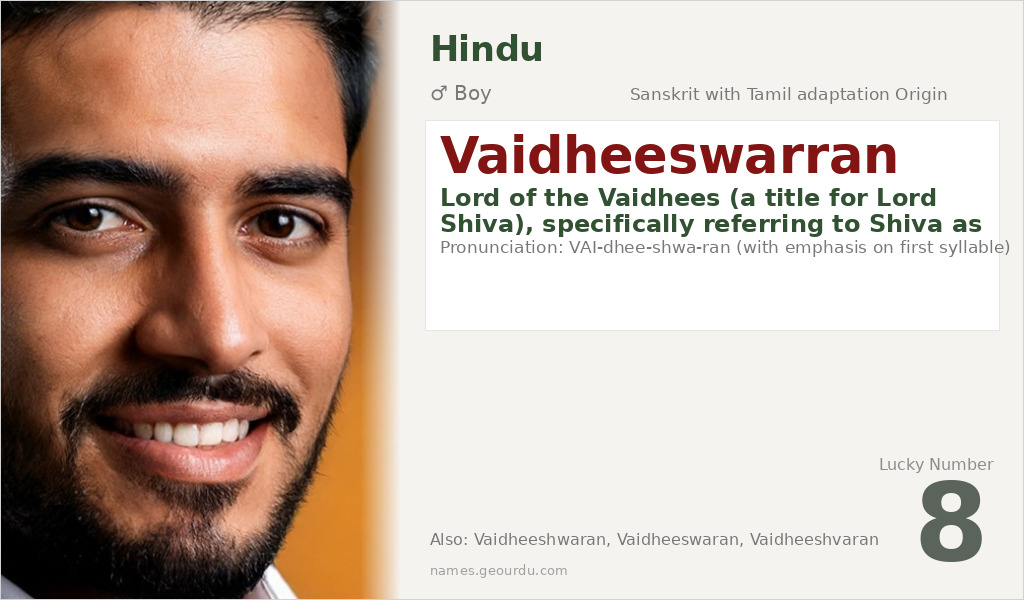
Vaidheeswarran is a powerful and traditional Hindu name with deep spiritual significance. Primarily used in South Indian communities, this name carries the weight of ancient Sanskrit roots while being adapted through Tamil linguistic traditions. As a name that directly references Lord Shiva, it holds particular importance in Shaivite Hindu families who seek to honor the supreme cosmic deity through their child’s identity.
Meaning of Vaidheeswarran
Vaidheeswarran is a compound Sanskrit name with precise theological meaning. The first component ‘Vaidhees’ (वैधीस्) derives from the Sanskrit root ‘vidh’ meaning ‘to rule, command, or be supreme,’ making it an epithet for the highest lord. The second component ‘Ishwarran’ comes from ‘Ishwara’ (ईश्वर) meaning ‘god, lord, or controller,’ with the Tamil suffix ‘-an’ added for masculine form and reverence. Together, the name translates to ‘Lord of the Vaidhees’ or ‘Supreme Master God,’ specifically referring to Lord Shiva in Hindu theology. This name appears in classical texts like the Shiva Puranas and temple inscriptions throughout South India, particularly in Tamil-speaking regions where Shiva worship has ancient roots.
| 📛 Name | Vaidheeswarran |
| 💎 Meaning | Lord of the Vaidhees (a title for Lord Shiva), specifically referring to Shiva as the supreme lord or master |
| 👤 Gender | Boy |
| 🕌 Religion | Hindu |
| 🌍 Origin | Sanskrit with Tamil adaptation |
| 🗣 Pronunciation | VAI-dhee-shwa-ran (with emphasis on first syllable) |
| ✍️ Urdu | ویدھیشورن |
| ✍️ Arabic | فيدهيشوران |
| 🔢 Numerology | 8 |
| ✨ Spellings | Vaidheeshwaran, Vaidheeswaran, Vaidheeshvaran, Vaidheesvaran |
Origin & Cultural Significance
The name Vaidheeswarran originates from classical Sanskrit but has been adapted and preserved primarily in Tamil Hindu communities. It emerged as a devotional name within Shaivite traditions, where devotees would name children after various aspects and epithets of Lord Shiva. The name is particularly common in Tamil Nadu, Kerala, and among Tamil diaspora communities worldwide. Historically, the name appears in temple inscriptions from the Chola and Pandya periods (9th-13th centuries CE), indicating its long-standing cultural significance. While the Sanskrit form ‘Vaidheeshvara’ exists in North Indian contexts, the Tamil adaptation ‘Vaidheeswarran’ with the characteristic ‘-an’ ending reflects the linguistic integration of Sanskrit names into Dravidian language structures.
Personality Traits
Those named Vaidheeswarran are often associated with qualities of strength, discipline, and spiritual depth. The name’s connection to Lord Shiva suggests characteristics of transformation, leadership, and philosophical insight. In cultural contexts, individuals with this name might be expected to exhibit traditional values, resilience in challenges, and a contemplative nature. The numerological association with number 8 further emphasizes traits of ambition, practicality, and organizational ability.
Similar Names
If you like Vaidheeswarran, consider: Vaidyanathan, Vaidyanath, Ishwaran, Shivaram, Mahadevan, Sivanathan, Natarajan, Sundareswaran
Famous People Named Vaidheeswarran
- Vaidheeswarran Koil — A famous Shiva temple in Tamil Nadu, India, dedicated to Lord Shiva as Vaidheeswarran
- Vaidheeswarran Bhagavathar — A classical Carnatic musician and composer from Tamil Nadu
Frequently Asked Questions About Vaidheeswarran
What does Vaidheeswarran mean?
Vaidheeswarran means 'Lord of the Vaidhees' or 'Supreme Master God,' specifically referring to Lord Shiva in Hindu tradition. It is a compound Sanskrit name adapted through Tamil linguistic traditions.
Is Vaidheeswarran a boy or girl name?
Vaidheeswarran is exclusively a boy's name in Hindu naming traditions. The '-an' ending in Tamil specifically denotes masculine gender, and the name references the male deity Lord Shiva.
What is the origin of Vaidheeswarran?
Vaidheeswarran originates from classical Sanskrit but has been adapted and preserved primarily in Tamil Hindu communities of South India. It combines Sanskrit roots 'Vaidhees' (supreme lord) and 'Ishwara' (god) with Tamil grammatical elements.





