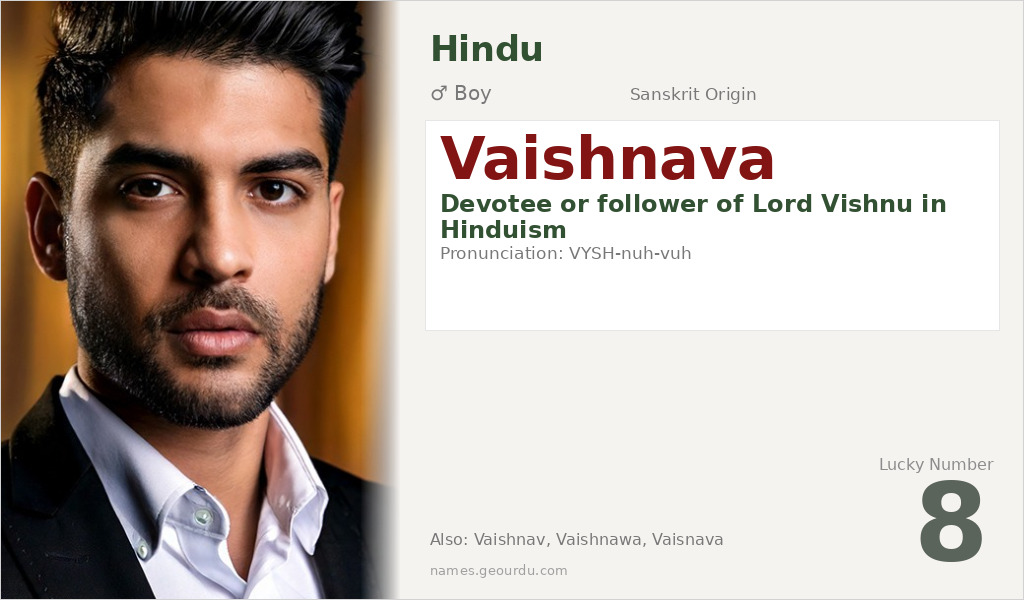
Table of Contents
Vaishnava is a profound Hindu name steeped in spiritual devotion and ancient tradition. Derived from Sanskrit, it directly connects to Vaishnavism, one of Hinduism’s major devotional paths. This name is not just a label but a declaration of faith, often chosen by families with deep religious roots. Exploring Vaishnava reveals insights into Hindu theology and naming practices.
Meaning of Vaishnava
Vaishnava originates from the Sanskrit word ‘Vaiṣṇava,’ which means ‘pertaining to Vishnu’ or ‘devotee of Vishnu.’ It is formed from ‘Viṣṇu,’ the name of the preserver deity in the Hindu trinity, combined with the suffix ‘-a’ denoting affiliation. In Hindu scriptures, Vaishnavas are those who worship Vishnu and his incarnations like Krishna and Rama, emphasizing bhakti (devotion). The term is widely used in religious texts such as the Puranas and the Bhagavata Purana to describe followers of this tradition. Linguistically, it reflects the rich morphological structure of Sanskrit, where suffixes create nouns indicating relationship or belonging. Thus, the name carries a clear, well-documented meaning rooted in Hindu theology.
| 📛 Name | Vaishnava |
| 💎 Meaning | Devotee or follower of Lord Vishnu in Hinduism |
| 👤 Gender | Boy |
| 🕌 Religion | Hindu |
| 🌍 Origin | Sanskrit |
| 🗣 Pronunciation | VYSH-nuh-vuh |
| ✍️ Urdu | وشنو |
| ✍️ Arabic | فايشنافا |
| 🔢 Numerology | 8 |
| ✨ Spellings | Vaishnav, Vaishnawa, Vaisnava |
Origin & Cultural Significance
The name Vaishnava has its origins in ancient India, emerging from Sanskrit, the classical language of Hinduism. It is intrinsically linked to Vaishnavism, a major tradition within Hinduism that focuses on the worship of Vishnu. Historically, Vaishnavism gained prominence through saints and philosophers like Ramanuja and Chaitanya Mahaprabhu, who spread devotional practices across regions. The name is primarily used in Hindu communities in India, Nepal, and the diaspora, reflecting cultural and religious identity. It is less common as a personal name in other languages or religions, as its meaning is specific to Hindu theology.
Personality Traits
Those named Vaishnava are often associated with traits of devotion, serenity, and protective instincts, mirroring the qualities of Lord Vishnu. They may be seen as reliable and caring individuals, with a strong moral compass guided by spiritual values. In social contexts, they might excel in roles that require compassion and leadership, inspired by the name’s religious heritage.
Similar Names
If you like Vaishnava, consider: Vishnu, Krishna, Rama, Narayana, Govinda
Famous People Named Vaishnava
- Chaitanya Mahaprabhu — 15th-century saint and key figure in Gaudiya Vaishnavism
- Ramanuja — 11th-century philosopher and proponent of Sri Vaishnavism
Frequently Asked Questions About Vaishnava
What does Vaishnava mean?
Vaishnava means 'devotee or follower of Lord Vishnu' in Sanskrit, specifically referring to adherents of Vaishnavism in Hinduism.
Is Vaishnava a boy or girl name?
Vaishnava is traditionally a boy's name in Hindu culture, though it is unisex in some modern contexts, but predominantly male.
What is the origin of Vaishnava?
Vaishnava originates from Sanskrit, the ancient language of India, and is deeply rooted in Hindu religious tradition, particularly Vaishnavism.