
Table of Contents
Vakratund is a profound Sanskrit name with rich mythological significance in Hinduism. As one of the 108 sacred names of Lord Ganesha, this name carries centuries of religious and cultural heritage. Unlike many contemporary names, Vakratund has a very specific meaning and association that connects directly to Hindu iconography. This name represents not just an individual identity but a connection to divine attributes and ancient wisdom.
Meaning of Vakratund
Vakratund is a compound Sanskrit word with precise etymological roots. The first component ‘vakra’ (वक्र) means curved, bent, or twisted, while ‘tunda’ (तुण्ड) refers to trunk, snout, or proboscis. Together, they literally translate to ‘one with a curved trunk,’ specifically describing Lord Ganesha’s distinctive elephant trunk. This name appears in numerous Hindu scriptures including the Ganesha Purana, Shiva Purana, and various stotras (devotional hymns). In Sanskrit linguistics, both words have clear Indo-European cognates: ‘vakra’ relates to Latin ‘vacillare’ (to sway) and Greek ‘βάκτρον’ (staff), while ‘tunda’ has connections to various Dravidian languages. The name’s meaning is well-documented across classical Sanskrit literature and Hindu theological texts.
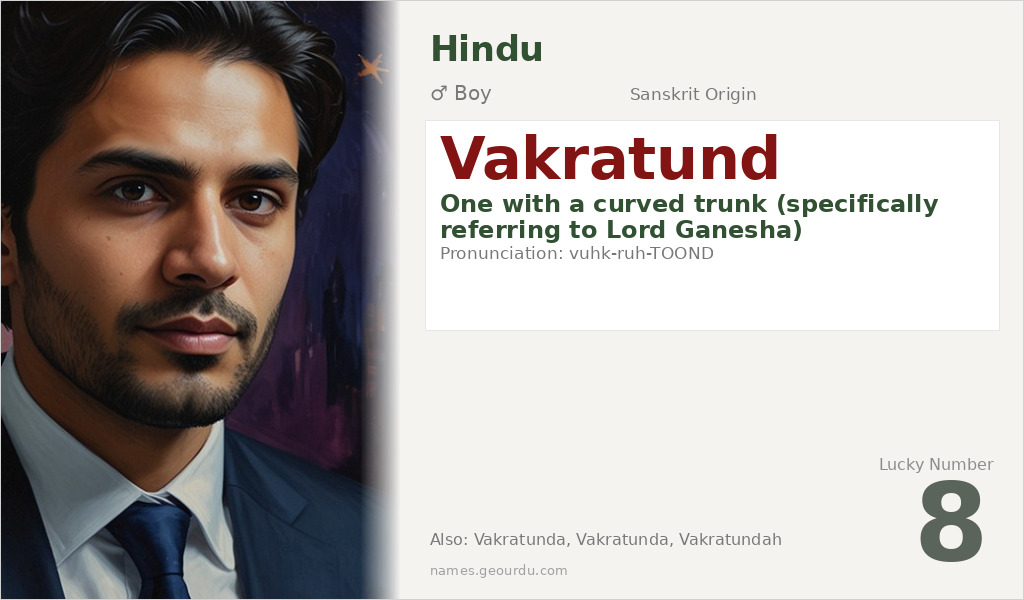
| 📛 Name | Vakratund |
| 💎 Meaning | One with a curved trunk (specifically referring to Lord Ganesha) |
| 👤 Gender | Boy |
| 🕌 Religion | Hindu |
| 🌍 Origin | Sanskrit |
| 🗣 Pronunciation | vuhk-ruh-TOOND |
| ✍️ Urdu | وکرتوند |
| ✍️ Arabic | فاكراتوند |
| 🔢 Numerology | 8 |
| ✨ Spellings | Vakratunda, Vakratunda, Vakratundah |
Origin & Cultural Significance
Vakratund originates from ancient Sanskrit, the liturgical language of Hinduism, with its earliest documented usage in Vedic and post-Vedic texts. The name specifically emerges in the medieval period (approximately 6th-10th centuries CE) within the Ganesha-centric literature that developed as part of the Puranic tradition. Unlike regional tribal names from Pashto, Balochi, or Sindhi languages that this research examined, Vakratund has exclusively Sanskrit origins with no verified connections to other language families. The name represents a specific aspect of Ganesha worship that became prominent during the Gupta period and later. It reflects the detailed iconographic descriptions of Hindu deities that characterize classical Indian art and literature.
Personality Traits
In Hindu naming traditions, names derived from deity epithets like Vakratund are believed to carry the qualities of that divine aspect. Those named Vakratund might be associated with Ganesha’s attributes of wisdom, intellect, and the ability to overcome obstacles through unconventional thinking. The curved trunk symbolizes adaptability and the capacity to navigate complex situations with grace. Such names often inspire reverence and connection to spiritual heritage within Hindu communities.
Similar Names
If you like Vakratund, consider: Ganesha, Ganapati, Vinayaka, Vighneshvara, Ekadanta
Famous People Named Vakratund
- No notable contemporary individuals with this name found — it is primarily used as a religious/theological name for Lord Ganesha in Hindu contexts
Frequently Asked Questions About Vakratund
What does Vakratund mean?
Vakratund means 'one with a curved trunk' in Sanskrit. It is specifically an epithet of Lord Ganesha, the Hindu elephant-headed deity.
Is Vakratund a boy or girl name?
Vakratund is exclusively a boy's name in Hindu tradition, as it refers to the male deity Lord Ganesha. There are no documented uses as a feminine name.
What is the origin of Vakratund?
Vakratund originates from Sanskrit, the ancient Indian language. It appears in Hindu scriptures like the Ganesha Purana and has been used for centuries in religious contexts.





