
Table of Contents
Varouna is a name steeped in ancient Vedic tradition, carrying the weight of cosmic significance and divine authority. Derived from Sanskrit, this name connects directly to one of Hinduism’s most important early deities. While sometimes used for both genders today, it remains powerfully linked to mythological heritage and spiritual concepts of order and natural forces.
Meaning of Varouna
The name Varouna comes from the Sanskrit word वरुण (váruṇa), which refers specifically to the Vedic deity governing waters, oceans, and cosmic law. Etymologically, it derives from the root √vṛ meaning ‘to cover’ or ‘envelop,’ reflecting the god’s association with the all-encompassing celestial waters and sky. In the Rigveda, Varuna is described as the upholder of ṛta (cosmic and moral order), often paired with Mitra. The name’s meaning extends beyond mere ‘river’ to encompass the entire aquatic realm and the principle of divine order that maintains the universe. This makes Varouna one of the most conceptually rich names in the Hindu tradition.
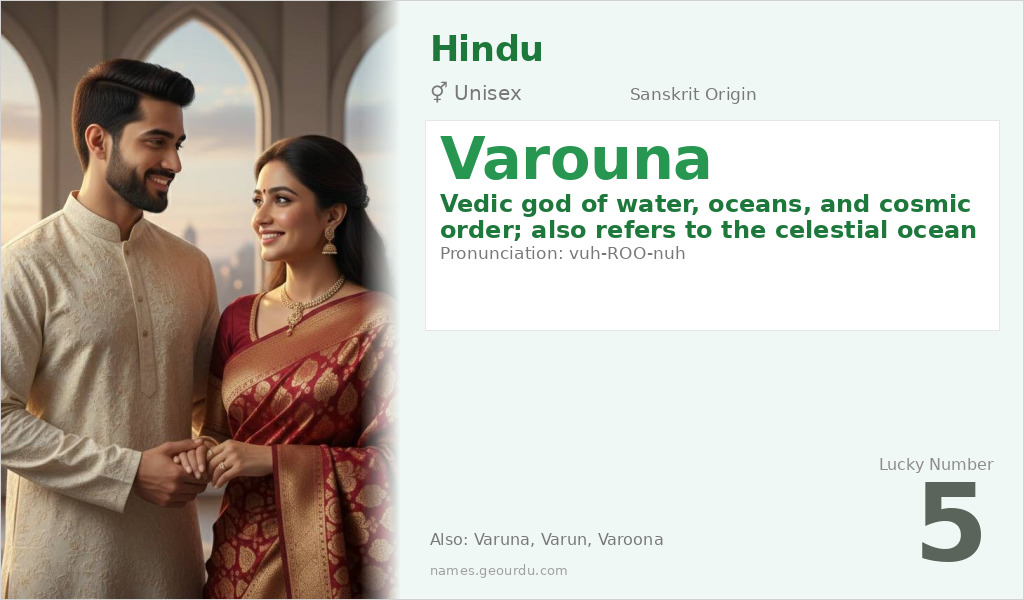
| 📛 Name | Varouna |
| 💎 Meaning | Vedic god of water, oceans, and cosmic order; also refers to the celestial ocean |
| 👤 Gender | Unisex |
| 🕌 Religion | Hindu |
| 🌍 Origin | Sanskrit |
| 🗣 Pronunciation | vuh-ROO-nuh |
| ✍️ Urdu | ورونا |
| ✍️ Arabic | فارونا |
| 🔢 Numerology | 5 |
| ✨ Spellings | Varuna, Varun, Varoona, Waruna |
Origin & Cultural Significance
Varouna originates from ancient Sanskrit texts, particularly the Rigveda (circa 1500-1200 BCE), where Varuna appears as a major deity. Initially a supreme sky god who regulated cosmic order and moral law, his domain later specialized to water and oceans in post-Vedic mythology. The name has been used historically in Hindu communities across South Asia, particularly among those with connections to Vedic traditions. While traditionally masculine, modern usage shows some flexibility, though it remains most common as a reference to the deity. The name appears in various forms across Indian languages and has been preserved through religious texts and cultural memory.
Personality Traits
Those named Varouna often carry associations with the deity’s attributes: wisdom, authority over natural elements, and a strong moral compass. The connection to water suggests emotional depth, intuition, and adaptability, while the cosmic aspect implies broad perspective and organizational ability. These individuals may be perceived as calm yet powerful, with an innate understanding of balance and justice in their interactions.
Similar Names
If you like Varouna, consider: Varun, Varuni, Varna, Vayu, Indra, Mitra, Surya, Agni, Marut, Pushan
Famous People Named Varouna
- Varuna (deity) — Vedic god of waters and cosmic order in Hindu mythology
- Varun Dhawan — Indian actor (named after the deity Varuna)
Frequently Asked Questions About Varouna
What does Varouna mean?
Varouna means 'Vedic god of water, oceans, and cosmic order' in Sanskrit. It refers specifically to the deity Varuna from ancient Hindu scriptures.
Is Varouna a boy or girl name?
Varouna is traditionally masculine as it names a male deity, but modern usage sometimes treats it as unisex. Historically and mythologically, it is unequivocally masculine.
What is the origin of Varouna?
Varouna originates from Sanskrit, appearing in the Rigveda (circa 1500-1200 BCE) as the name of the Vedic god Varuna. It has been used in Hindu traditions for millennia.