
Table of Contents
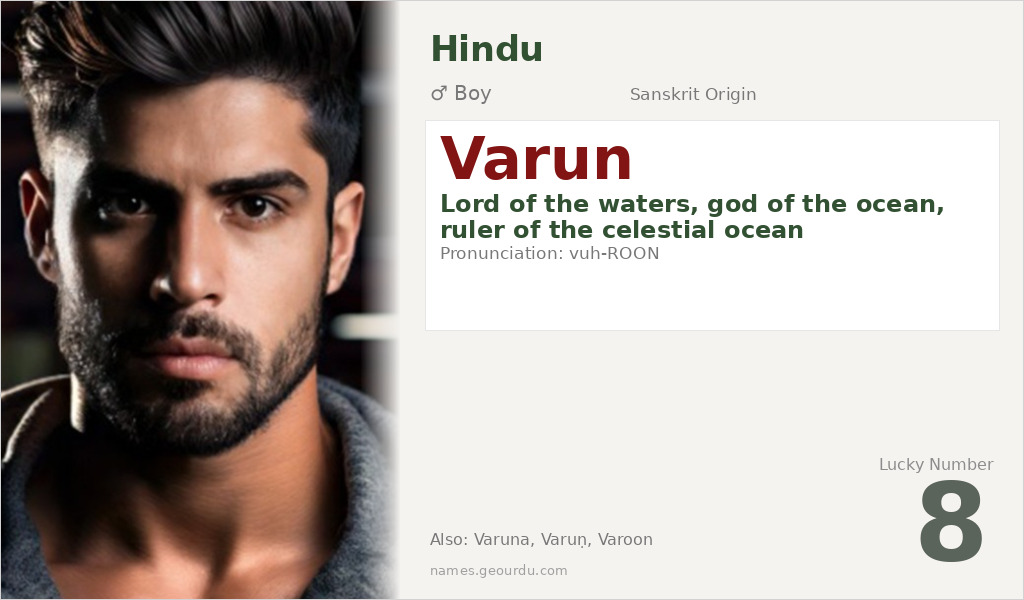
Varun is a powerful and ancient Hindu name with deep roots in Vedic tradition. Derived from Sanskrit, it means ‘Lord of the waters’ and refers to the deity Varuna, who governs the oceans and celestial waters. This name carries connotations of wisdom, cosmic order, and natural authority, making it a meaningful choice for parents seeking a name with spiritual depth. Today, Varun remains popular in India and among Hindu communities worldwide.
Meaning of Varun
The name Varun comes directly from the Sanskrit word ‘Varuna’ (वरुण), which is derived from the root ‘vṛ’ meaning ‘to cover, surround, or restrain.’ This etymology reflects Varuna’s role as the deity who encompasses and rules over all waters. In the Rigveda, Varuna is described as the maintainer of cosmic order (ṛta) and moral law, with his dominion extending over rivers, oceans, and rainfall. The name’s specific meaning—’Lord of the waters’—highlights his sovereignty over aquatic realms, both earthly and celestial. Linguistically, it’s related to the Avestan ‘Ahura Mazda’ and possibly the Greek ‘Ouranos,’ showing Indo-European connections. In modern usage, Varun retains these associations with wisdom, depth, and natural power.
| 📛 Name | Varun |
| 💎 Meaning | Lord of the waters, god of the ocean, ruler of the celestial ocean |
| 👤 Gender | Boy |
| 🕌 Religion | Hindu |
| 🌍 Origin | Sanskrit |
| 🗣 Pronunciation | vuh-ROON |
| ✍️ Urdu | ورن |
| ✍️ Arabic | فارون |
| 🔢 Numerology | 8 |
| ✨ Spellings | Varuna, Varuṇ, Varoon, Varon |
Origin & Cultural Significance
Varun originates from ancient Sanskrit texts, particularly the Vedas, where Varuna appears as one of the principal deities. Initially, in early Vedic religion (circa 1500–500 BCE), Varuna was the supreme god associated with the sky, waters, and moral order. Over time, his prominence diminished as Indra rose, but he remained important as the god of oceans in later Hinduism. The name spread through Hindu communities across South Asia and the diaspora, maintaining religious significance. It’s primarily used in India, Nepal, and among Hindu populations worldwide, with cultural ties to festivals and rituals honoring water deities. Unlike some names that cross religious boundaries, Varun remains distinctly Hindu in its cultural and religious associations.
Personality Traits
People named Varun are often perceived as calm, intelligent, and deeply intuitive, much like the waters they’re named after. They tend to exhibit strong leadership qualities combined with emotional sensitivity, making them effective in both personal and professional realms. Their connection to the element of water suggests adaptability, creativity, and a natural ability to navigate complex situations with grace and wisdom.
Similar Names
If you like Varun, consider: Varuna, Varunika, Varuni, Varunesh, Varunendra
Famous People Named Varun
- Varun Dhawan — Indian Bollywood actor known for films like 'Badlapur' and 'Judwaa 2'
- Varun Aaron — Indian cricketer who played for the Indian national team as a fast bowler
Frequently Asked Questions About Varun
What does Varun mean?
Varun means 'Lord of the waters' or 'god of the ocean' in Sanskrit, referring to the Hindu deity Varuna who rules over aquatic realms and celestial waters.
Is Varun a boy or girl name?
Varun is exclusively a boy's name in Hindu tradition, derived from the masculine deity Varuna. There are feminine variants like Varuni or Varunika for girls.
What is the origin of Varun?
Varun originates from Sanskrit, the ancient language of Hindu scriptures like the Vedas. It comes directly from the name of the Vedic deity Varuna, with roots in Indo-European mythology.





