
Table of Contents
Vasanta is a beautiful name deeply rooted in Sanskrit tradition, evoking images of blooming flowers and renewed life. Derived from the word for ‘spring season’, this name carries centuries of cultural significance in Hindu and Buddhist contexts. Whether chosen for a boy or girl, Vasanta symbolizes freshness, beauty, and cyclical renewal. Its melodic sound and rich meaning make it a timeless choice across South Asian cultures.
Meaning of Vasanta
Vasanta comes directly from Sanskrit वसन्त (vasanta), meaning specifically ‘the spring season’. In Sanskrit literature, Vasanta represents the period between March and April when nature blossoms—a time celebrated in poetry, music, and festivals. The etymology traces to the root ‘vas’ meaning ‘to dwell, shine, or be radiant’, perfectly capturing spring’s vibrant energy. This isn’t just a seasonal reference but a cultural concept embodying fertility, joy, and the Hindu deity of spring. Unlike generic ‘brilliant’ translations, Vasanta’s meaning is precisely tied to this seasonal and mythological context.
| 📛 Name | Vasanta |
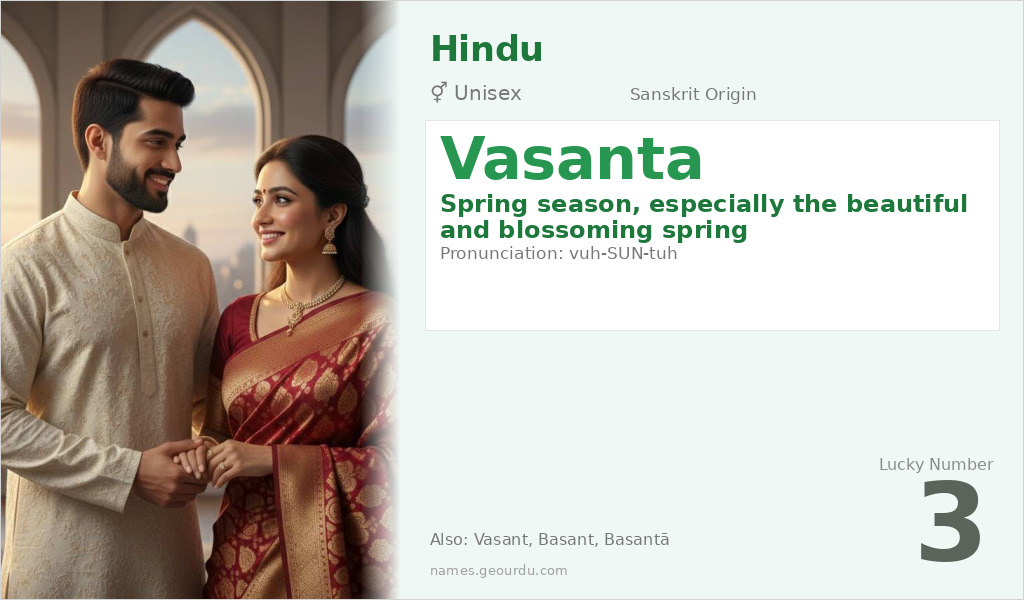
| 💎 Meaning | Spring season, especially the beautiful and blossoming spring |
| 👤 Gender | Unisex |
| 🕌 Religion | Hindu |
| 🌍 Origin | Sanskrit |
| 🗣 Pronunciation | vuh-SUN-tuh |
| ✍️ Urdu | وسنت |
| ✍️ Arabic | فاسانتا |
| 🔢 Numerology | 3 |
| ✨ Spellings | Vasant, Basant, Basantā, Vasanth |
Origin & Cultural Significance
Vasanta originates from classical Sanskrit, one of the oldest languages of the Indian subcontinent. It appears in ancient texts like the Rigveda and Mahabharata, where Vasanta is both a season and a personified deity. The name spread through Hindu and Buddhist traditions across India, Nepal, Sri Lanka, and Southeast Asia. In modern times, it’s used primarily in Hindu communities but also appears in Sikh and Jain contexts due to shared cultural heritage. Regional variations include Basant in Punjabi and Vasanth in South Indian languages, often associated with the spring festival Basant Panchami.
Personality Traits
Named after the season of renewal, those called Vasanta often exhibit creative, optimistic, and adaptable qualities. They tend to approach life with freshness and vitality, inspiring growth in their relationships and endeavors. Like spring itself, they may bring new beginnings and natural charm to their surroundings, with an inherent appreciation for beauty and tradition.
Similar Names
If you like Vasanta, consider: Vasantika, Varsha, Sharad, Hemant, Grishma
Famous People Named Vasanta
- Vasanta — Character in ancient Sanskrit drama 'Mṛcchakaṭika' (The Little Clay Cart)
- Vasanta Panchami — Hindu festival celebrating spring and knowledge, dedicated to goddess Saraswati
Frequently Asked Questions About Vasanta
What does Vasanta mean?
Vasanta means 'spring season' in Sanskrit, specifically referring to the beautiful, blossoming spring between March and April.
Is Vasanta a boy or girl name?
Vasanta is traditionally unisex in Hindu naming traditions, though it's more commonly used for boys in some regions and girls in others.
What is the origin of Vasanta?
Vasanta originates from Sanskrit, an ancient Indian language, with deep roots in Hindu mythology and seasonal celebrations.