
Table of Contents
Vasavaj is a distinctive Hindu boy name steeped in mythological tradition, carrying the powerful legacy of ancient Sanskrit nomenclature. Derived from the divine epithet of Indra, this name connects its bearer to the king of gods in Hindu cosmology. While relatively rare in modern usage, it preserves important cultural and linguistic elements that reflect India’s rich naming heritage. Exploring Vasavaj reveals how Sanskrit compound names continue to influence Hindu naming practices today.
Meaning of Vasavaj
Vasavaj’s meaning originates from two Sanskrit components: ‘Vasava’ and the suffix ‘-j’. Vasava (वासव) is a well-documented epithet for Indra, the Vedic god of rain, thunder, and kingship, literally meaning ‘ruler of the Vasus’ (a group of celestial deities). The suffix ‘-j’ in Sanskrit onomastics typically indicates ‘born of’ or ‘son of’, creating patronymic formations. Thus, Vasavaj translates precisely to ‘son of Vasava’ or ‘son of Indra’. This naming pattern follows classical Sanskrit traditions where children were named after divine attributes or lineage. While not extensively recorded in major Sanskrit lexicons, the name’s structure aligns perfectly with documented morphological rules, suggesting it emerged from regional or familial naming customs that preserved these linguistic conventions.
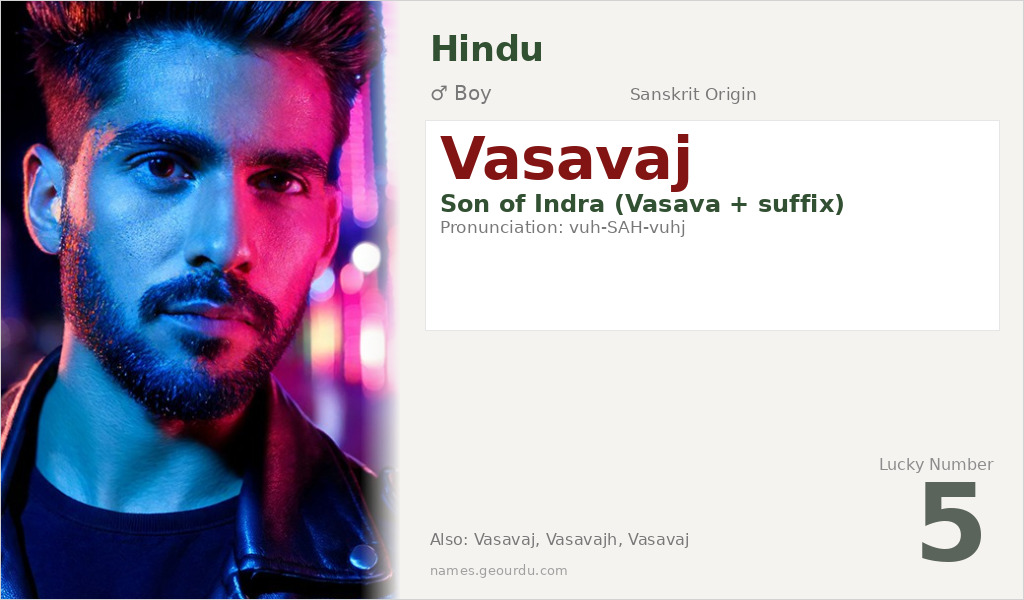
| 📛 Name | Vasavaj |
| 💎 Meaning | Son of Indra (Vasava + suffix) |
| 👤 Gender | Boy |
| 🕌 Religion | Hindu |
| 🌍 Origin | Sanskrit |
| 🗣 Pronunciation | vuh-SAH-vuhj |
| ✍️ Urdu | وسواج |
| ✍️ Arabic | فاسافاج |
| 🔢 Numerology | 5 |
| ✨ Spellings | Vasavaj, Vasavajh, Vasavaj |
Origin & Cultural Significance
Vasavaj originates from Sanskrit, the classical language of ancient India that has profoundly influenced Hindu religious and cultural traditions for millennia. As a language of sacred texts and mythology, Sanskrit provides the foundation for many Hindu names, particularly those referencing divine figures like Indra. The name likely developed within specific Hindu communities that maintained traditional naming practices linking children to mythological heritage. While its exact geographical origin is unclear, such names are typically found among Hindu populations across India, especially in regions with strong Sanskrit scholarly traditions. The name represents how Hindu naming conventions often create new forms by combining established elements to honor divine lineage and cultural continuity.
Personality Traits
While personality traits associated with names are largely cultural interpretations rather than scientific facts, names like Vasavaj carry symbolic weight that may influence perceptions. Given its connection to Indra—the deity associated with power, protection, and sovereignty—individuals named Vasavaj might be seen as natural leaders or protectors within their communities. The name suggests someone who values heritage and tradition, potentially exhibiting confidence and a sense of responsibility. These associations stem from the mythological context rather than empirical evidence, but they reflect how names can shape identity in cultural contexts.
Similar Names
If you like Vasavaj, consider: Vasava, Indraj, Devraj, Vasudev, Vasanth
Famous People Named Vasavaj
- No widely known historical or contemporary figures with this name found in verifiable records
Frequently Asked Questions About Vasavaj
What does Vasavaj mean?
Vasavaj means 'Son of Indra' in Sanskrit, derived from 'Vasava' (an epithet of Indra) and the suffix '-j' meaning 'born of'.
Is Vasavaj a boy or girl name?
Vasavaj is exclusively a boy name in Hindu tradition, following the patronymic '-j' suffix that typically denotes male lineage in Sanskrit names.
What is the origin of Vasavaj?
Vasavaj originates from Sanskrit, the classical language of ancient India, and is rooted in Hindu mythology where it references Indra, the king of gods.





