
Table of Contents
Vatsyayana is a name steeped in ancient Indian tradition and intellectual history. While relatively uncommon today, this Sanskrit name carries significant cultural weight as the name of one of India’s most famous philosophers. Derived from patronymic roots, Vatsyayana connects its bearer to both familial lineage and scholarly heritage. Understanding this name requires exploring its linguistic origins and historical context.
Meaning of Vatsyayana
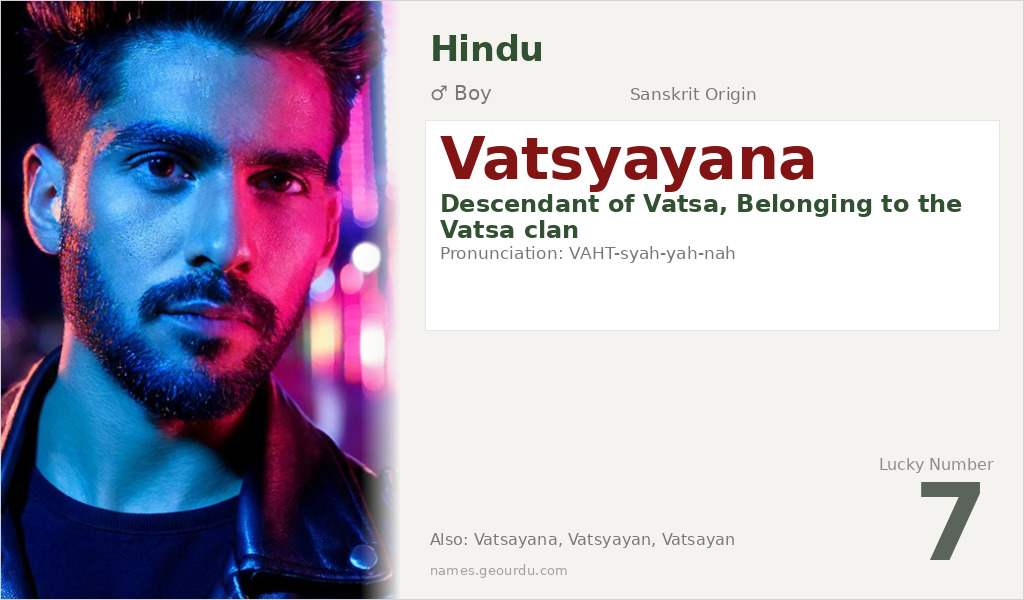
Vatsyayana is a compound Sanskrit name with clear etymological roots. The first component ‘Vatsa’ has multiple meanings in Sanskrit, primarily ‘calf’ but also extending metaphorically to ‘child’ or ‘offspring’. The suffix ‘-yana’ is a common patronymic ending in Sanskrit, indicating descent or belonging. Thus, Vatsyayana literally means ‘descendant of Vatsa’ or ‘belonging to the Vatsa clan’. This naming pattern was common in ancient India, where gotra (clan) names were often used as surnames or secondary names. The name should not be confused with ‘Vatsalya’, which means ‘affection’ or ‘parental love’ in Sanskrit—a completely different root word.
| 📛 Name | Vatsyayana |
| 💎 Meaning | Descendant of Vatsa, Belonging to the Vatsa clan |
| 👤 Gender | Boy |
| 🕌 Religion | Hindu |
| 🌍 Origin | Sanskrit |
| 🗣 Pronunciation | VAHT-syah-yah-nah |
| ✍️ Urdu | وتسیان |
| ✍️ Arabic | فاتسيانا |
| 🔢 Numerology | 7 |
| ✨ Spellings | Vatsayana, Vatsyayan, Vatsayan |
Origin & Cultural Significance
Vatsyayana originates from classical Sanskrit, the liturgical language of Hinduism. The name is most famously associated with the author of the Kama Sutra, who lived around the 2nd-3rd century CE. Historically, Vatsa was also the name of an important kingdom in ancient India, located in present-day Uttar Pradesh. The Vatsa gotra (clan) is one of the eight primary gotras of Brahmins, tracing lineage to the sage Vatsa. While the name has Hindu associations due to its Sanskrit origin and historical usage, it represents more of a cultural and intellectual heritage than strictly religious significance.
Personality Traits
The name Vatsyayana evokes qualities of wisdom, intellectual curiosity, and traditional values. Given its association with the author of a comprehensive treatise on human relationships and pleasure, the name suggests someone with analytical depth and understanding of human nature. Those named Vatsyayana might be perceived as thoughtful, scholarly, and connected to cultural heritage, with an appreciation for both tradition and nuanced understanding of complex subjects.
Similar Names
If you like Vatsyayana, consider: Vatsa, Vatsal, Vatsaraj, Vatsyayani, Vatsyayaniputra
Famous People Named Vatsyayana
- Vatsyayana — Ancient Indian philosopher and author of the Kama Sutra (c. 2nd-3rd century CE)
- Vatsyayana Mallanaga — Alternative name for the same philosopher, with Mallanaga possibly being his gotra name
Frequently Asked Questions About Vatsyayana
What does Vatsyayana mean?
Vatsyayana means 'descendant of Vatsa' or 'belonging to the Vatsa clan' in Sanskrit. It is a patronymic name derived from 'Vatsa' (meaning calf/child) and the suffix '-yana' (indicating descent).
Is Vatsyayana a boy or girl name?
Vatsyayana is exclusively a boy's name in its historical and cultural context. All known bearers throughout history have been male, and the name follows masculine grammatical patterns in Sanskrit.
What is the origin of Vatsyayana?
Vatsyayana originates from Sanskrit, the classical language of ancient India. It is most famously associated with the 2nd-3rd century CE philosopher who authored the Kama Sutra, and represents a patronymic naming tradition from Vedic culture.





