
Table of Contents
Vedacharya is a profound Sanskrit name that carries centuries of spiritual and educational significance in Hindu tradition. Meaning ‘Teacher of the Vedas’, this name represents the highest form of scholarly and spiritual guidance in ancient Indian culture. Parents choosing this name often hope to instill values of wisdom, knowledge, and ethical leadership in their child. With its rich etymological roots, Vedacharya connects modern bearers to India’s ancient Vedic heritage.
Meaning of Vedacharya
Vedacharya is a compound Sanskrit name with deep philosophical significance. The first component ‘Veda’ refers to the sacred knowledge contained in Hinduism’s oldest scriptures—the four Vedas that form the foundation of Hindu philosophy, rituals, and spirituality. The second component ‘Acharya’ means much more than just a teacher; it signifies a master who teaches through personal example and conduct, derived from the Sanskrit root ‘ācāra’ (conduct). Together, Vedacharya specifically denotes a preceptor who specializes in Vedic studies, someone qualified to teach, interpret, and preserve the ancient Vedic wisdom. Historically, Vedacharyas were revered scholars in gurukuls (traditional Hindu schools) who maintained oral traditions of Vedic recitation and interpretation. The name thus represents a combination of sacred knowledge and exemplary teaching methodology.
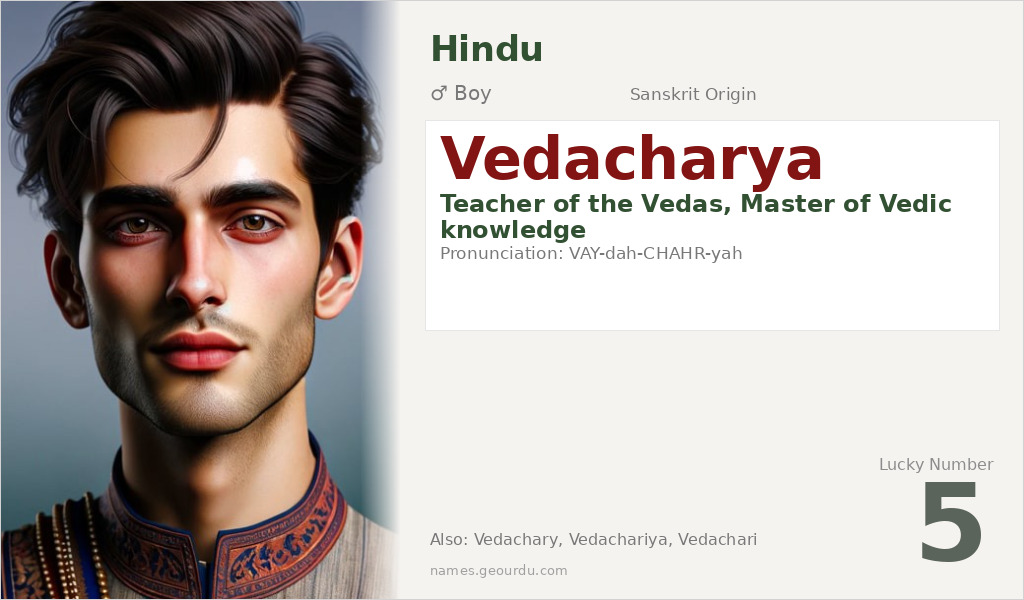
| 📛 Name | Vedacharya |
| 💎 Meaning | Teacher of the Vedas, Master of Vedic knowledge |
| 👤 Gender | Boy |
| 🕌 Religion | Hindu |
| 🌍 Origin | Sanskrit |
| 🗣 Pronunciation | VAY-dah-CHAHR-yah |
| ✍️ Urdu | ویداچاریہ |
| ✍️ Arabic | فيداشاريا |
| 🔢 Numerology | 5 |
| ✨ Spellings | Vedachary, Vedachariya, Vedachari |
Origin & Cultural Significance
Vedacharya originates from classical Sanskrit, the ancient liturgical language of Hinduism that developed in the Indian subcontinent around 1500 BCE. The name emerges from the traditional Hindu guru-shishya (teacher-disciple) parampara (lineage) system, where specialized titles denoted particular scholarly expertise. In ancient India, a Vedacharya was a Brahmin scholar specifically trained in one or more Vedas, responsible for preserving and transmitting Vedic knowledge through generations. The title was both a professional designation and an honorific, often bestowed upon or adopted by scholars who had mastered Vedic scriptures and rituals. While primarily associated with Hindu tradition, the concept of Vedic teachers influenced educational systems across South Asia. Today, the name continues in Hindu communities, particularly among those valuing traditional scholarship and spiritual guidance.
Personality Traits
Those named Vedacharya are often associated with intellectual depth, spiritual insight, and natural leadership in educational matters. They tend to approach life with philosophical contemplation and a desire to understand deeper truths. Their personality typically combines traditional wisdom with a practical approach to teaching and guiding others. As potential mentors and counselors, they often exhibit patience, clarity of thought, and a strong moral compass rooted in ancient wisdom traditions.
Similar Names
If you like Vedacharya, consider: Vedang, Vedant, Acharya, Ved Prakash, Ved Vyas
Famous People Named Vedacharya
- Vedacharya S. R. Rao — Renowned Indian archaeologist and Sanskrit scholar known for his work on Indus Valley civilization
- Various historical Hindu scholars and gurus in traditional lineages who carried the title Vedacharya
Frequently Asked Questions About Vedacharya
What does Vedacharya mean?
Vedacharya means 'Teacher of the Vedas' or 'Master of Vedic knowledge' in Sanskrit, combining 'Veda' (sacred knowledge/scriptures) and 'Acharya' (teacher/master).
Is Vedacharya a boy or girl name?
Vedacharya is traditionally a masculine name in Hindu culture, though names ending in 'Acharya' are occasionally used for girls in modern contexts with different prefixes.
What is the origin of Vedacharya?
Vedacharya originates from Sanskrit, the ancient language of Hindu scriptures, and specifically from the Hindu scholarly tradition of Vedic education and guru lineages.





