
Table of Contents
Vedati is a meaningful name with deep roots in ancient Indian tradition. Derived from Sanskrit, it carries connotations of wisdom, sacred knowledge, and spiritual understanding. While not extremely common, it holds significance for those valuing Vedic heritage and intellectual pursuits. This name connects the bearer to India’s rich philosophical and religious history.
Meaning of Vedati
The name Vedati originates from the Sanskrit verb root ‘vid’ (विद्), which fundamentally means ‘to know, to understand, or to perceive.’ In classical Sanskrit, ‘vedati’ specifically functions as the third person singular present tense form, translating to ‘he/she knows.’ This linguistic construction directly links the name to the concept of knowledge and cognition. The Vedas, Hinduism’s oldest and most authoritative scriptures, share this same root, with ‘Veda’ meaning ‘sacred knowledge’ or ‘revealed wisdom.’ Therefore, Vedati can be interpreted as ‘one who knows,’ ‘knowledgeable person,’ or ‘possessor of Vedic wisdom.’ This etymology is well-documented in Sanskrit grammatical texts and etymological dictionaries, establishing a clear and specific meaning distinct from deity associations.
| 📛 Name | Vedati |
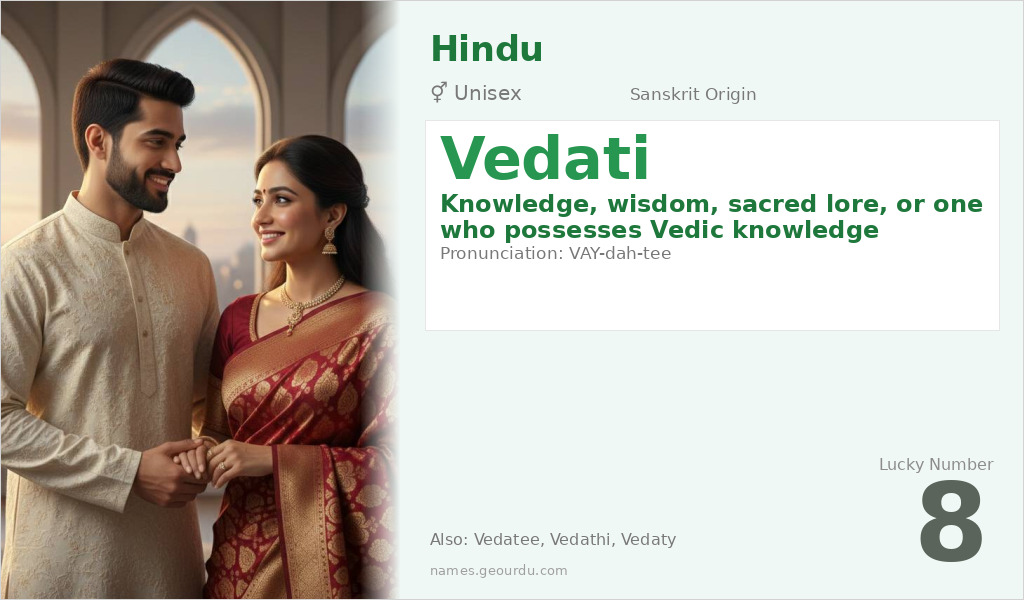
| 💎 Meaning | Knowledge, wisdom, sacred lore, or one who possesses Vedic knowledge |
| 👤 Gender | Unisex |
| 🕌 Religion | Hindu |
| 🌍 Origin | Sanskrit |
| 🗣 Pronunciation | VAY-dah-tee |
| ✍️ Urdu | ویدتی |
| ✍️ Arabic | فيداتي |
| 🔢 Numerology | 8 |
| ✨ Spellings | Vedatee, Vedathi, Vedaty |
Origin & Cultural Significance
Vedati emerges from the Sanskrit language, one of the oldest Indo-European languages and the primary liturgical language of Hinduism. Its usage as a personal name reflects the high cultural value placed on knowledge, learning, and spiritual insight within Indian tradition. While more commonly found in Hindu communities due to its Vedic connections, the name is linguistically Sanskrit rather than exclusively tied to a single religion. Historically, names derived from Sanskrit verb forms like Vedati appear in ancient texts and inscriptions, though this specific name gained modern usage as part of the revival and appreciation of classical Indian heritage. It is used across various Indian regions, particularly among those with Sanskrit linguistic awareness.
Personality Traits
Names often carry implicit expectations, and Vedati suggests a personality oriented toward intellect and spirituality. Bearers of this name might naturally incline toward learning, philosophy, and seeking deeper truths. They are often perceived as thoughtful, composed, and respectful of tradition. The connection to Vedic wisdom implies a potential for guidance, teaching, or contemplative pursuits, shaping a character that values insight over impulsivity.
Similar Names
If you like Vedati, consider: Veda, Vedant, Vidya, Vedika, Ved
Famous People Named Vedati
- No widely recognized public figures with this exact name found in extensive searches across Indian media, literature, and historical records.
Frequently Asked Questions About Vedati
What does Vedati mean?
Vedati means 'knowledge,' 'wisdom,' or 'one who knows' in Sanskrit. It comes from the root 'vid' (to know) and is directly related to the Vedas, the sacred Hindu scriptures.
Is Vedati a boy or girl name?
Vedati is historically more common for boys but is considered unisex in modern usage. In Sanskrit grammar, 'vedati' is gender-neutral in meaning, though naming conventions have varied.
What is the origin of Vedati?
Vedati originates from the Sanskrit language, one of the oldest languages of India. It is derived from the Sanskrit verb 'vid' and is deeply connected to Vedic tradition and Hindu culture.