
Table of Contents
Vignesh is a powerful and meaningful Hindu boy name with deep roots in Sanskrit tradition and Hindu mythology. As one of the primary names for Lord Ganesha, the elephant-headed deity, Vignesh carries the beautiful meaning ‘Remover of Obstacles’. This name has been cherished for generations across India, particularly in South Indian communities, where it symbolizes divine protection and success in overcoming life’s challenges. Parents choosing this name often hope to imbue their child with the wisdom and strength of this beloved deity.
Meaning of Vignesh
Vignesh is a Sanskrit compound name with precise linguistic components that reveal its profound meaning. The name combines ‘vighna’ (विघ्न), which means ‘obstacle, impediment, or hindrance’, with ‘īśa’ (ईश), meaning ‘lord, master, or ruler’. This creates the literal translation ‘Lord of Obstacles’ or ‘Master of Obstacles’. In Hindu theology, this refers specifically to Lord Ganesha’s role as both the creator and remover of obstacles in devotees’ lives. The name appears in ancient Sanskrit texts and has been used consistently in Hindu religious contexts for millennia. Unlike generic divine names, Vignesh carries this specific theological significance related to overcoming challenges and ensuring success in new beginnings.
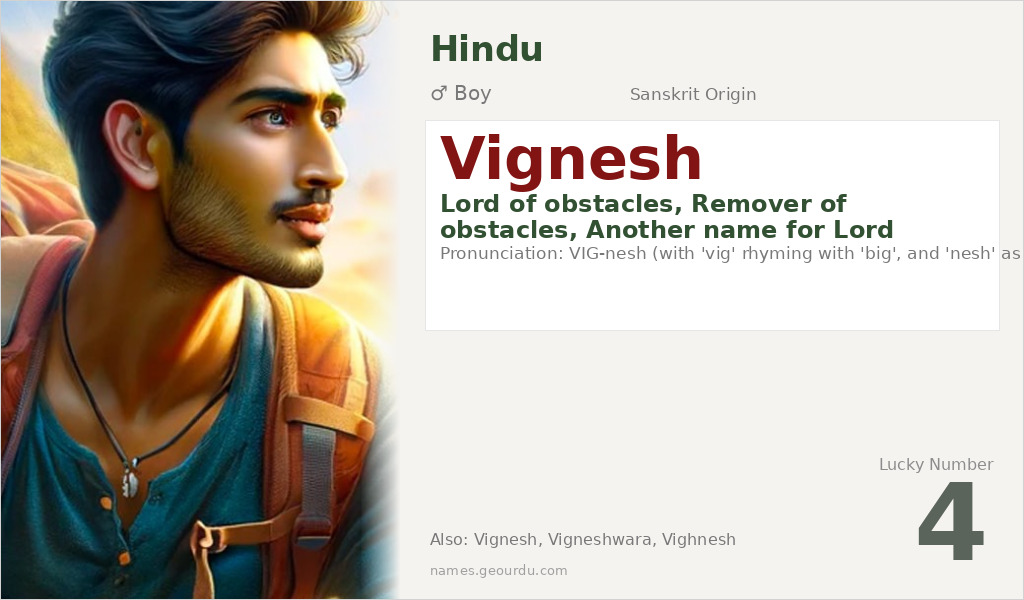
| 📛 Name | Vignesh |
| 💎 Meaning | Lord of obstacles, Remover of obstacles, Another name for Lord Ganesha |
| 👤 Gender | Boy |
| 🕌 Religion | Hindu |
| 🌍 Origin | Sanskrit |
| 🗣 Pronunciation | VIG-nesh (with 'vig' rhyming with 'big', and 'nesh' as in 'fresh') |
| ✍️ Urdu | ویگنیش |
| ✍️ Arabic | فيغنش |
| 🔢 Numerology | 4 |
| ✨ Spellings | Vignesh, Vigneshwara, Vighnesh, Vighneshwara, Vignesha |
Origin & Cultural Significance
Vignesh originates from classical Sanskrit, the ancient liturgical language of Hinduism, and has been adopted into various Indian languages including Tamil, Telugu, Kannada, and Marathi. The name’s cultural significance is deeply tied to the worship of Lord Ganesha, who is traditionally invoked at the beginning of any important undertaking in Hindu tradition. Historically, the name has been particularly popular in South India, where Ganesha worship has strong regional traditions. While primarily a Hindu name, its usage has spread with the Indian diaspora worldwide. The name maintains its religious and cultural associations while also being appreciated for its melodic sound and positive meaning in modern contexts.
Personality Traits
Those named Vignesh are often perceived as having qualities reminiscent of their namesake deity—intelligent, wise, and adept at problem-solving. They tend to approach life’s challenges with patience and strategic thinking, often finding innovative solutions where others see only obstacles. Many Vigneshs exhibit a protective nature toward family and friends, combined with a creative spirit that helps them navigate complex situations. Their personality often blends traditional values with modern adaptability, making them respected in both personal and professional spheres.
Similar Names
If you like Vignesh, consider: Ganesh, Vinayak, Ganapati, Vighnaharta, Siddhivinayak
Famous People Named Vignesh
- Vignesh Shivan — Indian film director, screenwriter and lyricist in Tamil cinema
- Vignesh Sundaresan — Indian entrepreneur and art collector, known for buying the most expensive NFT artwork
Frequently Asked Questions About Vignesh
What does Vignesh mean?
Vignesh means 'Lord of Obstacles' or 'Remover of Obstacles' in Sanskrit. It is a compound name from 'vighna' (obstacle) and 'īśa' (lord), specifically referring to Lord Ganesha in Hindu mythology.
Is Vignesh a boy or girl name?
Vignesh is exclusively a boy's name in Hindu naming tradition. It is the name of a male deity (Lord Ganesha) and has been used as a masculine given name for centuries across Indian communities.
What is the origin of Vignesh?
Vignesh originates from Sanskrit, the ancient language of Hindu scriptures. It has been adopted into various Indian languages and is deeply rooted in Hindu religious tradition, specifically associated with the worship of Lord Ganesha.





