
Table of Contents
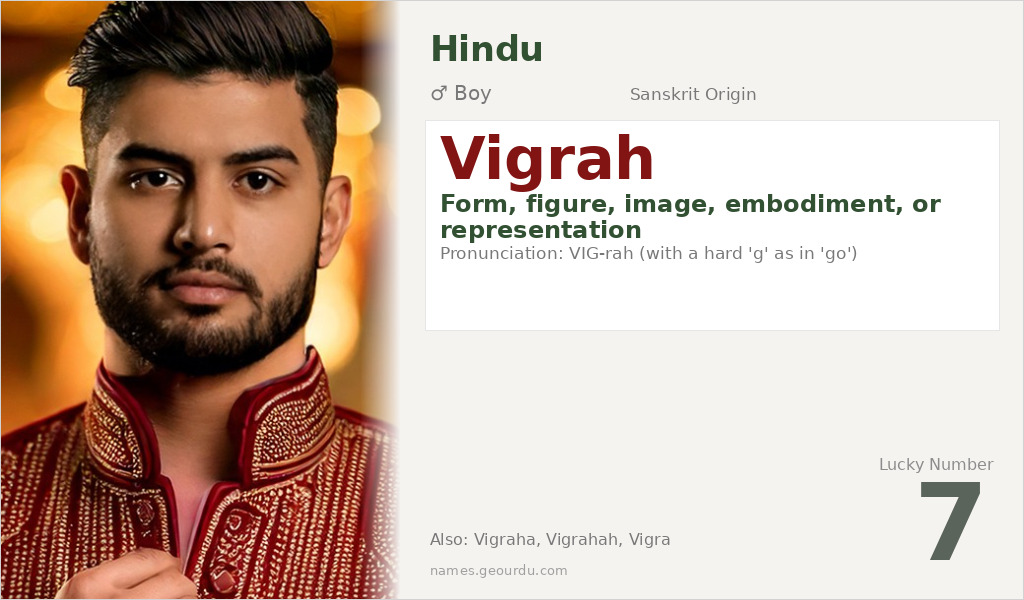
Vigrah is a distinctive Sanskrit name with deep roots in Hindu culture and philosophy. Meaning ‘form’, ‘figure’, or ’embodiment’, this name carries significant weight in religious and historical contexts. While primarily used for boys, its profound meaning makes it a powerful choice for parents seeking a name with spiritual resonance. Discover the rich linguistic heritage and cultural significance of the name Vigrah.
Meaning of Vigrah
Vigrah originates from the Sanskrit word विग्रह (vigraha), which literally translates to ‘form’, ‘figure’, ‘image’, ’embodiment’, or ‘representation’. The term is composed of two elements: the prefix ‘vi-‘ meaning ‘apart’ or ‘distinct’, and ‘grah’ from the root ‘grah’ meaning ‘to seize’ or ‘to take’. Thus, Vigrah conveys the concept of taking distinct form or embodiment. In Hindu religious context, it specifically refers to the physical manifestation or form of a deity, particularly in temple murtis (idols) and iconography. This makes it a name with profound spiritual connotations, suggesting someone who embodies divine qualities or has a distinct, well-formed personality.
| 📛 Name | Vigrah |
| 💎 Meaning | Form, figure, image, embodiment, or representation |
| 👤 Gender | Boy |
| 🕌 Religion | Hindu |
| 🌍 Origin | Sanskrit |
| 🗣 Pronunciation | VIG-rah (with a hard 'g' as in 'go') |
| ✍️ Urdu | ویگرہ |
| ✍️ Arabic | فيجراه |
| 🔢 Numerology | 7 |
| ✨ Spellings | Vigraha, Vigrahah, Vigra |
Origin & Cultural Significance
Vigrah has its origins in classical Sanskrit, the ancient liturgical language of Hinduism, Buddhism, and Jainism. The name appears in historical records, most notably as part of the names of several rulers of the Pala Empire in medieval Bengal, such as Vigrahapala I and II. In Hindu religious texts and philosophy, ‘vigraha’ refers to the embodied form of deities, making the name particularly significant in devotional contexts. While primarily used in Hindu communities, the name’s Sanskrit roots give it pan-Indian appeal. The historical usage by Pala dynasty rulers suggests it was considered a name denoting strength and sovereignty.
Personality Traits
Those named Vigrah are often associated with qualities of distinctiveness and embodiment. The name suggests someone with a strong, well-defined personality who makes a lasting impression. They may possess creative talents, particularly in visual or formative arts, and tend to approach life with conviction and purpose. The etymological connection to ‘form’ and ’embodiment’ implies someone who fully inhabits their principles and stands as a representation of their values.
Similar Names
If you like Vigrah, consider: Vigraha, Vikram, Vihaan, Viraj, Vishnu
Famous People Named Vigrah
- Vigrahapala I — 9th century Pala Empire ruler of Bengal
- Vigrahapala II — 10th century Pala Empire ruler
Frequently Asked Questions About Vigrah
What does Vigrah mean?
Vigrah means 'form', 'figure', 'image', 'embodiment', or 'representation' in Sanskrit. It specifically refers to the physical manifestation of deities in Hindu iconography.
Is Vigrah a boy or girl name?
Vigrah is traditionally a masculine name in Hindu naming traditions, though its meaning is gender-neutral in the Sanskrit language.
What is the origin of Vigrah?
Vigrah originates from Sanskrit, the ancient liturgical language of India. It has historical usage in Hindu religious contexts and was borne by several rulers of the Pala Empire in medieval Bengal.





