
Table of Contents
Vinayaka is a profound Sanskrit name deeply rooted in Hindu tradition and mythology. As one of the primary names of Lord Ganesha, it carries spiritual significance and cultural heritage. This name represents wisdom, leadership, and the removal of obstacles. Parents choosing Vinayaka often seek to imbue their child with divine protection and intellectual strength.
Meaning of Vinayaka
Vinayaka derives from the Sanskrit language, combining ‘vi-‘ meaning ‘apart, away, without’ and ‘nayaka’ meaning ‘leader, guide, or commander’. The complete meaning translates to ‘one who removes obstacles’ or ‘supreme leader’. In Hindu scriptures, Vinayaka specifically refers to Lord Ganesha, the elephant-headed deity worshipped as the remover of obstacles and patron of arts and sciences. The name appears in ancient texts like the Mahabharata and various Puranas, where it denotes Ganesha’s role as the leader of the ganas (divine attendants). This etymological construction highlights both the destructive aspect (removing hindrances) and constructive aspect (guiding forward) inherent in the name.
| 📛 Name | Vinayaka |
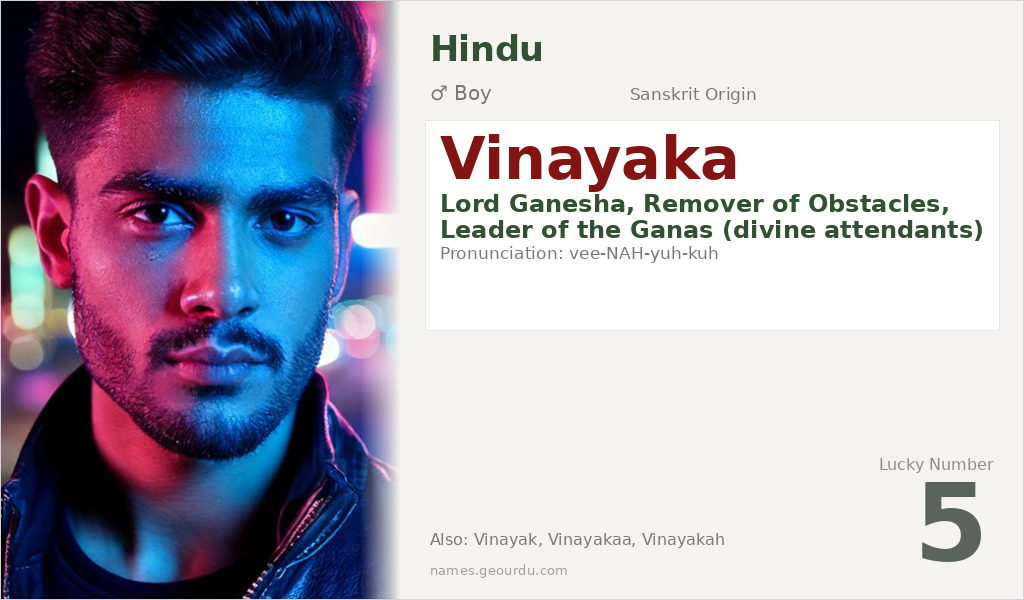
| 💎 Meaning | Lord Ganesha, Remover of Obstacles, Leader of the Ganas (divine attendants) |
| 👤 Gender | Boy |
| 🕌 Religion | Hindu |
| 🌍 Origin | Sanskrit |
| 🗣 Pronunciation | vee-NAH-yuh-kuh |
| ✍️ Urdu | وینایک |
| ✍️ Arabic | فيناياكا |
| 🔢 Numerology | 5 |
| ✨ Spellings | Vinayak, Vinayakaa, Vinayakah, Bhinayaka |
Origin & Cultural Significance
Vinayaka originates from ancient Sanskrit literature and Hindu religious texts dating back over two millennia. The name gained prominence through its association with Lord Ganesha, one of the most widely worshipped deities in Hinduism. Historically, the term appears in early Sanskrit works including the Mahabharata (circa 400 BCE-400 CE) and later in Puranic literature. Culturally, Vinayaka represents more than just a deity name—it embodies the concept of overcoming challenges and providing guidance. The name is particularly popular in India and among Hindu communities worldwide, often given to boys with the hope they will embody Ganesha’s qualities of wisdom, intellect, and obstacle-clearing abilities.
Personality Traits
Those named Vinayaka are often perceived as natural problem-solvers with leadership qualities. They tend to approach challenges with intelligence and creativity, much like their namesake deity who is known for wisdom and resourcefulness. Their personality often combines analytical thinking with compassionate guidance, making them effective in both personal and professional spheres. The name’s association with Ganesha suggests individuals who can navigate obstacles while maintaining a balanced perspective.
Similar Names
If you like Vinayaka, consider: Ganesha, Ganapati, Vighneshvara, Gajanan, Heramba
Famous People Named Vinayaka
- Vinayaka Damodar Savarkar — Indian independence activist and writer
- Vinayaka Krishna Gokak — Kannada poet and scholar, recipient of Jnanpith Award
Frequently Asked Questions About Vinayaka
What does Vinayaka mean?
Vinayaka means 'Lord Ganesha, Remover of Obstacles, or Supreme Leader' in Sanskrit. It specifically refers to the Hindu deity Ganesha who removes hindrances and guides devotees.
Is Vinayaka a boy or girl name?
Vinayaka is exclusively a boy's name in Hindu tradition, as it refers to the male deity Lord Ganesha. There are no feminine variants in common usage.
What is the origin of Vinayaka?
Vinayaka originates from Sanskrit, the ancient language of India. It appears in Hindu scriptures dating back over 2,000 years and is deeply connected to Hindu religious and cultural traditions.





