Table of Contents
Vrunda is a beautiful Sanskrit name for girls that carries deep spiritual significance in Hindu culture. Meaning ‘basil’ or specifically ‘holy basil grove,’ this name connects the bearer to one of India’s most sacred plants. With roots in ancient Sanskrit literature and religious texts, Vrunda represents purity, devotion, and natural beauty. Parents choosing this name often seek to instill traditional values and spiritual connection in their daughter.
Meaning of Vrunda
Vrunda originates from the Sanskrit word ‘वृन्द’ (vṛnda), which directly translates to ‘basil’ or more specifically ‘holy basil’ (Ocimum tenuiflorum). In Hindu tradition, this isn’t just any plant—it’s considered the manifestation of Goddess Lakshmi and is worshipped daily in many Hindu households. The name can also refer to a grove or cluster of basil plants, symbolizing abundance and sacred space. Linguistically, it derives from the Sanskrit root that relates to grouping or clustering, reflecting how basil often grows in clusters. This connection to the sacred Tulsi plant makes Vrunda a name imbued with religious and cultural significance beyond its literal botanical meaning.
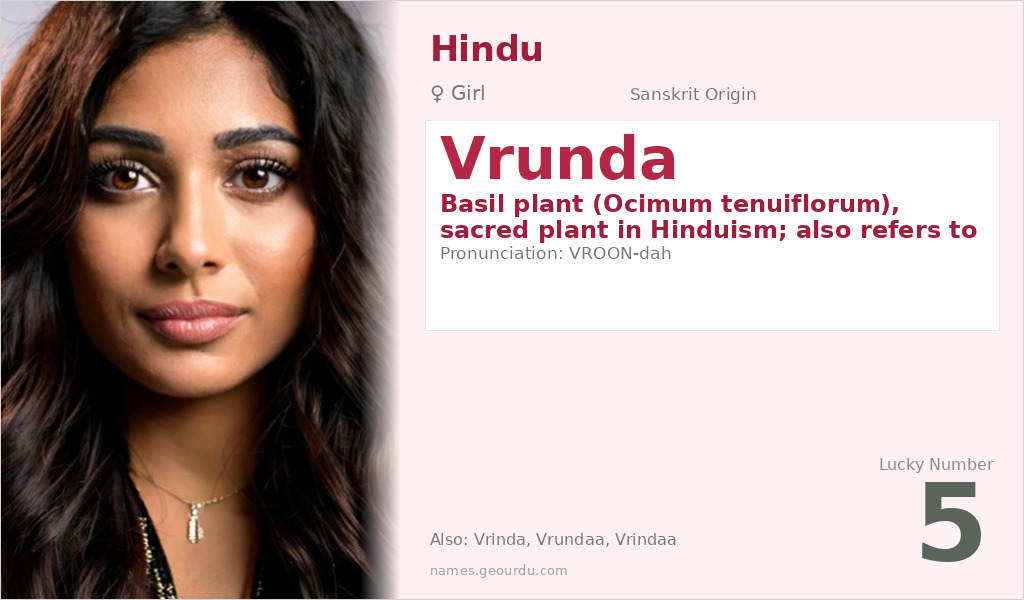
| 📛 Name | Vrunda |
| 💎 Meaning | Basil plant (Ocimum tenuiflorum), sacred plant in Hinduism; also refers to a grove or cluster of basil plants |
| 👤 Gender | Girl |
| 🕌 Religion | Hindu |
| 🌍 Origin | Sanskrit |
| 🗣 Pronunciation | VROON-dah |
| ✍️ Urdu | ورندا |
| ✍️ Arabic | فروندا |
| 🔢 Numerology | 5 |
| ✨ Spellings | Vrinda, Vrundaa, Vrindaa, Vrundha |
Origin & Cultural Significance
Vrunda has its origins in ancient Sanskrit, the classical language of India that dates back over 3,500 years. The name appears in various Hindu scriptures and texts where the Tulsi (holy basil) plant is venerated. In Hindu mythology, the Tulsi plant is considered sacred and is believed to be the earthly form of Goddess Lakshmi, Vishnu’s consort. The name gained popularity as a feminine given name in India, particularly among Hindu families who value traditional Sanskrit names with spiritual connotations. While primarily used in India, the name has spread to Hindu diaspora communities worldwide, maintaining its religious and cultural associations.
Personality Traits
Those named Vrunda are often perceived as gentle, spiritual, and deeply connected to tradition. They tend to exhibit nurturing qualities, much like the caring nature associated with the sacred basil plant. Their personality often reflects purity of heart and devotion to their beliefs, with a calm presence that grounds those around them. Many Vrundas show an affinity for nature, ritual, and maintaining cultural practices that honor their heritage.
Similar Names
If you like Vrunda, consider: Tulsi, Vrindavani, Basanti, Priya, Lakshmi
Famous People Named Vrunda
- Vrinda Gopinath — Indian classical dancer and choreographer
- Vrinda Nabar — Indian author and literary critic
Frequently Asked Questions About Vrunda
What does Vrunda mean?
Vrunda means 'basil' or 'holy basil grove' in Sanskrit. It specifically refers to the sacred Tulsi plant (Ocimum tenuiflorum) worshipped in Hinduism.
Is Vrunda a boy or girl name?
Vrunda is exclusively a girl's name in Hindu naming tradition. It has feminine grammatical endings in Sanskrit and is only used for females in cultural practice.
What is the origin of Vrunda?
Vrunda originates from Sanskrit, the ancient classical language of India. It comes from the word 'वृन्द' meaning basil or basil grove, with deep roots in Hindu religious texts and practices.