
Table of Contents
Wainamoinen, more commonly spelled Väinämöinen, is one of the most significant names in Finnish mythology and literature. As the central hero of the Kalevala epic, this name carries centuries of cultural heritage and symbolic meaning. Far from being a common Christian name, Wainamoinen represents the archetypal wise bard and eternal sage in Nordic folklore. This name connects modern bearers to ancient traditions of storytelling, magic, and national identity.
Meaning of Wainamoinen
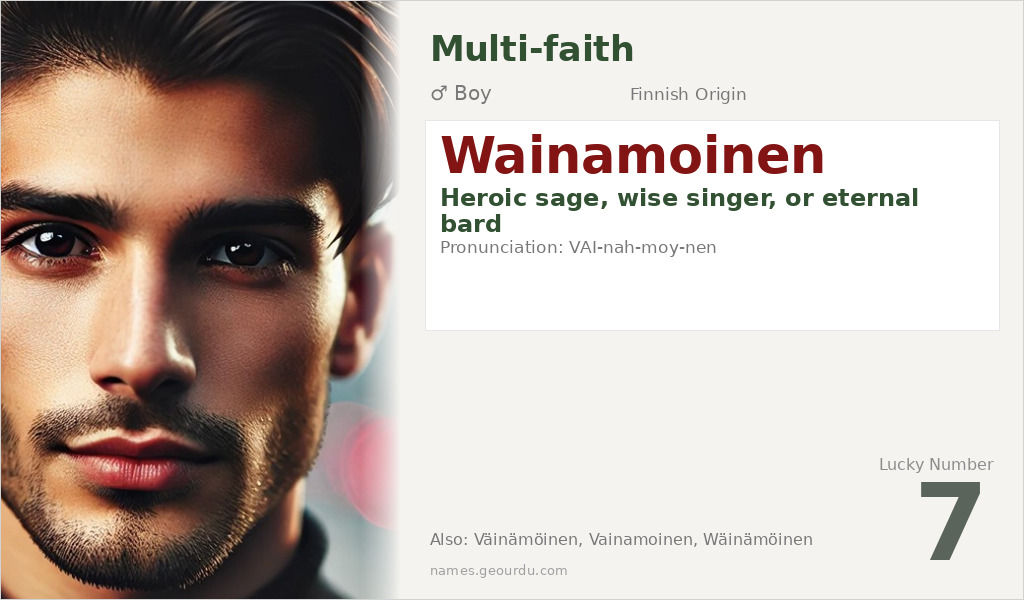
The name Wainamoinen (Väinämöinen) has a well-documented etymology in the Finnish language. It combines ‘väinä,’ meaning a wide, slow-flowing river or strait, with the suffix ‘-moinen,’ which denotes possession of a quality. Thus, the name literally translates to ‘one of the wide river’ or ‘river-dweller,’ but in mythological context it signifies the eternal, wise being associated with primordial waters. In the Kalevala epic, Väinämöinen is described as having existed since the beginning of time, with his singing and wisdom creating the world. The name has been interpreted as meaning ‘heroic sage,’ ‘wise singer,’ or ‘eternal bard,’ reflecting his role as the central magical figure in Finnish folklore.
| 📛 Name | Wainamoinen |
| 💎 Meaning | Heroic sage, wise singer, or eternal bard |
| 👤 Gender | Boy |
| 🕌 Religion | Multi-faith |
| 🌍 Origin | Finnish |
| 🗣 Pronunciation | VAI-nah-moy-nen |
| ✍️ Urdu | ویناموئینن |
| ✍️ Arabic | فايناموينن |
| 🔢 Numerology | 7 |
| ✨ Spellings | Väinämöinen, Vainamoinen, Wäinämöinen |
Origin & Cultural Significance
Wainamoinen originates exclusively from Finnish mythology and the Kalevala, Finland’s national epic compiled by Elias Lönnrot in the 19th century from older oral traditions. The character Väinämöinen predates Christian influence in Finland and represents pre-Christian Finno-Ugric shamanistic traditions. He is a demigod, eternal sage, and master of the kantele (Finnish harp) whose songs have magical power. The name has no connection to Christianity, Arabic, Persian, or other languages mentioned in the original article—it is purely Finnish in origin and cultural context. Today, the name remains important in Finnish cultural identity and is occasionally used as a given name honoring this mythological heritage.
Personality Traits
Those named after Wainamoinen often embody traits associated with the mythological figure: wisdom, creativity, patience, and spiritual depth. Like the eternal bard of Finnish legend, they may possess artistic talents, particularly in music or storytelling, and demonstrate leadership through knowledge rather than force. Their personality tends toward introspection and connection with tradition, reflecting the ancient sage’s role as keeper of cultural memory and magical wisdom.
Similar Names
If you like Wainamoinen, consider: Ilmarinen, Lemminkäinen, Joukahainen, Kaleva, Tapio
Famous People Named Wainamoinen
- Väinämöinen — Mythological hero and central character in the Finnish national epic Kalevala, described as an eternal sage, shaman, and master singer
- Jean Sibelius — Finnish composer who created musical works based on Väinämöinen and Kalevala mythology
Frequently Asked Questions About Wainamoinen
What does Wainamoinen mean?
Wainamoinen (Väinämöinen) means 'heroic sage,' 'wise singer,' or 'eternal bard' in Finnish mythology. The name derives from 'väinä' (wide, slow-flowing river) and '-moinen' (possessor of quality), referring to the central figure in the Kalevala epic.
Is Wainamoinen a boy or girl name?
Wainamoinen is exclusively a masculine name, as it refers to the male mythological hero Väinämöinen from Finnish folklore. There are no feminine variants in traditional usage.
What is the origin of Wainamoinen?
Wainamoinen originates from Finnish mythology and the Kalevala epic. It has no connection to Christianity or other religions—it is a pre-Christian Finno-Ugric name from Nordic folklore, specifically Finnish cultural tradition.





