
Table of Contents
Wasidali is an intriguing Muslim boy name that combines elements suggesting deep devotion and spiritual absorption. While not widely documented in mainstream sources, this name carries potential significance in regional naming traditions. Its compound structure hints at a meaningful connection to Islamic heritage, particularly through the revered figure of Ali ibn Abi Talib. Exploring this name reveals the rich tapestry of cultural naming practices across Muslim communities.
Meaning of Wasidali
The name Wasidali appears to be a compound formation, potentially blending Persian and Arabic elements. The first component ‘Wasid’ may derive from the Persian word ‘vāsid’ (واسد), meaning ‘engrossed,’ ‘absorbed,’ or ‘immersed.’ This suggests a state of deep concentration or devotion. The second component ‘Ali’ is clearly the Arabic name meaning ‘exalted,’ ‘noble,’ or ‘high,’ referring specifically to Ali ibn Abi Talib, the cousin and son-in-law of Prophet Muhammad and the fourth caliph in Sunni Islam. Together, the name could be interpreted as ‘one who is engrossed in Ali’ or ‘devoted to Ali,’ indicating spiritual dedication. However, this specific combination ‘Wasidali’ is not found in standard etymological references, suggesting it may be a regional or familial variation rather than a widely recognized name.
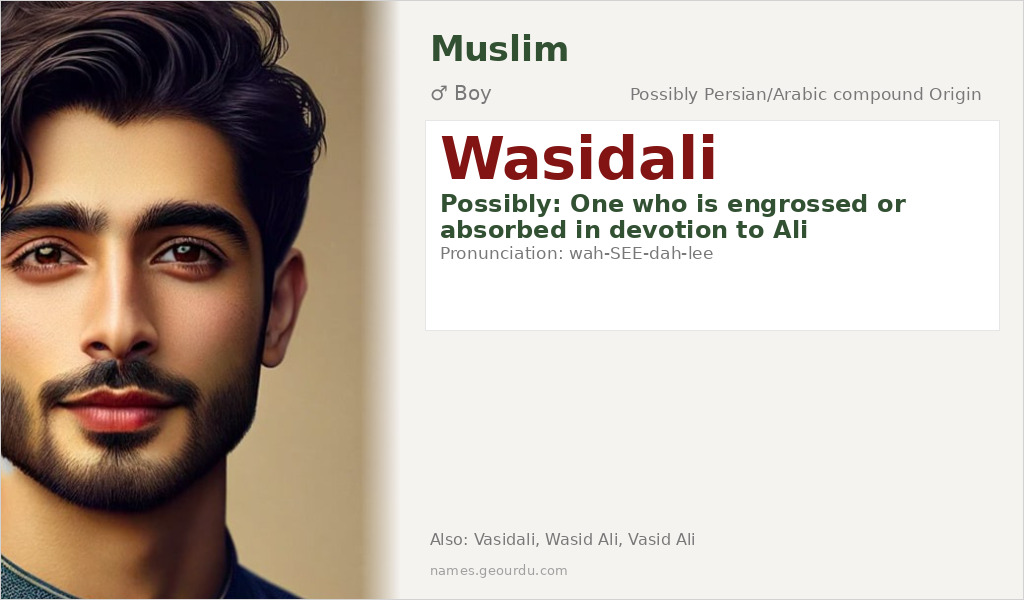
| 📛 Name | Wasidali |
| 💎 Meaning | Possibly: One who is engrossed or absorbed in devotion to Ali |
| 👤 Gender | Boy |
| 🕌 Religion | Muslim |
| 🌍 Origin | Possibly Persian/Arabic compound |
| 🗣 Pronunciation | wah-SEE-dah-lee |
| ✍️ Urdu | وسیع علی |
| ✍️ Arabic | وسيد علي |
| 🔢 Numerology | |
| ✨ Spellings | Vasidali, Wasid Ali, Vasid Ali |
Origin & Cultural Significance
Wasidali likely originates from Persian and Arabic linguistic traditions, though its exact geographic origin is unclear. Compound names combining descriptive elements with ‘Ali’ are common in Muslim naming practices, particularly in South Asian and Middle Eastern cultures. The name may have emerged in regions where Persian influence is strong, such as Iran, Afghanistan, Pakistan, or parts of India. Such names often reflect devotional attitudes toward important figures in Islamic history. While not documented in major historical texts, names like Wasidali represent the living tradition of name creation within Muslim communities, where parents combine meaningful elements to express religious and cultural values. The name’s rarity suggests it may be specific to certain families or local traditions rather than widespread usage.
Personality Traits
Individuals named Wasidali might be associated with traits of deep focus, spiritual dedication, and noble character. The ‘engrossed’ element implies someone who becomes fully absorbed in their pursuits, whether religious, intellectual, or personal. The connection to Ali suggests qualities of leadership, justice, and moral excellence. Such a name could inspire a person to live with purpose and devotion, embodying the virtues associated with both components of their name. While personality traits are not determined by names alone, the meaning behind Wasidali offers an aspirational framework for personal development.
Similar Names
If you like Wasidali, consider: Wasi, Wasif, Waseem, Ali, Murtaza
Famous People Named Wasidali
- No verified famous individuals with this exact name found in historical or contemporary records
Frequently Asked Questions About Wasidali
What does Wasidali mean?
Wasidali possibly means 'one who is engrossed or absorbed in devotion to Ali.' It appears to be a compound name combining Persian 'vāsid' (engrossed) with Arabic 'Ali' (exalted, noble), though this specific combination is not verified in standard sources.
Is Wasidali a boy or girl name?
Wasidali is exclusively a boy name in Muslim naming traditions. The inclusion of 'Ali,' a masculine name, and the name's structure align with male naming patterns in Islamic cultures.
What is the origin of Wasidali?
Wasidali likely originates from Persian and Arabic linguistic elements, possibly emerging in regions with Persian cultural influence like Iran, Afghanistan, or South Asia. It represents a compound name formation common in Muslim naming practices, though it is not widely documented in historical records.





